Study Medicine or Dentistry Abroad from Greece: Panhellenic Exams, EU Recognition and the Best Destinations
23.09.2026

Why So Many Greek Students Study Medicine Abroad
Admission to Greek universities runs entirely through the Panhellenic exams. The number of places in each school is fixed nationally, and the base score required for Medicine regularly sits at the very top of the scale. Students compete not only against the exam, but against each other, down to the last decimal.
The pressure is enormous. Many students spend years in intensive tutoring to prepare, and those who miss the base by a small margin face a hard choice: repeat the year, accept a different field or look abroad.
A Long Tradition of Studying Abroad
Greece has one of the strongest traditions of studying Medicine abroad in Europe. Generations of Greek doctors trained in other countries and returned home to practise. As a result, a degree from abroad is well accepted in Greek hospitals and practices.
Dentistry
Dentistry is offered at only a few Greek universities, and the base scores are similarly high. A dental degree from another EU country is therefore a common and respected route into the profession.
How a Foreign Degree Is Recognised in Greece
Greece is an EU member state, so Directive 2005/36/EC on the recognition of professional qualifications applies. It sets minimum training standards for Medicine and Dentistry across the EU and lists each member state's recognised qualifications in its Annex V.
Automatic Recognition for EU Degrees
A Greek citizen with a qualifying medical degree from another EU country benefits from automatic recognition. No additional licensing exam is required. After recognition, you obtain your licence to practise from the competent Regional Unit and register with the local medical association.
Specialist Training
With a licence to practise, graduates of European universities can apply for specialist training in Greece on the same basis as graduates of Greek medical schools. Many also complete their specialisation in other EU countries and return later.
Degrees From Outside the EU
Degrees from outside the EU follow a different route. Academic recognition by DOATAP, the Hellenic National Academic Recognition and Information Center, is usually required, often combined with additional exams. For most Greek students, an EU degree is the more direct option.
Dentistry
The same principles apply to Dentistry. Qualifying dental degrees from other EU countries are recognised automatically, followed by the licence to practise and registration with the local dental association.
{{cta}}Which Destination Countries Suit Greek Students?
Greek students mostly choose EU countries close to home, where recognition is automatic and travel is easy.
Bulgaria
Bulgaria is one of the most popular destinations for Greek students. It is close to northern Greece, offers long-established English-language programmes in Medicine and Dentistry and has a large Greek student community.
Romania
Romania offers numerous English-language programmes with EU standards and moderate living costs. Greek students value the solid clinical training and the international atmosphere.
Cyprus
Cyprus is culturally and linguistically close to Greece and offers medical programmes in a familiar environment. It is a natural choice for students who want to stay close to home.
Czech Republic, Hungary, Slovakia and Poland
These Central European countries have taught Medicine and Dentistry in English for decades. Their six-year programmes follow EU standards and are widely recognised across Europe.
Italy
Italy has a long tradition of hosting Greek medical students and offers programmes in Italian and English. It is an option for students willing to learn Italian.
{{callout}}Practical Tips for Greek Students
Choose an EU Programme
An EU degree gives you automatic recognition in Greece. This is the most direct route back to practising at home.
Apply Abroad in Parallel
Many Greek students apply abroad at the same time as they sit the Panhellenic exams. If the results fall short, a place is already secured and no year is lost.
Keep Your Greek Medical Terminology Up to Date
Teaching abroad is usually in English. Reading Greek medical literature alongside your studies makes the transition into Greek hospitals smoother.
Use the Greek Community
In popular destinations, Greek student associations help newcomers with housing, paperwork and study materials. The first months become much easier.
Plan Military Service Early
Male students can generally apply for a deferral of military service while studying abroad. It is worth clarifying this before you leave.
How We Help You Find the Right Programme
The right EU programme is the key to a smooth return to Greece. We offer solutions for exactly this. Contact us and we check individually which of our 25+ partner universities fits you, your results and your budget. Marcel or another experienced consultant on our team will review your situation and give you a clear recommendation.
The Author's View
Greek families understand studying abroad better than almost anyone. Many parents I speak to have a relative, a family doctor or a dentist who trained in another European country. They know it works, and they know that the Panhellenic exams do not measure everything that makes a good doctor.
What I emphasise in consultations is the value of planning early. Applying abroad in parallel with the Panhellenic exams removes a lot of pressure, and choosing a programme with automatic EU recognition makes the return to Greece straightforward.
I also see how quickly Greek students settle in abroad. In many destinations there are established Greek communities, regular flights home and a lifestyle that feels familiar. Students often tell me that the independence they gained abroad helped them mature as future doctors, and that the international friendships they made became a lasting part of their professional lives. That combination of roots at home and experience abroad is a real strength.
If your dream is to become a doctor or a dentist, a few points on one exam should not decide your future. Book a consultation and let us find the right path for you.
Conclusion
- In 2025, the most sought-after medical school in Greece required 18,775 out of 20,000 points in the Panhellenic exams.
- Directive 2005/36/EC provides automatic recognition of qualifying medical and dental degrees from other EU countries.
- After recognition, graduates obtain their licence to practise from the Regional Unit and register with the local medical association.
- Degrees from outside the EU usually require academic recognition by DOATAP.
- Bulgaria, Romania, Cyprus, the Czech Republic, Hungary, Slovakia, Poland and Italy are popular destinations for Greek students.
A missed base score does not end a medical career. With a European degree, you return to Greece with a qualification recognised by law and a wealth of international experience. Book your free consultation and take the first step.
Frequently Asked Questions
Is a medical degree from another EU country recognised in Greece?
Yes. Directive 2005/36/EC provides automatic recognition of medical degrees listed in its Annex V. Greek citizens with such a degree obtain their licence to practise without an additional licensing exam.
What do I need to do after graduation to practise in Greece?
After recognition, you obtain your licence to practise from the competent Regional Unit and register with the local medical association.
Can I do my specialist training in Greece after studying abroad?
Yes. With a licence to practise, graduates of European universities apply for specialist training on the same basis as graduates of Greek medical schools.
What about degrees from outside the EU?
Degrees from outside the EU usually require academic recognition by DOATAP and additional exams. An EU degree is the more direct route.
Does the same apply to Dentistry?
Yes. Qualifying dental degrees from other EU countries are recognised automatically.
Do I need Panhellenic results to study Medicine abroad?
No. European universities apply their own admission criteria, usually based on your school results in biology and chemistry and, depending on the programme, an entrance exam or interview. A Panhellenic score that fell just short of the base for Medicine is no obstacle abroad.
Are the programmes abroad taught in Greek?
Most programmes for international students are taught in English. Greek students usually adapt quickly, and the English-language degree has the added advantage of opening doors across Europe and beyond.
How long does a medical degree abroad take?
Most medical programmes in the EU last six years, the same as in Greece. Dentistry usually takes five to six years. Both combine preclinical sciences with clinical training in university hospitals.
Can I work in other EU countries with my degree?
Yes. A qualifying EU degree is recognised in every EU member state. Many Greek doctors trained abroad spend part of their career in other European countries before returning home.
When should I start planning?
Ideally during the final year of school, before the Panhellenic exams. Applying abroad in parallel gives you a secure option and avoids losing a year if the results are not what you hoped for.
Is it possible to start mid-year or transfer later?
Most programmes start in autumn, and transfers between universities follow strict rules. Planning the right programme from the beginning is usually the smoothest path, and we help you choose carefully.
Which university abroad is right for me?
That depends on your results, preferences and budget. Contact us and we check individually which of our 25+ partner universities fits you.
What students say about Medschool Experts
Over 500 placements at more than 25 partner universities across 10+ countries. Read independent student reviews on Trustpilot.
About the author
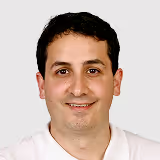
Marcel Kloos
Swiss-licensed dentist and founder of Medschool Experts
Marcel Kloos founded Medschool Experts while studying abroad; since then, over 500 study places have been secured. The Stuttgart-born dentist studied dentistry from 2015 to 2021 in Sofia and holds a Swiss dental licence.
Today he lives in Bern and runs Medschool Experts full-time as its owner.
More articles worth reading
Study Medicine or Dentistry Abroad from Brazil: Revalida, EU Passports and the Best Destinations
Study Medicine or Dentistry Abroad from the Gulf States: Licensing in Saudi Arabia, the UAE, Kuwait, Qatar, Oman and Bahrain
Study Medicine or Dentistry Abroad from Nigeria: MDCN Assessment Exam, Recognition and the Best Destinations
Ahmad
Sabrina
Rami
Noah
500+ students placed.
Now it's your turn!
No daydreaming, no empty promises. Just a clear plan — for the start of your medical degree.
40 minutes, no obligation