Study Medicine or Dentistry Abroad from Norway: Authorisation, Lånekassen and the Best Destinations
23.09.2026

Why So Many Norwegians Study Medicine Abroad
Norway's medical faculties admit a limited number of students each year, and admission is based almost entirely on school grades. The grade point average required for Medicine is among the highest of any programme in the country, and many applicants need additional points from retaking subjects or other qualifications to have a chance. Even students with excellent grades are regularly turned down.
At the same time, Norway needs more doctors. The country has deliberately relied on students trained abroad to meet this need, which is why studying abroad is widely accepted by employers, hospitals and the authorities. A Norwegian doctor with a degree from Poland, Hungary or Slovakia is a completely normal part of hospital life.
Dentistry Follows the Same Pattern
Places in Dentistry are even scarcer than in Medicine, and many Norwegian dentists are trained abroad as well. The same rules on authorisation and funding apply.
How Your Degree Is Recognised in Norway
Norway is not a member of the EU, but it is part of the European Economic Area (EEA). This means Directive 2005/36/EC on the recognition of professional qualifications applies in Norway too.
Authorisation From Helsedirektoratet
To work as a doctor in Norway, you need authorisation from Helsedirektoratet, the Norwegian Directorate of Health. A medical qualification from an EU or EEA country that meets the requirements of the directive is treated as equivalent to a Norwegian qualification. Helsedirektoratet applies the rules in force when you complete your studies, not when you start them, which makes it important to choose a programme with a stable, recognised structure.
A Special Agreement With Poland
Since September 2016, Norway and Poland have had an agreement on the recognition of medical degrees. Graduates who finished after this date only need to submit their diploma together with a collective certificate from the Polish health authorities. This has made Poland especially straightforward for Norwegian students.
LIS1 and Specialist Training
After authorisation, the next step for most doctors is LIS1, the first part of specialist training, which combines hospital service and municipal health service. Graduates from abroad apply for LIS1 posts on the same terms as graduates from Norwegian universities.
Degrees From Outside the EU and EEA
Degrees from outside the EU and EEA are assessed individually and usually require additional exams and courses. For most Norwegian students, an EU or EEA programme is therefore the most direct route.
Dentistry
Dentists also need authorisation from Helsedirektoratet. Dental qualifications from EU and EEA countries that meet the requirements of the directive are recognised in the same way as medical degrees.
How Lånekassen Finances Studies Abroad
One of the great advantages for Norwegian students is funding. Lånekassen supports full degrees abroad with several components:
- Basic support: a student loan, of which up to 40 percent can be converted into a grant when you complete your degree and meet the income and asset conditions.
- Travel support: a contribution to travel costs to the continent where you study.
- Tuition fee support: a loan to cover tuition fees up to a maximum amount.
- Enhanced grant: for a list of particularly highly ranked universities abroad, Lånekassen offers an enhanced tuition grant.
The loans are interest-free while you study. You need a confirmed study place before applying, you reapply each year, and you document your academic progress annually. The programme must also be approved by Lånekassen, which is why choosing the right university matters for your funding as well as for your authorisation.
{{cta}}Which Destination Countries Suit Norwegian Students?
Most Norwegian medical students abroad choose EU or EEA countries, because the curricula are similar and authorisation is straightforward afterwards.
Poland
Poland is the most popular destination by far. Around 1,200 Norwegian students receiving Lånekassen support study there. English-language programmes, large Norwegian communities and the recognition agreement since 2016 make Poland a natural choice.
Hungary
Hungary is the second most popular destination, with around 520 Norwegian students supported by Lånekassen. Hungarian universities have taught Medicine and Dentistry in English for decades.
Slovakia
Slovakia follows closely with around 470 Norwegian students. Its programmes are known for small groups and personal supervision.
Czech Republic, Latvia, Lithuania and Other EU Countries
These countries offer English-language programmes with EU standards and growing Nordic communities. They are well suited for students who want a slightly smaller study environment.
Denmark
Some Norwegians study in neighbouring Denmark, where teaching is in Danish. This is an option mainly for students with a strong Scandinavian language background.
{{callout}}Practical Tips for Norwegian Students
Check Lånekassen Approval First
Before you apply anywhere, make sure the programme is approved by Lånekassen. This determines whether you receive support for tuition and living costs.
Choose a Programme With a Clear Authorisation Route
An EU or EEA degree that meets the requirements of the directive leads to authorisation without additional exams. This is the most secure choice.
Plan Summer Work in Norway
Many Norwegian medical students abroad work as healthcare assistants or student doctors in Norwegian hospitals during their summers. This builds your network and strengthens your later LIS1 application.
Join the Norwegian Student Community
In popular destinations, Norwegian student associations help newcomers settle in, share study materials and organise social events. This makes the first months much easier.
Learn the Local Language
Teaching is in English, but patient contact in clinical years is in the local language. Early language courses pay off in your clinical training.
How We Help You Find the Right Programme
The right programme combines Lånekassen approval, a clear authorisation route and a study environment that suits you. We offer solutions for exactly this. Contact us and we check individually which of our 25+ partner universities fits you and your plans for a career in Norway. Marcel or another experienced consultant on our team will look at your grades, your budget and your preferences and give you a clear recommendation.
The Author's View
Norway is one of the best examples of how studying Medicine abroad can work at a national scale. The state finances it, the authorities recognise it and hospitals are full of doctors who trained in Poland, Hungary, Slovakia and elsewhere. Norwegian students do not need to justify their choice. They are following a path that thousands have taken before them.
What I see in consultations is that the real questions are practical: which programme is approved by Lånekassen, which city suits me, and how do I stay connected to Norway during six years abroad? These are good questions, and they all have clear answers.
I would add one more point. Students who spend their summers working in Norwegian hospitals and keep in touch with the Norwegian medical community during their studies usually have a very smooth start after authorisation. The years abroad do not separate them from Norway. They simply add a European perspective, a second or third language and a network of colleagues across the continent.
If your grades were not quite enough for a place at home, that says little about how good a doctor you will be. Book a consultation and let us find the programme that brings you back to Norway as a doctor.
Conclusion
- Around 3,000 Norwegian students study Medicine in other European countries, and more than 30 percent of doctors in Norway were trained abroad.
- Helsedirektoratet grants authorisation, and EU and EEA qualifications that meet Directive 2005/36/EC are treated as equivalent to Norwegian ones.
- Since 2016, Norway and Poland have had a recognition agreement for medical degrees.
- Lånekassen supports approved programmes abroad with basic support, travel support and tuition fee support.
- Poland, Hungary and Slovakia are the most popular destinations for Norwegian students.
Studying abroad is a proven path into Norwegian medicine, supported by the state and recognised by law. With the right programme, you can begin your career with confidence. Book your free consultation and take the first step.
Frequently Asked Questions
Is a medical degree from the EU recognised in Norway?
Yes. As an EEA country, Norway applies Directive 2005/36/EC. Helsedirektoratet treats qualifying EU and EEA medical degrees as equivalent to Norwegian degrees and grants authorisation.
Does Lånekassen fund medical studies abroad?
Yes. Lånekassen provides basic support, travel support and tuition fee support for approved full-degree programmes abroad. Part of the basic loan can be converted into a grant when you complete your degree.
Which countries are most popular with Norwegian medical students?
Poland, Hungary and Slovakia are the most popular destinations, followed by other EU countries such as the Czech Republic, Latvia and Lithuania.
Can I apply for LIS1 with a degree from abroad?
Yes. After authorisation, graduates from abroad apply for LIS1 posts on the same terms as graduates from Norwegian universities.
Does the same apply to Dentistry?
Yes. Dentists also need authorisation from Helsedirektoratet, and qualifying EU and EEA dental degrees are recognised. Lånekassen funding applies to approved dental programmes as well.
Do I need top Norwegian grades to study Medicine abroad?
No. European universities set their own admission criteria, usually based on your grades in biology and chemistry and, depending on the programme, an entrance exam or interview. Many students who narrowly missed the Norwegian requirements are admitted abroad without difficulty.
Which rules apply if they change during my studies?
Helsedirektoratet applies the rules in force when you complete your studies. Choosing an EU or EEA programme with a stable structure that meets the directive gives you the most secure starting point.
How many doctors in Norway trained abroad?
More than 30 percent of doctors in Norway earned their medical degree at a foreign university. Studying abroad is therefore a completely normal part of a Norwegian medical career.
Which university abroad is right for me?
That depends on your grades, preferences and budget. Contact us and we check individually which of our 25+ partner universities fits you.
What students say about Medschool Experts
Over 500 placements at more than 25 partner universities across 10+ countries. Read independent student reviews on Trustpilot.
About the author
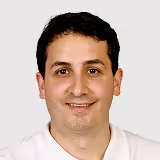
Marcel Kloos
Swiss-licensed dentist and founder of Medschool Experts
Marcel Kloos founded Medschool Experts while studying abroad; since then, over 500 study places have been secured. The Stuttgart-born dentist studied dentistry from 2015 to 2021 in Sofia and holds a Swiss dental licence.
Today he lives in Bern and runs Medschool Experts full-time as its owner.
More articles worth reading
Study Medicine or Dentistry Abroad from Brazil: Revalida, EU Passports and the Best Destinations
Study Medicine or Dentistry Abroad from the Gulf States: Licensing in Saudi Arabia, the UAE, Kuwait, Qatar, Oman and Bahrain
Study Medicine or Dentistry Abroad from Nigeria: MDCN Assessment Exam, Recognition and the Best Destinations

Ahmad

Sabrina

Rami

Noah
500+ students placed.
Now it's your turn!
No daydreaming, no empty promises. Just a clear plan — for the start of your medical degree.
40 minutes, no obligation