Transfer from Ivane Javakhishvili Tbilisi State University: Where to Continue Medicine in 2026
23.09.2026

Is a transfer from Ivane Javakhishvili Tbilisi State University possible in 2026?
A transfer from Ivane Javakhishvili Tbilisi State University is possible in 2026 for students in any year of the English-taught Medicine programme. The faculty issues an official transcript with ECTS credits per module, and that transcript is the currency of every transfer. Medschool Experts uses it to place students at partner universities worldwide.
Quick answer
Yes. A transfer from Ivane Javakhishvili Tbilisi State University to another medical faculty is possible at almost any stage of the six-year, 360-ECTS programme. Medschool Experts reviews the transcript, matches the credits to a fitting faculty worldwide and organises the placement. The consultation is free.
Tbilisi State University has taught medicine since 1918 and re-opened its Faculty of Medicine in 1994. The one-cycle MD runs six years, carries 360 ECTS and is taught in English with compulsory Georgian language modules. This structure matters for a transfer: ECTS is the same unit that medical faculties across Europe use, so a receiving university can read a Tbilisi transcript without a conversion table.
| Item | Detail |
|---|---|
| University | Ivane Javakhishvili Tbilisi State University, founded 1918 |
| City | Tbilisi, Georgia, about 1.1 million inhabitants |
| Programme | Medicine (one-cycle MD) |
| Tuition per year (2026) | around 7,000 to 8,000 USD |
| Language | English, with compulsory Georgian language modules |
| Degree | Medical Doctor (MD), 6 years |
| ECTS | 360 |
| Living costs | approx. 500 to 750 EUR per month |
| University page | Ivane Javakhishvili Tbilisi State University profile |
The facts in the table come from the university profile of Ivane Javakhishvili Tbilisi State University. Tuition sits at around 7,000 to 8,000 USD per year in 2026, which places the faculty in the mid-range for English-taught medicine outside the EU.
On 4 December 2025 Georgia's Minister of Education and Science announced that state universities, including Ivane Javakhishvili Tbilisi State University, will not admit new foreign students from the 2026/2027 academic year, while enrolled students continue their studies and private universities keep admitting international students.
Failed exams at Tbilisi State University: what now?
A student who has failed exams at Tbilisi State University in 2026 has three realistic options: retake the exam within the faculty's rules, repeat the year, or transfer the credits already earned to another medical faculty and continue there. A transfer does not erase passed modules. It moves them.
Failing an anatomy or biochemistry exam in year one or two is common at every medical faculty in the world, and it says little about whether someone will become a good doctor. What matters is the next step. Some retake and pass. Others discover that the exam format or the distance from home makes a second attempt unlikely to succeed.
For the second group, a transfer is the alternative to dropping out. The passed modules stay on the transcript. A receiving faculty looks at those modules, not at the failed attempt, and decides which year the student enters. Marcel Kloos, who studied dentistry in Sofia from 2015 to 2021, has guided many students through exactly this decision.
Three things to do this week after a failed year
- Request the official transcript with ECTS per module from the faculty office.
- Download or ask for the syllabus of every module passed so far.
- Book a free consultation so the credit review can start before the next intake deadline.
Why do students consider transferring from Tbilisi State University?
Students consider a transfer from Tbilisi State University in 2026 for five recurring reasons: exam difficulties, tuition or living costs, friction with a specific course or professor, the wish for an EU degree, and the career goal USA. Each reason has a solution, and the table below pairs them.
| Situation | What the transfer solves |
|---|---|
| Failed exams or a repeated year | Placement at a faculty whose exam format and teaching style fit the student better |
| Tuition or living costs strain the family budget | Faculties with a different fee level or lower living costs, checked against the budget |
| Problems with a course or a professor | A fresh start in the same year of study, with credits carried over |
| Wish for an EU or OECD degree | Continuation at a faculty inside the EU or another OECD member state |
| Career goal USA | A faculty with structured USMLE preparation and US clinical electives |
| Israeli licensing rules | Continuation at an institution in an OECD member state |
Tbilisi is affordable and lively. Still, a family budget can change, a professor can be a poor fit, and career plans can shift after two years of clinical exposure. None of this reflects on the faculty. It reflects on the student's life, and a transfer is the tool that adapts the study path to it.
How does ECTS credit transfer work after Tbilisi State University?
ECTS credit transfer after Tbilisi State University works module by module: the receiving faculty compares each passed module on the Tbilisi transcript with its own curriculum, using the syllabus to check content and hours, and then issues a recognition decision that states the year of entry. The 360-ECTS structure of the Tbilisi MD makes that comparison straightforward.
Medschool Experts is the leading expert in this field worldwide and frequently achieves placements in year 4 or year 5 at top universities worldwide. The outcome depends on the transcript, the syllabus and the target faculty. That is why no reliable number can be given before the documents are on the table, and why the credit review is done individually and free of charge.
Three details decide most cases. First, the syllabus: a receiving faculty needs to see that anatomy in Tbilisi covered what its own anatomy course covers. Second, the exam record: passed modules count, failed attempts do not. Third, timing: an application that reaches the faculty early in the year leaves room to fix gaps with a bridging exam instead of a lost semester. Every step of the review is described on the Medschool Experts services page.
Which universities accept transfer students from Tbilisi State University?
Which universities accept transfer students from Tbilisi State University depends on the individual profile: year of study, grades, ECTS earned, budget and the country where the student wants to practise later. Medschool Experts checks each case against its partner universities and does not publish lists of accepting faculties, because a list would be out of date within a semester and would mislead students whose profile fits a different faculty.
A study transfer is a complex undertaking. Our experts have almost 10 years of experience in study transfers worldwide, which is why they plan and carry it out confidently. The consultation is free.
What can be said in general: partner faculties exist inside the EU, in other OECD member states and beyond, in English-taught programmes that run on ECTS. Medschool Experts places students at its partner universities in different years of study, with credits carried over. Which faculty fits a specific student becomes clear in the consultation with Marcel or another experienced consultant on our team.
What does Israel's Yatziv reform mean for Israeli students at Ivane Javakhishvili Tbilisi State University?
Israel's Ministry of Health ties admission to the Israeli medical licensing exam to the institution where a doctor studied. Under the Yatziv reform, for Israelis who began their studies in 2019 or later, all institutions in OECD member states count as approved, plus institutions in other countries that the Ministry lists individually. Georgia is not an OECD member state, so for Israeli students at Ivane Javakhishvili Tbilisi State University the Ministry's individual list is the reference.
Some Israeli students therefore plan their degree with a university in an OECD member state in mind, and a transfer is one way to do that. Others continue in Tbilisi. Both are valid plans. Medschool Experts advises Israeli students on both paths, free of charge, in a personal consultation.
What does a transfer from Tbilisi State University cost, and how do living costs compare?
A transfer from Tbilisi State University costs the student three things in 2026: the tuition of the new faculty, the living costs of the new city, and one-off items such as certified translations, travel and a housing deposit. The consultation and the credit review at Medschool Experts are free; the placement fee is discussed openly in the first conversation.
A year in Tbilisi currently adds up to roughly 13,000 to 16,000 EUR when tuition of about 8,000 USD is combined with living costs of 500 to 750 EUR per month. Some target faculties are more expensive, some are cheaper, and the difference in living costs between cities is often larger than the difference in tuition. Marcel, who lives in Bern and knows how quickly rent decides a budget, compares both figures with the family before any application is sent.
One saving is easy to overlook. A student who transfers instead of repeating a year avoids one full year of tuition and living costs, which in Tbilisi alone means 13,000 EUR or more. Seen that way, a transfer is often the cheaper option.
Can I go the USMLE or USA route after Tbilisi State University?
Yes, the USMLE route remains open to students of Tbilisi State University in 2026. Georgia's National Center for Educational Quality Enhancement has held WFME recognition status since 19 October 2018, which is the basis on which graduates of Georgian programmes can pursue ECFMG certification and sit the USMLE steps. The UK PLAB route is likewise open.
A transfer changes the question from whether the route is open to how well the faculty prepares for it. Students with a firm US goal often look for a faculty with structured USMLE Step 1 preparation, clinical electives in the USA and a network of alumni in US residency programmes. Others prefer to stay in Georgia and prepare on their own. Both paths work. The consultation clarifies which one fits.
Why is Georgia still an attractive place to study Medicine in 2026?
Georgia remains an attractive place to study Medicine in 2026 because it combines an English-taught six-year MD worth 360 ECTS with tuition clearly below Western European levels: at Ivane Javakhishvili Tbilisi State University around 7,000 to 8,000 USD per year. Georgia's National Center for Educational Quality Enhancement holds WFME recognition status since 2018, which keeps the USMLE and ECFMG route and the UK PLAB route open for graduates. Tbilisi and Batumi host international students from many countries, and lecture halls in both cities are used to a mix of languages and backgrounds. Daily life in Georgia is welcoming, safe and affordable.
For Iranian students, Georgia has one more advantage. Iranian citizens can enter Georgia without a visa and stay for up to 45 days, and the study visa and the residence permit are then arranged inside Georgia. Many Iranian students face long waiting times or refusals when they apply for student visas elsewhere, so Georgia is one of the most accessible places for them to study Medicine in English.
A transfer is one option among good ones. Both paths can work. Whether you stay at Ivane Javakhishvili Tbilisi State University or move to another university, Marcel or another experienced consultant on our team advises you free of charge.
{{cta}}Can I continue Medicine in the EU after Tbilisi State University without losing a year?
Continuing Medicine in the EU after Tbilisi State University without losing a year is possible when the ECTS credits are recognised in full for the year already completed, and Medschool Experts frequently achieves that for students with a clean transcript. Inside the EU a Georgian degree is a third-country qualification that is assessed case by case, because Directive 2005/36/EC does not apply to it automatically. A degree earned at an EU faculty, by contrast, moves across the EU under that directive.
That distinction is the main reason students with a European career plan transfer during their studies rather than after graduation. A transfer in year two or three means the final diploma is an EU diploma. Recognition in the home country then follows the automatic route instead of the individual one.
The timing is not fixed. Some transfer after year one, others after year three. Later is possible too.
How does the transfer with Medschool Experts work step by step?
The transfer with Medschool Experts works in five steps over roughly eight months: free consultation, credit analysis, document preparation, admission decision, and the move. Marcel or another experienced consultant on our team runs every step, and the student keeps studying in Tbilisi until the new place is confirmed.
Month one is the consultation. The student sends the transcript, describes the goal and the budget, and receives a first assessment. Month two is the credit analysis: the team compares the Tbilisi modules with the curricula of fitting partner faculties and prepares a shortlist. Months three and four cover documents: certified transcripts, the syllabus, translations and the application itself. Months five and six bring the recognition letter with the year of entry and the enrolment. Months seven and eight are the move.
The timeline stretches when documents arrive late from the faculty office, and it shrinks when a student contacts the team a full year before the planned start. Marcel Kloos has placed more than 500 students since founding Medschool Experts, and the cases that ran smoothest were the ones that began early.
What documents does a transfer from Tbilisi State University need?
A transfer from Tbilisi State University needs four core documents in 2026: the official transcript with ECTS per module, the course syllabus, an enrolment certificate showing the current year, and the original school-leaving certificate. Everything else, from translations to the application form of the target faculty, is organised by Medschool Experts.
The transcript and the syllabus carry the most weight. A transcript tells a receiving faculty that anatomy was passed; the syllabus tells it how many hours and which topics. Students who collect both before the consultation gain several weeks.
The author's view
I studied dentistry in Sofia from 2015 to 2021, six years in a foreign city and a foreign exam system. So I understand every student in Tbilisi who sits with a transcript in one hand and a plane ticket in the other and wonders what to do with the credits.
My answer after more than 500 placements is simple: keep the credits, change the address if the reasons are real. Tbilisi State University is a serious faculty with a century of history, and nobody transfers because the university is bad. They transfer because life moved: a budget, a licensing rule at home, a career plan in the USA.
From my desk in Bern, the cases that end well share one trait. They start early. Send the transcript before the next deadline passes, and let us check what is possible. That check costs nothing.
Summary
- A transfer from Ivane Javakhishvili Tbilisi State University is possible in any year of the six-year, 360-ECTS Medicine programme.
- Failed exams do not block a transfer: passed modules move with the student, failed attempts stay behind.
- ECTS credit transfer is assessed module by module; Medschool Experts frequently achieves placements in year 4 or year 5 at top universities worldwide.
- Which faculty fits depends on the profile; there are no public lists, only an individual, free check.
- For Israeli students the Ministry of Health's individual list is the reference, because Georgia is not an OECD member state; some plan a transfer, others continue in Tbilisi.
- The USMLE and UK PLAB routes remain open; an EU diploma adds automatic recognition under Directive 2005/36/EC.
- The transfer takes about eight months in five steps, and starting early is the single biggest time saver.
Conclusion
The world needs more doctors, and a student who has completed one, two or three years of Medicine in Tbilisi has already done the hardest part: getting in and staying in. A transfer keeps that work. It changes the address, sometimes the country, and often the recognition route of the final diploma, but it does not send anyone back to the starting line.
Whether the reason is an exam, the budget, a career goal in the USA or the Israeli licensing rules, the next step is the same. Send the transcript, describe the goal, and let Marcel or another experienced consultant on our team check the case. Book a free consultation and find out where your Medicine studies can continue in 2026.
Frequently Asked Questions about a transfer from Tbilisi State University
Is an agency necessary for a transfer from Tbilisi State University?
An agency is not legally required for a transfer from Tbilisi State University, but the credit recognition and the application to a foreign medical faculty involve syllabus comparisons, certified translations and intake deadlines that are easy to miss from Tbilisi. Medschool Experts has handled study transfers for almost 10 years, knows the partner faculties' curricula and checks each case free of charge before any fee is discussed.
Will I lose a year if I transfer from Tbilisi State University?
Not necessarily. The receiving faculty recognises the ECTS credits module by module and states the year of entry in its recognition letter. Medschool Experts is the leading expert in this field worldwide and frequently achieves placements in year 4 or year 5 at top universities worldwide. The result depends on the transcript and the target faculty, which is why the review is done individually and without charge.
I failed a year at Tbilisi State University. Can I still transfer?
Yes. A failed year does not delete the modules passed before it. A receiving faculty assesses the passed modules on the transcript and decides which year the student enters; the failed attempt itself is not transferred. Many students who transfer after a failed year continue in the same or the following year of study elsewhere. Marcel or another experienced consultant on our team checks the transcript free of charge.
How does ECTS credit transfer work after Tbilisi State University?
The Medicine programme at Tbilisi State University carries 360 ECTS over six years, and each passed module has an ECTS value on the transcript. The receiving faculty compares those modules with its own curriculum, using the syllabus for content and hours, and issues a recognition decision. Because ECTS is the standard unit at European medical faculties, no conversion is needed, only a content comparison.
Which universities accept transfer students from Tbilisi State University?
That depends on the individual profile: year of study, grades, credits earned, budget and the country where the student wants to practise. Medschool Experts checks each case against its partner universities in the EU, in other OECD member states and beyond, and does not publish lists of accepting faculties, because such lists change every semester. The fitting faculty is identified in the free consultation.
What does Israel's Ministry of Health recognition mean for Israeli students at Tbilisi State University?
Israel's Ministry of Health ties admission to the Israeli licensing exam to the institution. For Israelis who began studying in 2019 or later, all institutions in OECD member states count as approved, plus individually listed institutions elsewhere. Georgia is not an OECD member, so the Ministry's individual list is the reference. Some Israeli students plan a transfer to an OECD-country university, others continue. Medschool Experts advises on both paths for free.
How much does a transfer from Tbilisi State University cost?
The consultation and the credit review at Medschool Experts are free. The costs that follow are the tuition of the new faculty, the living costs of the new city, and one-off items such as certified translations, travel and a housing deposit. The placement fee is explained openly in the first conversation. A transfer often costs less than repeating a year in Tbilisi, which alone adds up to 13,000 EUR or more.
When should I start planning a transfer from Tbilisi State University?
Ideally nine to twelve months before the planned start at the new faculty, because the full process takes about eight months: consultation, credit analysis, documents, decision and move. Students who contact Medschool Experts right after a failed exam session or at the beginning of a semester have the most options. A shorter lead time is sometimes possible, but it narrows the choice of faculties and intakes.
Is Georgia a good place to study Medicine for Iranian students?
Yes. Iranian citizens can enter Georgia without a visa and stay for up to 45 days, and the study visa and residence permit are then arranged inside Georgia. Many Iranian students face long waiting times or refusals when applying for student visas elsewhere, so Georgia is one of the most accessible places for them to study Medicine in English, in a six-year MD worth 360 ECTS.
Can I continue Medicine in the USA after Tbilisi State University?
The USMLE route is open to students and graduates of Tbilisi State University, since Georgia's National Center for Educational Quality Enhancement has held WFME recognition status since 19 October 2018. A transfer during the studies does not close this route; it can open a faculty with structured USMLE preparation and US clinical electives. Which option fits depends on the student's timeline and budget.
What students say about Medschool Experts
Over 500 placements at more than 25 partner universities across 10+ countries. Read independent student reviews on Trustpilot.
About the author
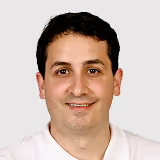
Marcel Kloos
Swiss-licensed dentist and founder of Medschool Experts
Marcel Kloos founded Medschool Experts while studying abroad; since then, over 500 study places have been secured. The Stuttgart-born dentist studied dentistry from 2015 to 2021 in Sofia and holds a Swiss dental licence.
Today he lives in Bern and runs Medschool Experts full-time as its owner.
More articles worth reading
Israeli Medical Students in Georgia: What the Yatziv Reform Means and Your Options in 2026
Transfer from Avicenna Batumi Medical University: Where to Continue Medicine in 2026
Transfer from Kutaisi University: Where to Continue Medicine in 2026
Ahmad
Sabrina
Rami
Noah
500+ students placed.
Now it's your turn!
No daydreaming, no empty promises. Just a clear plan — for the start of your medical degree.
40 minutes, no obligation