Emigrating as a Dentist to Switzerland – MEBEKO, Licence and Pay 2026
01.09.2026

Why Switzerland is a market of its own for dentists
In Switzerland dentistry is one of the university medical professions and is analysed annually by the Federal Office of Public Health. As at 31 December 2024, 7,393 dentists held a licence to practise under their own professional responsibility. 53 percent of them hold a Swiss federal diploma and 46 percent a recognised foreign one. The total has grown by 34 percent within ten years, from 5,522 people in 2014 to 7,393 in 2024.
Among new entrants the picture is clearer still. Of the 651 dentists newly licensed in 2024, according to the Federal Office of Public Health 63 percent held a recognised foreign diploma. 71 percent (302) of the recognised diplomas came from the five most frequent issuing states, with the remaining 29 percent (125) spread across 27 further states. The average age of licence holders is 49 and the share of women 42 percent – already 55 percent among those newly licensed in 2024.
A second point shapes the market: dental treatment in Switzerland is predominantly privately financed. Under Article 31(1) of the Health Insurance Act, the compulsory health insurance scheme covers the cost of dental treatment only where it is "caused by a serious, unavoidable disease of the masticatory system", caused by a serious general illness or its consequences, or necessary for the treatment of such an illness. Anyone arriving from Germany therefore meets a practice economy without budgeting and without statutory insurance accreditation – the biggest structural difference from the German system.
MEBEKO recognition in principle
Responsibility and legal framework
The Medical Professions Commission MEBEKO, based at the Federal Office of Public Health, is responsible for recognising foreign dental diplomas. Under Article 36 of the Medical Professions Act, practising under your own responsibility requires a Swiss or a recognised foreign diploma. Added to that are entry in the register of medical professions MedReg and proof of the required language skills under Article 33a of the same act. Since 1 January 2018 the rule has been: all medical professionals working or wanting to work in Switzerland must be entered in the MedReg.
Automatic recognition for EU and EFTA diplomas
The basis is the Agreement on the Free Movement of Persons between Switzerland and the EU, the EFTA Convention and Directive 2005/36/EC. The SSO describes the conditions as cumulative:
- the applicant or their spouse holds the citizenship of Switzerland or of an EU or EFTA state;
- the diploma complies with Directive 2005/36/EC or the EFTA Convention;
- it was issued by the authority competent under the directive;
- proof of language at at least level B2 in an official language at the place of licensing is available.
Where these points are met, recognition is not a discretionary decision but a bound administrative act. That is the real core of free movement: the authority checks the formal conditions, not the quality of the training in the individual case.
What lies behind automatic recognition
The reason for this automatic quality lies in European minimum harmonisation. Article 34(2) of Directive 2005/36/EC requires basic dental training of at least five years and at least 5,000 hours of full-time theoretical and practical training, covering the programme set out in Annex V number 5.3.1 and delivered at a university or an equivalent institution, or under its supervision. Paragraph 1 requires for admission a certificate that opens access to that course of study in the member state. Because every member state observes these minimum standards, diplomas can be mutually recognised without a substantive re-examination – and Switzerland participates through the Agreement on the Free Movement of Persons.
The scale of the procedure
How routine the procedure is, is shown by the MEBEKO annual report 2024: 4,155 diplomas were recognised in total, 3,228 of them in human medicine, 427 in pharmacy, 299 in veterinary medicine and 201 in dentistry (2023: 212). A further 54 dental postgraduate titles were recognised. The report also notes that most applications are handled directly in the office and only in exceptional cases have to be put to a meeting for assessment.
EU diploma or non-EU diploma – the decisive difference
Outside the EU and EFTA there are no corresponding international agreements. Diplomas from other countries are therefore in principle not recognised. Applications under Article 36(3) of the Medical Professions Act, which provides an exception for such cases, are according to the MEBEKO annual report very rare, running at zero to two a year.
Indirect recognition
More significant in practice is the detour through an EU or EFTA state. Where a non-EU diploma has already been recognised there, MEBEKO can recognise it indirectly. Here too the conditions are cumulative: citizenship of Switzerland or of an EU or EFTA state on the part of the applicant or their spouse, unrestricted entitlement to practise with the same rights in the recognising state, observance of the minimum requirements under Article 2(2) of Directive 2005/36/EC at the point of first recognition, at least three years of current clinical experience no more than five years old, and proof of language at level B2.
The route via the Swiss federal diploma
Anyone who does not meet these conditions can acquire the Swiss federal diploma subsequently. The SSO names two routes: a master's programme at the universities of Basel, Bern, Geneva or Zurich followed by passing the Swiss federal examination in dentistry, and accredited specialist dental training in oral surgery, orthodontics, periodontology or reconstructive dentistry at a university or at Lucerne Cantonal Hospital. Both then lead to a licence and a MedReg entry.
Working under professional supervision
Alongside these there is a third variant that is often overestimated: dependent work under professional supervision. For that the diploma must be registered in the MedReg, proof of language at level B2 is needed, and a cantonal licence to practise. The SSO points out expressly that not all cantons issue such a licence, that MedReg registration does not constitute formal recognition of a diploma, and that it creates no independent entitlement to a licence. In 2024, 623 such diplomas were registered across all the university medical professions.
Language: B2 in the official language of the place of licensing
Proof of language is not a formality but a licensing condition in its own right under Article 33a of the Medical Professions Act. At least level B2 of the Common European Framework of Reference is required, in the official language that applies at the place of licensing – German, French or Italian. Anyone wanting to work in Geneva or Lausanne will not get far with German.
The dentistry information sheet of the Canton of Zurich health department states that since 2018 language skills must be entered in the register of medical professions and must be at least at level B2. Employers are obliged to check whether salaried dentists meet this requirement. For German-speaking applicants this is as a rule unproblematic in German-speaking Switzerland; the proof must nevertheless be formally in place before the licence is granted.
The cantonal licence – 26 jurisdictions, one principle
Recognition by MEBEKO does not yet permit treatment in the chair. Only the canton grants the licence to practise, and separately for work under your own professional responsibility and for work under supervision. Anyone working in several cantons needs several licences.
What that looks like in practice is shown by the Canton of Zurich. The licence is granted for ten years, and from the age of 70 for a maximum of three years at a time. First issue costs 1,000 francs and renewal 250 francs, and processing takes around eight weeks according to the health department. For work under professional supervision the canton provides an assistant licence: 400 francs open-ended, 200 francs for a time-limited first issue and 80 francs for its renewal. Assistant dentists need a Swiss or recognised diploma; employment at the main location is capped at a maximum of 200 percent of a full-time equivalent. Other cantons set fees and deadlines differently – the principle is the same everywhere.
In residence terms the step is comparatively lean for EU and EFTA nationals. The Agreement on the Free Movement of Persons was signed on 21 June 1999 and came into force on 1 June 2002. Anyone producing an employment contract receives, according to the State Secretariat for Migration, a B permit valid for five years; for short-term employment the L permit is provided. The agreement expressly also covers the mutual recognition of professional diplomas and the coordination of social security systems.
Pay, costs and what is left at the end of the month
The Swiss earnings structure survey of the Federal Statistical Office reports a median wage of 7,024 francs gross a month for 2024, extrapolated to a full-time post; in 2022 it was 6,788 francs. The top ten percent earned more than 12,526 francs. Regionally the range runs from a median of 7,502 francs in Zurich to 5,708 francs in Ticino. These figures are the benchmark against which any offer can be measured.
For dentists themselves there is no official separate statistic. According to the specialist portal praktischArzt.ch, the average dentist's salary in Switzerland in April 2025 was around 9,167 francs a month, with a cantonal range from about 83,000 francs in Thurgau to about 125,000 francs in Basel and Zurich a year. These figures are not official and should be read as orientation.
For comparison, the German side: the 2025 statistical yearbook of the National Association of Statutory Health Insurance Dentists reports, for 2023, income per practice owner of 677,900 euros and expenditure of 463,200 euros, equal to 68.3 percent of income. The surplus averaged 214,700 euros, with a median of 180,300 euros – 222,900 euros in the western states and 178,800 euros in the eastern. The largest cost block was staff at 43.1 percent, followed by external laboratory work at 23.6 percent.
On the cost side in Switzerland the main item is health insurance. The average premium rises by 4.4 percent in 2026 to 393.30 francs a month. The deductible can be chosen between 300 and 2,500 francs for adults, which lowers the premium; households on low incomes can apply to the canton for a premium reduction. Taxes in Switzerland are levied at three levels – federal, cantonal and municipal – and differ considerably between cantons. Place of residence, premium region and rent level therefore decide disposable income more than the gross figure in the employment contract.
The labour market and everyday practice
Access is open, and the figures prove it: 63 percent of the licences newly granted in 2024 went to people with a recognised foreign diploma, and the total has grown by a third in ten years. Entry is as a rule as a salaried dentist in a private practice, a practice group or a university clinic. Only afterwards does the question of your own practice or a partnership arise.
Three things shape daily life more than the formalities. First, private financing: treatment plans are negotiated with the patient and not with an insurer, so advice and explanation take up correspondingly more room. Second, multilingualism: even in German-speaking Switzerland, communicating with patients from all language regions is part of the job, and dialect is a learning task in itself. Third, the expectation around documentation and quality, structurally anchored in the licensing requirement and the ten-year validity of the licence.
An account of experience: how I came to Switzerland myself
I did not research this route, I took it. My school leaving grades were not enough for dentistry in Germany, so I studied in Sofia from 2015 to 2021, on the English-language programme of the Medical University. That was not a fallback but the fastest option available – and legally the same basis as a German diploma.
After graduating, recognition ran exactly as the legal position would suggest: what was checked was whether the diploma complied with the European requirements and had been issued by the competent body – not how good I was at prosthetics. Anyone who has ever been through an administrative procedure with a substantive individual assessment knows what a difference that is.
Two things I underestimated at first. First, the order: recognition, register entry with proof of language and the cantonal licence are three separate steps with three separate jurisdictions, and the canton only begins once the federal level has finished. Second, the documents: I gathered diploma, study records and certificates together after the fact, instead of filing them in order from the first semester. Doing that early saves weeks.
Linguistically, the formal part was unproblematic for me as a German speaker. Everyday life is nonetheless a learning task of its own: you do not come to understand dialect through a certificate but through listening, and in a practice that is almost entirely privately financed a large part of the work consists of explaining – why this treatment, why this price, why now.
What I would do differently in hindsight: work out the cost of living before signing the contract, not afterwards. Premiums, taxes and rents differ so much between cantons that two identical gross salaries look very different at the end of the month. That is exactly the calculation I now do with everyone who asks me about it.
Today I am a Swiss-licensed dentist and run Medschool Experts from Bern. The detour through Sofia cost me nothing in the end but the tuition fee – and it earned me a diploma that is valid across the EU and, through the Agreement on the Free Movement of Persons, here too.
The route via a dentistry degree in the EU
For anyone considering a degree, the decisive insight is that the Swiss route does not hang on the place of study but on the legal basis of the diploma. A dentistry degree at a university in the EU that observes the requirements of Article 34 of Directive 2005/36/EC – five years, at least 5,000 hours, the programme under Annex V number 5.3.1 – leads to a diploma recognised automatically in all member states and, through the Agreement on the Free Movement of Persons, in Switzerland too. That is exactly what the statistics reflect: almost half of licensed dentists in Switzerland work with a recognised foreign diploma.
Anyone studying dentistry today in Bulgaria, Hungary, Croatia, Poland or another EU state acquires the same European basis as in Germany – and keeps both options open: the German licence just as much as MEBEKO recognition and a licence in a Swiss canton. Which locations fit, and how to plan your own route, is best clarified in person.
Anyone wanting to know which place of study suits their own plans can book a free consultation with us.
International comparison: Austria, the Netherlands, Norway
Switzerland is not the only country in which a European dentistry diploma carries immediately. The differences lie less in recognition itself than in language level, responsible body and fees.
In Austria the Austrian Dental Chamber is responsible. According to the federal business service portal, what is required is German at level C1 unless German is the applicant's mother tongue, a medical certificate, criminal record and disciplinary certificates no more than three months old, and professional liability insurance with minimum cover of two million euros. The procedure takes up to three months from complete submission, and up to four months where recognition is not automatic; administrative charges total 26.40 euros.
In the Netherlands the route runs through the BIG register of the CIBG. Direct entry is provided for certain European qualifications; the register expressly names "doctors, pharmacists, dentists, midwives and nurses". Assessment can take up to three months. On proof of language the country is stricter than Switzerland: the professional organisation KNMT describes for foreign-trained dentists level B2 plus sufficient command of medically interactive Dutch, demonstrated among other ways through the Taaltoets Nederlands of the Taleninstituut Babel. Anyone trained outside the EU must additionally demonstrate English at level B2 and sit a professional examination.
In Norway the Helsedirektoratet grants authorisation. For applicants trained outside the EEA, additional requirements apply: a recognised Norwegian language examination at level B2 – the Norskprøven in all parts, or the Bergen test – a course in national subjects covering the structure of the health service and health, social and insurance law, and a professional examination which for dentists is held twice a year by the University of Oslo. Three years are available to meet all requirements. For dentists trained within the EEA, different and considerably shorter rules apply. On pay Norway is high: according to Statistics Norway table 11418 as analysed by Lønnsguiden, the average monthly salary of dentists in 2025 was 79,370 Norwegian kroner, with a median of 75,000 kroner.
| Country | Responsible body | Recognition of an EU/EEA diploma | Proof of language | Fees / duration |
|---|---|---|---|---|
| Switzerland | MEBEKO (Federal Office of Public Health), then the canton | automatic under the free movement agreement and Directive 2005/36/EC | B2 in the official language at the place of licensing | Canton of Zurich: 1,000 CHF first issue, approx. 8 weeks |
| Austria | Austrian Dental Chamber | automatic for the EEA and Switzerland | C1 German unless it is the mother tongue | 26.40 euros administrative charges, up to 3 months |
| Netherlands | BIG register (CIBG) | direct entry for certain EU diplomas | Dutch B2 plus medically interactive competence | assessment up to 3 months |
| Norway | Helsedirektoratet | authorisation, shortened procedure for the EEA | outside the EEA: Norwegian B2 plus a course and a professional examination | dentistry professional examination at the University of Oslo, twice a year |
The order of the hurdles is notable. Austria demands the most formally on language with C1 but is by far the cheapest on fees. Switzerland is content with B2 but requires an additional cantonal licence with its own fee. The Netherlands defines language in job-related terms rather than by reference framework alone, and Norway adds a professional examination for training obtained outside the EEA.
This article reflects the state of the published official sources in August 2026 and does not replace legal or tax advice in an individual case. What is authoritative is the information given by MEBEKO and by the responsible cantonal health department.
The author's view
I took exactly this route: a dentistry degree in Sofia, EU recognition, the recognition procedure in Switzerland. Today I am a Swiss-licensed dentist and run Medschool Experts from Bern. When I read the figures from the Federal Office of Public Health, I therefore read them not as an abstract statistic but as a description of my own daily life: 46 percent of licensed dentists in Switzerland work with a recognised foreign diploma. Among colleagues it is entirely normal for the training to have taken place in Sofia, Budapest, Zagreb, Krakow or Vienna. In practice nobody asks about it any more.
What I learned along the way is above all this: the difference between a European and a non-European diploma is greater than any difference between two European universities. Article 34 of Directive 2005/36/EC, with its five years and 5,000 hours, is the quietest but most effective switch in the whole procedure. Meet it and you get a confirmation at the end. Fail to meet it and you get a procedure. That is the point at which study decisions are really decided – not by a university's ranking.
The second point concerns language. B2 sounds like a formality, and for German-speaking applicants in German-speaking Switzerland it is. Everyday life nonetheless demands more. You do not come to understand dialect through a certificate but through listening, and a large part of dental work in Switzerland consists of explaining: why this treatment, why this price, why now. Because dentistry here is almost entirely privately financed, the conversation at the chair is a genuine part of the service. Anyone who enjoys that will work very happily in Switzerland. Anyone who prefers to work from a catalogue will experience it differently.
Does emigrating really pay off financially? My honest answer
Here I am plainer than most guides are. Anyone looking for big money will find no location in Switzerland either where it is guaranteed. The market is competitive – and precisely where there is a lot to earn. That is not a Swiss peculiarity; it is the same everywhere.
As I see it, the density of dentists here is even higher than in Germany. The real difference lies elsewhere: fewer patients, more money nonetheless. Adjusted for purchasing power, at least as much is left at the end – with noticeably less work. That, for me, is the honest core of the Swiss advantage, not the gross figure in the contract.
It becomes genuinely lucrative for specialist dentists working independently. That is where specialisation pays off, and where the gap to Germany is largest.
Conversely: for a salaried post alone, emigrating is in my view not worth the effort in purely financial terms. Anyone moving only for the salary and staying salaried is shifting home, environment and family for a difference that, after premiums, rents and taxes, turns out smaller than expected. There are good reasons for this step – training, environment, quality of life, prospects. But salary alone is not one of them.
What I can say without qualification, by contrast: working independently is more enjoyable in Switzerland than in Germany. Without budgeting, without statutory insurance accreditation, with a treatment plan negotiated with the patient rather than with an administration. Anyone who thinks entrepreneurially will find conditions here that do not exist in Germany.
And the figures. Yes, gross salaries are higher than in Germany; the median wage across all sectors in 2024 was 7,024 francs. But the average health insurance premium rises in 2026 to 393.30 francs a month per person, and rents and taxes differ markedly from canton to canton. I advise everyone to measure the contract not against a German gross salary but against their own cost of living at the specific place of residence. Anyone who works that through soberly usually still reaches a good result – just an honest one.
What I find most important, though, is the message contained in these statistics: the route through a degree elsewhere in Europe is not a detour. It leads into the same practices, the same clinics and the same registers as any other route. That is not something you have to take on trust. It is in the official figures.
Conclusion: an orderly route with three levels
Emigrating to Switzerland as a dentist is clearly structured in law. An EU or EFTA diploma complying with Directive 2005/36/EC is recognised by MEBEKO; added to that are the MedReg entry with proof of language at level B2 and the cantonal licence to practise. A diploma from outside the EU is recognised only by the detour through recognition already granted in an EU or EFTA state, together with at least three years of current clinical experience – or it leads via the Swiss federal diploma.
Economically the step pays off if it is calculated for the specific place of residence: premiums, taxes and rents differ considerably between cantons. And for everyone still ahead of their degree, the simplest insight of this article applies: the European dentistry diploma is the entry ticket – regardless of which member state it was obtained in. Anyone wanting to plan their route there can book a free consultation at any time.
Further reading
- Dentistry without the NC abroad – an overview of locations, because this is where the universities are whose diplomas are recognised across Europe.
- German medical licence (Approbation) and recognition of a medical degree from elsewhere in the EU, because the German counterpart to the Swiss procedure is explained there.
- The structure of the medical degree in Bulgaria, because the Bulgarian curriculum shows well how the EU minimum standards are implemented.
- From law student to dentist in Sofia, because that account describes the route this article sets out in legal terms.
- Cost comparison: studying medicine abroad and in Germany, because financing belongs in the planning early on.
Frequently asked questions
Who recognises a foreign dentistry diploma in Switzerland?
The Medical Professions Commission MEBEKO at the Federal Office of Public Health. It decides on recognition; the licence to practise is then granted by the canton.
Is a German dentistry diploma recognised automatically in Switzerland?
Yes, provided the conditions are met cumulatively: citizenship of Switzerland or of an EU or EFTA state on the part of the applicant or their spouse, a diploma complying with Directive 2005/36/EC issued by the competent authority, and proof of language.
What language level is required?
At least B2 of the Common European Framework of Reference in an official language at the place of licensing, that is German, French or Italian. The legal basis is Article 33a of the Medical Professions Act.
What is the MedReg and who has to be entered in it?
The register of medical professions covers all university-trained medical professionals. Since 1 January 2018 everyone practising or intending to practise their medical profession in Switzerland must be entered.
What applies to a diploma from outside the EU?
It is in principle not recognised. Indirect recognition is possible where the diploma has already been recognised in an EU or EFTA state and where, among other things, at least three years of current clinical experience no more than five years old exist.
Can I work in dentistry in Switzerland without a recognised diploma?
Only in a dependent role under professional supervision, with the diploma registered in the MedReg, proof of language and a cantonal licence. The SSO points out that not all cantons issue such a licence and that registration creates no entitlement to one.
How long does the cantonal licence take and what does it cost?
That differs by canton. The Canton of Zurich gives 1,000 francs for first issue, 250 francs for renewal and a processing time of around eight weeks; the licence is valid for ten years.
Which residence permit do I need?
Nationals of EU and EFTA states receive, on producing an employment contract, a B permit valid for five years according to the State Secretariat for Migration, or an L permit for short-term employment.
How many dentists in Switzerland work with a foreign diploma?
As at 31 December 2024, 7,393 people held a licence to practise under their own professional responsibility, 46 percent of them with a recognised foreign diploma. Among the 651 licences newly granted in 2024 it was 63 percent.
Do you earn more in Switzerland than in Germany?
Gross figures are higher: the median wage across all sectors in 2024 was 7,024 francs a month according to the Federal Statistical Office. Set against that are health insurance premiums – 393.30 francs a month on average in 2026 – plus rents and taxes that differ by canton.
Does basic insurance pay for dental treatment?
Only in narrowly defined cases. Under Article 31(1) of the Health Insurance Act the compulsory health insurance scheme covers the cost where the treatment is caused by a serious, unavoidable disease of the masticatory system or by a serious general illness, or is necessary for the treatment of such an illness.
Is a dentistry degree elsewhere in the EU suitable for Switzerland?
Yes. What matters is that the diploma complies with the requirements of Article 34 of Directive 2005/36/EC – at least five years and 5,000 hours. Such diplomas are recognised in Switzerland too, through the Agreement on the Free Movement of Persons.
What students say about Medschool Experts
Over 500 placements at more than 25 partner universities across 10+ countries. Read independent student reviews on Trustpilot.
About the author
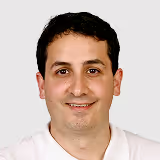
Marcel Kloos
Swiss-licensed dentist and founder of Medschool Experts
Marcel Kloos founded Medschool Experts while studying abroad; since then, over 500 study places have been secured. The Stuttgart-born dentist studied dentistry from 2015 to 2021 in Sofia and holds a Swiss dental licence.
Today he lives in Bern and runs Medschool Experts full-time as its owner.
More articles worth reading
Why Students Transfer from Medical University of Varna — Your Options
Why Students Transfer from Medical University of Warsaw — Your Options
Why Students Transfer from Masaryk University Faculty of Medicine — Your Options
Ahmad
Sabrina
Rami
Noah
500+ students placed.
Now it's your turn!
No daydreaming, no empty promises. Just a clear plan — for the start of your medical degree.
40 minutes, no obligation