Is Medical School Abroad Really More Expensive? A Cost Comparison with Germany
28.08.2026

The error in reasoning: looking only at the tuition fee
In Germany, studying at state universities is free of tuition fees, but living costs are high. Abroad, it is the other way round. A meaningful comparison only becomes possible once you add both together and break the figure down by month.
The comparison in figures
| Location | Tuition fees per year | Living costs per month | Total per month |
|---|---|---|---|
| LMU Munich | none | approx. 1,200 euros | approx. 1,200 euros |
| University of Hamburg | none | approx. 900 euros | approx. 900 euros |
| Goethe University Frankfurt | none | approx. 900 euros | approx. 900 euros |
| University of Cologne | none | approx. 850 euros | approx. 850 euros |
| Medical University of Sofia | approx. 9,950 euros | 500 to 700 euros | approx. 1,330 to 1,530 euros |
| Medical University of Varna | approx. 10,000 euros | 450 to 650 euros | approx. 1,280 to 1,480 euros |
| Medical University of Pleven | approx. 9,000 euros | 350 to 500 euros | approx. 1,100 to 1,250 euros |
| Trakia University Stara Zagora | approx. 9,000 euros | 350 to 500 euros | approx. 1,100 to 1,250 euros |
| University of Cluj (Romania) | approx. 10,000 euros | 400 to 550 euros | approx. 1,230 to 1,380 euros |
| Victor Babes Timisoara (Romania) | approx. 8,500 euros | 400 to 550 euros | approx. 1,110 to 1,260 euros |
The figures are guide values for 2026 and vary with the type of accommodation and lifestyle. What matters is the order of magnitude: the gap to an expensive German university city is considerably smaller than the tuition figure alone suggests. The individual items behind the living-costs column are set out in the monthly budget by location, and the largest location in the table is described in the lead article Studying medicine in Sofia.
What this calculation looks like for your preferred location is something we clarify in a free consultation.
{{cta}}
The hidden costs in dentistry
In dentistry, the picture shifts once again. In Germany, instruments, a phantom head and materials are purchased by the students themselves. An articulator accepted by the university costs around 1,500 euros on its own, and across the whole programme the total quickly runs into several thousand euros. At many faculties abroad, these materials are provided. Anyone who honestly compares the two routes often arrives at a draw in dentistry, or even at an advantage for studying abroad – which locations come into question is set out under Dentistry without an NC abroad.
What shifts the comparison further
- Auslands-BAföG (the German study-abroad grant): the tuition fee subsidy of up to 5,600 euros per year is a full grant. It reduces the fee burden directly and does not have to be repaid – all funding routes are set out under Financing medical studies abroad.
- Waiting time costs money: anyone who waits two years for a place loses not only time but also two years of professional income at the end of their training. In almost every calculation, this is the largest item. How realistic a place in Germany is for you is shown by the chances calculator.
- The euro since 2026: in Bulgaria, exchange rate risks and currency conversion fees disappear entirely.
- Part-time work: at many locations, part-time work in an international environment is readily possible.
What the programme costs in total over six years
For six years of human medicine in Bulgaria, tuition fees come to around 54,000 to 60,000 euros, with living costs of roughly 30,000 to 50,000 euros on top. A considerable share of this can be pre-financed through BAföG and education funds.
Are there more affordable alternatives in Europe?
Yes. In Romania, Croatia and Slovakia, fees are in some cases considerably lower. You will find a full overview with costs per semester in the fee comparison of all NC-free universities in Europe, and all study locations at a glance on the location overview.
If you want to draw up your personal calculation, arrange a free consultation.
The author's view
I drew up this calculation for myself before I went to Sofia – and again years later when I started working as a dentist in Switzerland. Both times the outcome was the same: the decisive item is not the tuition fee but the time.
Anyone who waits three years for a place loses three years of professional income and three years of clinical experience. Anyone who starts instead pays fees but finishes earlier. I say this without pressure: there are good reasons to wait. It is just that the cost of waiting should be honestly included in the calculation.
Summary
The prejudice about expensive studies abroad does not hold up to the arithmetic. Anyone who looks at fees and living costs together, factors in the BAföG tuition subsidy and does not forget the material costs in dentistry ends up in a similar order of magnitude to a large German city. And the biggest cost factor is a different one anyway: lost years.
You can read other students' experiences on Trustpilot. We draw up your personal calculation in a free consultation; book an appointment via the contact page.
- State universities in Germany charge no tuition fees, but living costs in large university cities are around 850 to 1,200 euros per month.
- Adding tuition fees and living costs together, studying medicine in Bulgaria or Romania comes to the same monthly order of magnitude as studying in Munich.
- In dentistry in Germany, instruments, a phantom head and materials are purchased by the students themselves; an articulator accepted by the university alone costs around 1,500 euros.
- At many faculties abroad, the university provides these dental materials, which is why studying dentistry abroad frequently works out the same or cheaper.
- Auslands-BAföG includes a tuition fee subsidy of up to 5,600 euros per year as a full grant that does not have to be repaid.
- The largest cost factor is lost waiting years, because every year of waiting means entering the profession a year later.
Further reading
- The monthly budget by location: the full calculation including flights and insurance.
- Financing medical studies abroad: all funding routes in detail.
- Studying medicine in Romania: a portrait of the most affordable EU location.
- Tuition fees in Europe: all locations with costs per semester.
- Dentistry without an NC abroad: why material costs make the difference.
- Transferring back to Germany: when the degree is to continue in Germany.
Frequently Asked Questions About the Cost Comparison
Is studying medicine abroad really more expensive than in Germany?
Only on paper. In Germany there are no tuition fees, but living costs are high, at around 900 to 1,200 euros per month in the large university cities. Abroad you pay fees but live considerably more cheaply. A meaningful comparison only becomes possible once you add both together.
What does studying medicine abroad cost in total?
Depending on the location, tuition fees range from around 3,500 to 20,000 euros per year, and living costs from 350 to 700 euros per month. In Bulgaria, including living costs, that brings you to around 1,250 to 1,550 euros per month – the same order of magnitude as studying in Munich.
Which costs are most often forgotten in the comparison?
In dentistry, the material costs. In Germany, instruments, a phantom head and accessories are purchased by the students themselves, and over the course of the programme this quickly adds up to several thousand euros. At some locations abroad, the university provides this equipment.
What does waiting time cost?
Every year of waiting for a study place is a year of entering the profession later. Anyone who starts at 19 instead of 22 is in the profession three years earlier – the largest item in any honest overall calculation.
Is Auslands-BAföG credited against tuition fees?
Yes. Auslands-BAföG covers tuition fees up to 5,600 euros per year as a full grant that is not repaid, plus up to 992 euros per month and flat-rate travel allowances. Repayment of the loan component is capped at 10,010 euros.
Are there more affordable alternatives in Europe?
Yes. In the Western Balkans, annual fees are in some cases around 3,500 euros, with low living costs. The overall budget there is therefore below what studying in an expensive large German city costs.
Does the investment pay off economically?
The degree is an investment with one of the most dependable professional profiles in Europe at the end of it. Doctors and dentists are in demand in Germany, Austria and Switzerland; the costs of the programme typically pay for themselves within a few years of working life.
What students say about Medschool Experts
Over 500 placements at more than 25 partner universities across 10+ countries. Read independent student reviews on Trustpilot.
About the author
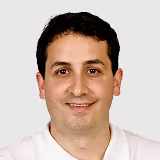
Marcel Kloos
Swiss-licensed dentist and founder of Medschool Experts
Marcel Kloos founded Medschool Experts while studying abroad; since then, over 500 study places have been secured. The Stuttgart-born dentist studied dentistry from 2015 to 2021 in Sofia and holds a Swiss dental licence.
Today he lives in Bern and runs Medschool Experts full-time as its owner.
More articles worth reading
Why Students Transfer from Medical University of Varna — Your Options
Why Students Transfer from Medical University of Warsaw — Your Options
Why Students Transfer from Masaryk University Faculty of Medicine — Your Options
Ahmad
Sabrina
Rami
Noah
500+ students placed.
Now it's your turn!
No daydreaming, no empty promises. Just a clear plan — for the start of your medical degree.
40 minutes, no obligation