Admissions Calculator: What Are Your Chances of Getting a Place?
11.09.2026

How are medical school places allocated in Germany?
Medicine, dentistry, veterinary medicine, and pharmacy are the four degree programmes with nationwide admission restrictions. All four run through hochschulstart, and all four follow the same model.
First, up to 20 percent of places go into preliminary quotas: hardship, second degree, international applicants, military medical officers, and the rural doctor and public health service quotas of the individual states. What remains is then distributed across the three main quotas.
| Quota | Share | Who decides | What counts |
|---|---|---|---|
| Top-grade quota (Abiturbestenquote) | 30 percent | hochschulstart | exclusively the score on the higher education entrance qualification |
| Additional aptitude quota | 10 percent | the university | test, vocational training, employment, service, prizes — the Abitur grade is excluded |
| University selection process | 60 percent | the university | Abitur grade plus at least one grade-independent criterion, two in medicine |
The crucial point: you are automatically placed in all three rankings. Someone with no chance in the top-grade quota can still get a place through the aptitude quota — because there, the grade doesn't matter at all. That's exactly why the Admissions Calculator calculates each quota separately and only combines them at the end.
Why does the state where you took your Abitur determine your cutoff?
In the top-grade quota, you don't compete nationally — only against applicants from the state where you obtained your higher education entrance qualification. The places are distributed across the 16 state quotas, one third according to the share of applicants and two thirds according to the share of 18- to under-21-year-olds.
The result is a difference that many underestimate. Using Freiburg in winter semester 2025/26 as an example:
| State of higher education qualification | Cutoff for Freiburg | Equivalent grade |
|---|---|---|
| Hesse | 854 points | 1.0 |
| Saarland | 853 points | 1.0 |
| North Rhine-Westphalia | 844 points | 1.0 |
| Baden-Württemberg | 840 points | 1.0 |
| Bavaria | 825 points | 1.1 |
| Schleswig-Holstein | 823 points | 1.1 |
Between Hesse and Schleswig-Holstein, there's a difference of 31 points. The same performance qualifies in one state but not in another. That's why the state is its own input field in the calculator, not a footnote.
Why is the point score more important than the Abitur grade?
The rankings don't use the rounded grade, but the point score on the 900-point scale. The conversion is simple: Points = 1020 − 180 × Grade. A 1.3 is 786 points, a 1.8 is 696 points.
At 840 points, the certificate shows a 1.0 — and beyond that, the grade doesn't get better, but the point score does. Someone with a 1.0 can be anywhere between 840 and 900 points. It's within exactly these 60 points that the entire top-grade quota is decided, because the cutoffs at the most sought-after institutions fall right in this range: Heidelberg was between 862 and 878 points depending on the state in winter semester 2025/26, Münster at 872.
If you know your point score, set the lower slider directly to it in the calculator. The result will be noticeably more accurate than using the grade.
What counts in the additional aptitude quota if the grade doesn't count?
The additional aptitude quota is the only quota where the certificate is legally not allowed to be considered at all. Neither the overall grade nor individual subjects. Only grade-independent criteria are permitted:
- a subject-specific aptitude test — TMS, HAM-Nat, or for pharmacy the PhaST
- completed vocational training or relevant professional experience
- service and voluntary engagement
- extracurricular achievements, such as prizes in science competitions
- results from selection interviews
At several institutions, this quota is practically a pure test ranking. Bochum, Bonn, Cologne, Düsseldorf, Bielefeld, Rostock, and Greifswald evaluate their first aptitude quota based 100 percent on the TMS. In Münster, 90 percent test weighting applies — the cutoff was most recently 76.5 out of 100 points, roughly equivalent to a standard score of 121. Without a test result, this quota is closed to you; with an excellent test result, it's the fastest route to a place.
How much does one more TMS point add?
The TMS doesn't produce a raw score but a standard score. 100 is the average of all participants, and the spread is 10. Almost all universities use the same formula to convert it into points:
Points = Weight × (Standard score − 70) ÷ 60
Below 70 you get zero points; from 130 onward you get the full amount. A standard score of 100 thus yields exactly half the weighting. What this means specifically when a university weights the test at 40 out of 100 points:
| Standard score | Percentile rank | Points at 40 percent test weighting |
|---|---|---|
| 90 | 16 | 13.3 |
| 100 | 50 | 20.0 |
| 110 | 84 | 26.7 |
| 120 | 98 | 33.3 |
| 130 | 99.9 | 40.0 |
Ten standard score points are worth 6.7 process points here. By comparison: to gain the same 6.7 points through the grade, with an Abitur weighting of 55 percent, you would need to be roughly 73 points better on the 900-point scale — that's four tenths of a grade. The test is by far the most flexible lever in the entire process.
Two institutions calculate more harshly. Heidelberg and Mannheim only credit what's above average: (Standard score − 100) ÷ 30. A result of 100 earns zero points there; only from 105 onward does it become interesting. And the weightings themselves vary widely: Augsburg decides one of its sub-quotas 100 percent by TMS, the Charité weights it at 60 percent in the selection process with the Abitur grade at only 20, while Erlangen-Nürnberg stays at 35 percent test weighting.
Important for your planning: the last regular TMS runs in November 2026, the last HAM-Nat in September 2026. From spring 2027, there will be the TMSnat, a fusion of both tests — but repeatable without limit.
{{cta}}
What other criteria earn points besides the grade and test?
Four things appear in almost every admissions statute, and they're worth more than most people assume:
- Completed vocational training in healthcare. The strongest additional lever. At the Charité, LMU Munich, and Erlangen-Nürnberg, that's 40 percent of total points in the aptitude quota; at Freiburg, 24 out of 100. Recognised fields include nursing, paramedics, medical-technical assistant, medical assistant, midwifery, physiotherapy, occupational therapy, speech therapy, and operating theatre assistant.
- Professional experience of at least one year in the trained profession, usually creditable in addition to training.
- Service of at least eleven completed months: FSJ, FÖJ, voluntary service, or voluntary military service. Heidelberg accepts more than six months. Volunteer work with fire services, DLRG, Malteser, ASB, or THW counts at many institutions from two years onward.
- Prizes at the national level of Jugend forscht or in the selection competition for an international olympiad in biology, chemistry, physics, computer science, or mathematics.
In the calculator, you set these four items as checkboxes. Someone with vocational training can immediately see how strongly — especially the aptitude quota — shifts in their favour.
How do dentistry, veterinary medicine, and pharmacy differ?
The quota model is identical in all four degree programmes. The differences lie elsewhere.
Dentistry is the toughest of the four, because roughly seven applicants compete for each place. Hamburg additionally uses the HAM-Man, a manual dexterity test that counts for 30 percent there.
Veterinary medicine is available at five institutions — Berlin, Giessen, Hanover, Leipzig, and Munich — and exclusively for the winter semester. All five use the TMS. Some states have additionally introduced a rural veterinarian quota for livestock medicine.
Pharmacy has a nationwide NC, but significantly more relaxed cutoffs. Instead of the TMS, the PhaST — the Pharmaceutical Study Aptitude Test — is used at around 20 institutions, weighted at 20 to 40 percent in the selection process and 30 to 100 percent in the aptitude quota. While Heidelberg also requires a 1.0 in pharmacy, the Saarland, Tübingen, and Regensburg most recently had cutoffs above 2.4.
How many applicants compete for one study place?
The figures from the Federal Statistical Office for winter semester 2025/26 show what it's actually about:
| Degree programme | Applicants | First-year students | Applicants per place |
|---|---|---|---|
| Medicine | 31,543 | 10,352 | 3.0 |
| Dentistry | 10,881 | 1,542 | 7.1 |
| Veterinary medicine | 5,216 | 1,159 | 4.5 |
| Pharmacy | 5,640 | 1,853 | 3.0 |
In medicine, statistically one in three gets a place; in dentistry, one in seven. Two thirds and six sevenths of applicants go empty-handed — year after year, regardless of how qualified they are.
What does the Admissions Calculator actually calculate?
You enter your degree programme, state, Abitur grade or point score, test result, and additional criteria. From this, three things emerge:
- an overall chance in percent with a clear classification from "very good chance" to "very low chance"
- the breakdown across the three quotas, including your process grade and your aptitude score on a 100-point scale
- a table with every individual institution — 42 in medicine, 29 in dentistry, five in veterinary medicine, 22 in pharmacy — each with the cutoff for your state and three separate chance values
Additionally, the calculator works backwards: it tells you what standard score you would need in the TMS to reach 50 or 80 percent. Anyone who took their Abitur in one of the eleven states with a rural doctor quota also receives a note about this preliminary quota — there, the grade counts for little; instead, the test, professional experience, and an interview matter, in exchange for a ten-year commitment to rural general practice. What that means over an entire career is discussed in the article on the rural doctor quota's commitment period.
The data basis is the selection cutoffs from hochschulstart, the published weightings of individual universities, and the applicant figures from the Federal Statistical Office. Where a university has not published its weighting, a standard profile is used; where hochschulstart does not provide an individual value for a state, the cutoff is derived from the published range and marked in the table.
What are the deadlines and how many study locations can you list?
For the winter semester, the deadline is 15 July; for the summer semester, 15 January. Those who obtained their Abitur before 16 January are considered prior-year applicants and must apply for the winter semester by 31 May. Documents must also be submitted by post.
A common misconception concerns location preferences: the six-location limit comes from the ZVS system before 2020 and no longer applies. For the four nationally restricted degree programmes, you can apply to as many institutions as you like. The order you specify only determines which offer you accept on the deadline date — it doesn't improve your chances. Some universities do, however, require a high location preference for certain sub-quotas.
If places remain unfilled, a coordinated waiting list follows with its own three-day registration window — you must actively register for this. All deadlines and process steps in detail are covered in our article on medical school place allocation.
What to do when the calculator shows a low chance?
A low number is not a statement about your suitability. It's a statement about a process in which 21,000 applicants per year fail at a capacity limit.
There are three ways out of this. The first is a test result — the calculator shows you what standard score would be needed. The second is vocational training in healthcare, which carries up to 40 percent of points in the aptitude quota but takes two to three years. The third is studying abroad in Europe: universities without a numerus clausus, with a degree automatically recognised in Germany and Switzerland, without waiting semesters and without TMS. Which institutions those are and what they cost is covered in our overview of studying medicine abroad without an NC.
Anyone investing money in tutoring, test preparation, a gap year, or a private school in order to shave another tenth off their grade should run the numbers: six years of tuition at an NC-free institution in Europe starts at around 21,000 euros. That's less than one year at many German boarding schools — and it leads reliably to graduation, rather than shifting the chance of a place by a few percentage points.
The author’s view
In 2015, I stood before this same calculation. My certificate wouldn't have qualified in any state quota, so I went to Sofia, studied dentistry from 2015 to 2021, and am today a Swiss-licensed dentist. What I lacked at the time was exactly what this calculator now does: an honest number, before losing a year.
What I see repeatedly in consultations: most people overestimate the top-grade quota and underestimate the test. Someone with a 1.4 who doesn't take the TMS is effectively only applying for 30 percent of places — and has no chance there. The same person with a standard score of 115 is suddenly competing for 100 percent of places and has realistic prospects at several institutions. That's the single biggest lever that exists, and it costs 100 euros in registration fees.
The second point where I often push back: waiting. Waiting semesters have counted for nothing since 2020. Someone who lets a year pass without taking a test or doing vocational training during that time has exactly the same chance afterwards as before — just a year later. I've seen applicants lose four years this way.
And third: a low percentage in this calculator says nothing about your suitability as a doctor or dentist. It says something about the number of study places in Germany. Anyone who genuinely wants to study medicine should take a parallel look at what a study place in Europe means — same degree, automatic recognition, starting in the same year. I took this path myself and would take it again.
Summary
- Four degree programmes run through hochschulstart: medicine, dentistry, veterinary medicine, and pharmacy — all following the same quota model.
- After the preliminary quotas, 30 percent go into the top-grade quota, 10 percent into the additional aptitude quota, and 60 percent into the university selection process. You are automatically placed in all three rankings.
- In the top-grade quota, the point score on the 900-point scale counts, not the rounded grade. What matters is the state where you took your Abitur — between Hesse and Schleswig-Holstein, there can be up to 31 points' difference.
- In the additional aptitude quota, the Abitur grade is legally excluded. At seven institutions, the TMS alone decides there.
- Ten standard score points in the TMS are worth roughly four tenths of a grade. The last regular TMS runs in November 2026; from spring 2027, the TMSnat follows.
- Completed vocational training in healthcare carries up to 40 percent of points in the aptitude quota at several universities.
- Waiting semesters have counted for nothing since 2020. Location preferences are no longer limited to six — apply to all institutions.
- In medicine, statistically one in three gets a place; in dentistry, one in seven. Those who don't get one have a second path with an NC-free university in Europe — same degree, automatic recognition, starting in the same year, recognised in Germany and Switzerland.
The Admissions Calculator doesn't replace an application or advice. It simply removes the uncertainty about where you stand — and shows you which lever can still actually move. If a low number appears at the end, that's not a verdict on you, but on an allocation system with too few places.
If you want to know what your path might actually look like — with or without a German study place — book a free consultation. We'll go through your numbers together, with no obligation.
Further reading
- Medical school place allocation: Quotas, deadlines, and TMS overview
- TMS 2026: Structure, scoring, and the transition to TMSnat
- Rural doctor quota: 21 years of commitment — the cost comparison with studying abroad
- Studying medicine abroad without an NC: Institutions, costs, financing
- Studying medicine with a vocational Abitur and without a top grade
Frequently asked questions about the Admissions Calculator and medical school place allocation
Is the Admissions Calculator free?
Yes. The Admissions Calculator is freely accessible, without registration or sign-up. No data is stored; the calculation runs entirely in your browser.
How accurate is the result?
The calculator uses the selection cutoffs that hochschulstart publishes after each round. These cutoffs fluctuate from semester to semester because the applicant pool changes every year. The result is therefore a reliable orientation, not a guarantee. Anyone who is close to a threshold should apply in any case.
What's the difference between the Abitur grade and the point score?
The grade is the rounded value on the certificate; the point score is the precise value on the 900-point scale. The top-grade quota rankings use the point score. 840 points equal a 1.0 — so someone with a 1.0 can be anywhere between 840 and 900 points, and it's precisely there that the quota is decided.
Do waiting semesters still count?
No. The waiting time quota was abolished with the 2020 reform. Waiting today doesn't improve your chances. The time is only worthwhile if you use it for an aptitude test, vocational training, or service — these three count in the aptitude quota and in the university selection process.
Do I absolutely need the TMS?
Not for the top-grade quota — there, only the certificate counts. But practically yes for the other 70 percent of places: in the additional aptitude quota, the Abitur grade is excluded; and in the university selection process, a subject-specific aptitude test must be considered under the state treaty. Anyone below 1.2 can barely advance without a test result.
How often can I take the TMS?
Since 2022, a repeat is possible — so a maximum of two sittings. The registration for the repeat must occur within one year of the first sitting. Both results remain valid; you may choose the better one. The successor TMSnat from spring 2027 is repeatable without limit.
Can I improve my chance by switching states?
What matters is the state where you obtained your higher education entrance qualification, not your place of residence. Moving after your Abitur changes nothing. Those who obtained their qualification abroad are assigned to a state quota by lot.
Does pharmacy really have a nationwide NC?
Yes. Pharmacy, like medicine, dentistry, and veterinary medicine, is allocated through hochschulstart and distributed according to the same quota model. The cutoffs, however, are considerably lower and range from 1.0 to above 2.4 depending on the institution.
Is veterinary medicine also available in the summer semester?
No, veterinary medicine starts exclusively in the winter semester. Medicine, dentistry, and pharmacy are available at some institutions in the summer semester as well.
How many study locations should I list?
As many as possible. The number of location preferences is not limited for the four nationally restricted degree programmes, and additional preferences cost you nothing. The order only determines which offer you accept on the deadline date.
What does the rural doctor quota offer?
It's a preliminary quota in eleven states where the Abitur grade counts little or not at all — Baden-Württemberg weights the TMS at 60 percent, Bavaria at 50. In exchange, you commit to ten years of rural general practice in an underserved region after specialist training, backed by a penalty of up to 250,000 euros. The application doesn't go through hochschulstart, but through a state authority with its own deadline in spring.
When does looking abroad make sense?
As soon as the calculator shows no realistic chance across multiple semesters and you neither have a test result nor want to complete vocational training. A study place at an NC-free university in Europe is available in the same year, the degree is automatically recognised in Germany and Switzerland. In a free consultation, we'll go through your numbers together.
What students say about Medschool Experts
Over 500 placements at more than 25 partner universities across 10+ countries. Read independent student reviews on Trustpilot.
About the author
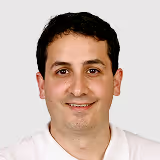
Marcel Kloos
Swiss-licensed dentist and founder of Medschool Experts
Marcel Kloos founded Medschool Experts while studying abroad; since then, over 500 study places have been secured. The Stuttgart-born dentist studied dentistry from 2015 to 2021 in Sofia and holds a Swiss dental licence.
Today he lives in Bern and runs Medschool Experts full-time as its owner.
More articles worth reading
Why Students Transfer from Medical University of Varna — Your Options
Why Students Transfer from Medical University of Warsaw — Your Options
Why Students Transfer from Masaryk University Faculty of Medicine — Your Options

Ahmad

Sabrina
Rami

Noah
500+ students placed.
Now it's your turn!
No daydreaming, no empty promises. Just a clear plan — for the start of your medical degree.
40 minutes, no obligation