Clinical Placement in Bali: Medical Internship at Wangaya University Hospital
11.09.2026

Why a clinical placement in Bali?
Bali sounds like a holiday, and the part after work is exactly that. Medically, however, the island is anything but a holiday backdrop. With around a million inhabitants in its metropolitan area, Denpasar is the medical centre of the region, and a public teaching hospital such as Wangaya treats precisely the patient groups you rarely see in that concentration at a German university hospital.
Three things set this placement apart from a placement in Germany:
- Clinical presentations you otherwise know only from textbooks. Dengue fever, typhoid, tuberculosis, parasitic infections and advanced courses of diseases that are picked up early at home.
- Medicine with limited resources. Seeing diagnoses made without an MRI on demand and without unlimited laboratory capacity sharpens your history taking and clinical examination faster than any course.
- Hands-on rather than watching. Integration into the team is more direct in many departments than at a German hospital with a fully staffed junior doctor roster.
In short: two weeks to six months of clinical placement or internship at an Indonesian university hospital. We handle all the paperwork, including the letter of acceptance, the C9 visa and the signatures of the dean, the hospital director and the hospital registrar, and provide a supervisor you can reach at any time.
The hospital: Wangaya in Denpasar
Wangaya Regional General Hospital is centrally located in Denpasar and is affiliated as a teaching hospital with Udayana University, the largest and most respected university in Bali. As a placement student you rotate, depending on your preference and availability, through departments such as internal medicine, surgery, obstetrics and gynaecology, paediatrics, the emergency department or anaesthesia.
Depending on capacity and timing, the placement may also take place at one of the following hospitals: Sanjiani Hospital, Mangusada Hospital or Bali Mandara Hospital. All are in the greater Denpasar area and work to a comparable standard.
Language in daily clinical work
The technical language in training is English, while communication with patients is in Indonesian or Balinese. That is exactly what the supervisor is there for: they translate, provide context and make sure you are not left standing by as a silent observer. Solid school-level English is enough.
What the package includes
The biggest effort in a placement in Southeast Asia is not the medicine but the bureaucracy. That is precisely what we take off your hands:
- arranging the placement at the hospital
- the signature of the dean of the faculty of medicine
- the signature of the hospital director
- submission to and signature of the hospital registrar
- letter of acceptance (LoA): application and full processing
- C9 visa including all visa fees
- residence permit and all associated processes
- hospital placement fee
- return flights
- airport pick-up in Bali
- accommodation for the whole placement
- a personal supervisor on site, reachable at any time
So you are not booking a placement fee plus ten additional costs, but a complete package, and at the end you simply board the plane.
{{cta}}
Duration: from two weeks to six months
You choose the length of the placement yourself. Periods of 2 weeks, 3 weeks, 6 weeks and 8 weeks through to 3 or 6 months are possible.
The longer you stay, the cheaper the individual week becomes. Anyone who has to complete the placement anyway is almost always better off with the longer stay, because travel and settling in only happen once. Which period fits your semester plan and what it specifically costs is something we discuss personally.
Free consultation on the clinical placement in Bali: tell us your preferred dates and preferred department, and we will check availability at Wangaya Hospital and come back to you with all the details. Book your free consultation.
Is the placement recognised in Germany?
Placements abroad are in principle creditable under the German Medical Licensing Regulations (Approbationsordnung für Ärzte). Three points are decisive: the placement must take place in a hospital or medical practice, be carried out under medical supervision, and serve patient care. The final decision on recognition rests with your responsible state examination office, or in Switzerland with the relevant faculty.
In practice that means: clarify recognition with your state examination office or dean of studies before booking, and have them confirm in writing what the certificate has to state. We issue you with the corresponding hospital documentation at the end of the placement, including department, period, number of hours and the signature of the supervising doctor.
Life in Bali during the placement
Denpasar is loud, warm and crowded, and 30 minutes later you are on a beach or in the rice terraces of Ubud. Living costs are considerably below German levels: a meal in a local warung costs a few euros, and a scooter is the usual means of transport. On climate, expect 27 to 32 °C year-round and high humidity; the rainy season runs roughly from November to March, which does not prevent a hospital placement.
What you should organise yourself: international health insurance with repatriation cover, the recommended vaccinations (travel medicine advice, frequently hepatitis A and B, typhoid, and depending on the length of stay rabies as well), and professional liability insurance if your faculty requires it.
Who is the placement suitable for?
- Medical students in the preclinical and clinical years who are completing their compulsory placement and want to see something other than the hospital around the corner.
- Students abroad (the Balkans, Bulgaria, Hungary, Poland) who need additional clinical practice and an international reference for their CV.
- Future doctors with an interest in tropical and travel medicine or in global health.
- Dentistry and Physician Assistant students on request; here we arrange the department individually.
The author’s view
During my own training I saw how differently medicine works as soon as you leave the central European standard behind. Nothing changed my clinical thinking as much as having to make a diagnosis without a machine making it for me. That is exactly why I recommend this placement: it is not a holiday in a white coat but concentrated learning on cases you barely get to see in Germany, with the side effect that your evenings are spent in Bali. If you are torn between „somewhere in my home town“ and „taking a chance for once“: take the longer option. Two weeks are over before you have understood how things work.
Frequently Asked Questions
Do I have to speak Indonesian?
No. The technical language is English, and your supervisor is there for communication with patients. A few polite phrases in Bahasa Indonesia still open doors.
When should I sign up?
The visa, letter of acceptance and chain of signatures need lead time. Allow at least two to three months before your preferred start date, and rather more in the popular semester holiday months.
Can I choose the department?
You tell us your preferred department and we check availability for the period you want. In most cases the request can be met, and sometimes a rotation across several departments as well.
Can I extend?
Yes, provided hospital capacity and your visa status allow it. Speak to us as early as possible so that we can apply for the extension properly.
Do I get a certificate?
You receive a hospital certificate stating the period, department and scope, signed by the supervising doctor, which is the basis for recognition by your state examination office.
Is the placement also possible for students from Switzerland and Austria?
Yes. The organisation is identical; you simply clarify recognition with your faculty or the responsible body in your country.
Summary
A clinical placement in Bali is not a compromise between travelling and learning but both at once: a university hospital with a case mix that advances you professionally, and an island that fills the rest of the day. Because we organise the placement, visa, accommodation, flights and supervision as a package, only one decision is left to you: when do you want to go?
- The clinical placement in Bali takes place at Wangaya University Hospital in Denpasar, the teaching hospital of Udayana University.
- Placement periods from two weeks to six months are possible, including in internal medicine, surgery, obstetrics and gynaecology, paediatrics, the emergency department or anaesthesia.
- The package covers the placement itself, the letter of acceptance, the C9 visa, the residence permit, the hospital fee, return flights, airport pick-up, accommodation and an on-site supervisor.
- The technical language in training is English, while communication with patients is in Indonesian or Balinese and is translated by the supervisor.
- In Germany, the responsible state examination office decides on credit for a placement abroad; in Switzerland the relevant faculty does.
- Students arrange international health insurance with repatriation cover, the recommended vaccinations and, where required, professional liability insurance themselves.
Genuine reviews on Trustpilot
More than 500 students placed. Read what our clients write about working with Medschool Experts: see all reviews on Trustpilot.
Further reading
- Studying medicine and dentistry in Varna (Bulgaria) – an EU degree on the Black Sea, ideal if you want to combine studying and placements abroad.
- Studying medicine and dentistry in Foča (University of East Sarajevo) – the most affordable open-admission route into medicine in Europe.
- Studying medicine without a numerus clausus: the location comparison – all locations compared directly on cost, recognition and admission.
- Studying medicine without the Abitur: from nurse to a study place – how to get started without the classic numerus clausus route.
- Compulsory deregistration during a medical degree – what you can do when the route in Germany seems to have ended.
What students say about Medschool Experts
Over 500 placements at more than 25 partner universities across 10+ countries. Read independent student reviews on Trustpilot.
About the author
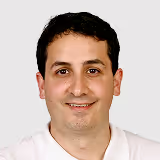
Marcel Kloos
Swiss-licensed dentist and founder of Medschool Experts
Marcel Kloos founded Medschool Experts while studying abroad; since then, over 500 study places have been secured. The Stuttgart-born dentist studied dentistry from 2015 to 2021 in Sofia and holds a Swiss dental licence.
Today he lives in Bern and runs Medschool Experts full-time as its owner.
More articles worth reading
Why Students Transfer from Medical University of Varna — Your Options
Why Students Transfer from Medical University of Warsaw — Your Options
Why Students Transfer from Masaryk University Faculty of Medicine — Your Options
Ahmad
Sabrina
Rami
Noah
500+ students placed.
Now it's your turn!
No daydreaming, no empty promises. Just a clear plan — for the start of your medical degree.
40 minutes, no obligation