Medical University of Lusatia Cottbus Launches in 2026 with 36 Places
17.09.2026

How many study places does the Medical University of Lusatia have in 2026?
The Medical University of Lusatia – Carl Thiem in Cottbus starts the 2026/27 winter semester with 36 first-year students in human medicine. By 2035 the number is to rise to around 165 a year; when fully built up, the Brandenburg state government gives 200 study places and 80 professorships. Set-up costs to 2038 come to around EUR 3.7 billion.
| Indicator | Value | Point in time |
|---|---|---|
| First-year students in the first cohort | 36 | 2026/27 winter semester |
| First-year students per year | around 165 | by 2035 |
| First-year students per year, target | 200 | fully built up |
| Professorships | 80 | fully built up |
| Additional posts in research and teaching | around 1,300 | by 2035 |
| Total set-up costs | around EUR 3.7 billion | by 2038 |
Source: press release 62/2025 of the Brandenburg Ministry of Finance and for Europe of 20 November 2025, together with information from the Medical University of Lusatia, as of August 2026.
Medschool Experts's own calculation: on 31 December 2025 Brandenburg had exactly 2,551,889 inhabitants (Berlin-Brandenburg Statistical Office, press release of 22 June 2026). The 36 starting places therefore correspond to 1.4 state medical study places per 100,000 inhabitants, and the 200 places when fully built up to 7.8. The nationwide comparison figure is around 12.2 places per 100,000 inhabitants. Adding the 96 places at the private Brandenburg Medical School Theodor Fontane, Brandenburg reaches around 11.6 when fully built up, and therefore almost the national figure.
This calculation shows the order of magnitude without varnish. With Cottbus, Brandenburg is making up a structural deficit it carried as the only large territorial state without its own state university medicine. The road there runs to 2035.
When I tell prospective students about Cottbus, the same hope often comes up: a brand-new location, barely anyone knows it, so less competition. That hope is misplaced. Allocation runs through hochschulstart and therefore from the same nationwide pool as every other state faculty. A new location is not an insider tip, only another entry on the same list.
What is being created in Cottbus, and who runs it?
The Medical University of Lusatia – Carl Thiem was founded on 1 July 2024. The legal basis is the Brandenburg University Medicine Act, which the Brandenburg state parliament passed in June 2024. On the same date, the Carl Thiem Hospital in Cottbus passed from municipal to state ownership and became Brandenburg's first state university hospital.
According to the science ministry in Potsdam, research, teaching and patient care sit within a single legal and organisational unit under joint management. The founding executive board is led by Eckhard Nagel, who is also responsible for patient care. On the academic side, the gerontologist and health services researcher Adelheid Kuhlmey, previously vice-dean at the Charité in Berlin, is responsible for building the institution. The campus lies on Thiemstrasse in the middle of Cottbus and will expand step by step over the coming years.
The road to the institution in fast forward
Preparation took longer than construction. The milestones, according to the Brandenburg science ministry and the institution itself:
- 2019: Brandenburg's governing parties agree on a Lusatia health model region.
- September 2020: Science Minister Manja Schüle appoints an expert commission chaired by Karl Max Einhäupl, the former chairman of the Charité's executive board.
- June 2021: the commission presents its recommendations.
- November 2022: regional health stakeholders sign a memorandum.
- March 2023: the concept goes to the German Science and Humanities Council for assessment.
- 22 April 2024: the Science and Humanities Council presents its opinion (Drs. 1873-24) and recommends starting teaching by the end of 2026.
- June 2024: the state parliament passes the University Medicine Act.
- 1 July 2024: the Medical University of Lusatia – Carl Thiem is founded.
- 20 November 2025: the supervisory board confirms that the criteria for starting teaching in autumn 2026 have been met.
Seven years pass between the first political agreement in 2019 and the first enrolment in 2026. From formal foundation to the first semester it is 27 months. Both figures describe the same process and lead to very different headlines.
What is different about the Cottbus model programme?
The Medical University of Lusatia starts with a model degree programme rather than a classically divided standard programme. According to the state government, the curriculum interlocks scientific fundamentals, clinical theory and clinical practice throughout. Learning is case-based and contact with patients comes early. The thematic priorities are the digitalisation of healthcare and health systems research.
Curricula of this kind are made possible by the model clause in the German medical licensing regulations. One point is frequently misrepresented here: the comprehensive reform of those regulations that has been discussed for years is not in force. The ÄApprO 2002 in its 2023 version still applies. Anyone who reads today that medical education has already been reformed should check the date of the source.
Is there a rural doctor quota in Cottbus?
No, not at the start. The Medical University of Lusatia admits its first cohort in the 2026/27 winter semester without a rural doctor quota. On 10 December 2025 the Deutsches Ärzteblatt reported that the state government is preparing a Brandenburg Rural Doctors Act to reserve ten per cent of study places for later work as a GP in underserved regions.
A closer look is worthwhile here, because the sources appear at first sight to diverge. On its own application page, the Medical University of Lusatia names a rural doctor quota whose details are in preparation. The Deutsches Ärzteblatt, by contrast, wrote in December 2025 that the start would take place without this quota. Both are correct, and the reason is procedural: advance quotas have to precede the regular allocation procedure in time. The state government explained the postponement by saying that there was not enough lead time. The act is coming; the quota simply takes effect later. Anyone applying for the 2026/27 winter semester therefore cannot count on it.
How do you apply to the Medical University of Lusatia?
Applications for human medicine at the Medical University of Lusatia run, as at every state faculty in Germany, through hochschulstart.de. The application deadline for the winter semester is 31 May if the higher-education entrance qualification was obtained before 16 January, otherwise 15 July. For the summer semester the date is 15 January.
The institution stresses that personal strengths, professional experience and social involvement count alongside school results. Specifically it names the top-grades quota, the universities' own selection procedures with aptitude tests such as the Test for Medical Degree Programmes, the consideration of completed vocational qualifications and practical prior experience, and a second-degree quota of three per cent. Applicants without EU or EEA citizenship apply through uni-assist.
Who is financing the build-up of university medicine in Lusatia?
The federal government and the state are financing the build-up of the Medical University of Lusatia jointly. Of around EUR 3.7 billion in set-up costs to 2038, the federal government is contributing more than EUR 1.85 billion from the Coal Regions Structural Strengthening Act, according to the Brandenburg finance ministry on 20 November 2025. The Deutsches Ärzteblatt puts the state's share at EUR 1.8 billion.
In December 2025 the Brandenburg cabinet approved a grant agreement with an investment budget of up to EUR 821 million for the construction projects. What remains open is how ongoing operating finance will look from the mid-2030s, when the structural funds run out. That question will then rest with the state. It is not a peculiarity of Lusatia but a typical constellation for new institutions initially financed from time-limited programmes.
Medschool Experts's own calculation: spreading the EUR 3.7 billion purely arithmetically across the 200 first-year places of the fully built-up institution gives EUR 18.5 million per place. As the price of a study place that figure is useless, because the sum also finances a university hospital, research buildings and around 1,300 posts. But it does make it comprehensible why no federal state can scale up medical capacity at short notice.
How long does it take to build a medical faculty in Germany?
Among the most recent German foundations, seven to ten years typically pass between the political decision and the first enrolment. The frequently cited Cottbus record refers solely to the phase between formal foundation and the first semester, that is to 27 months. A look at comparable locations puts that in context.
| Location | Key preliminary stage | First cohort | Places at the start |
|---|---|---|---|
| Augsburg | Application to the Science and Humanities Council October 2015, recommendation July 2016, faculty founded November 2016 | 2019/20 winter semester | 84, target 252 |
| Bielefeld | Built up without its own university hospital, within the East Westphalia-Lippe hospital network | 2021/22 winter semester | incremental, target up to 300 |
| Oldenburg | European Medical School jointly with the University of Groningen | 2012/13 winter semester | 40, target 200 from 2026 |
| Cottbus | Expert commission from September 2020, Science and Humanities Council April 2024, foundation July 2024 | 2026/27 winter semester | 36, target 165 by 2035 |
Two patterns become visible. New faculties practically never start at full capacity, because staff, teaching buildings, anatomy facilities and academic teaching hospitals have to grow in parallel. And the lead time is enormous: before the first Cottbus cohort holds a medical licence, at least six years and three months of standard study time pass from October 2026. The first specialists from that cohort will be working in the 2040s.
What do 36 places mean for the nationwide capacity bottleneck?
Nationwide in the 2024/25 winter semester, according to the analysis by the Centre for Higher Education Development, around 10,219 medical study places awarded through hochschulstart faced 32,966 applications. The 36 Cottbus places correspond to around 0.35 per cent of that capacity, and the target of 200 places to just under two per cent. In the 2015/16 winter semester there were 9,068 places.
Over nine years, centrally allocated capacity has therefore grown by a good 1,000 places. Including private institutions, the German Medical Faculty Association reckons with around 12,000 first-year students in human medicine a year and puts the total number of medical students at more than 105,000, the highest in the Federal Republic's history. At the same time the association points out that, according to 2019 calculations, a study place in human medicine costs an average of around EUR 240,000, and argues for quality and curriculum development rather than additional places alone.
Medschool Experts's own calculation: the private Brandenburg Medical School Theodor Fontane in Neuruppin trains 96 human medicine students a year by its own account, and records around 700 applications. That is 7.3 applications per place, more than twice the nationwide figure of 3.23 in the central procedure. Expanding capacity lowers that ratio; it does not reverse it.
That is precisely why the route to other European countries remains the faster option for many prospective students. For the 2023/24 winter semester the Centre for Higher Education Development counted at least 8,821 German students of human medicine at foreign institutions, against 103,176 German human medicine students at home. Around one in eleven German medical students is therefore enrolled abroad. The most important destination countries are Austria with 2,563, Hungary with 1,930, Bulgaria with 1,131 and Switzerland with 802 students. About half study on regular national programmes, the other half on purpose-built international programmes.
Which route fits in an individual case – waiting for a place in Germany, preparing for the Test for Medical Degree Programmes, the rural doctor quota or starting a degree elsewhere in the EU – can only be judged individually. At Medschool Experts we have been supporting exactly this decision for years. Anyone who would like their starting position assessed can have a free consultation with us.
How are other countries expanding their medical capacity?
Germany is not the only country reassessing its capacity to train doctors. The answers differ widely: Germany founds new locations, the Netherlands fine-tunes existing faculties, England doubles capacity to a fixed timetable, and Poland and Hungary plan systematically for international students.
| Country | Steering instrument | Documented figures |
|---|---|---|
| Germany | State capacity law, central allocation through hochschulstart.de | around 10,219 places against 32,966 applications (2024/25 winter semester); 9,068 places in the 2015/16 winter semester |
| Netherlands | Numerus fixus per programme, capacity recommendations from the Capaciteitsorgaan | 2,724 bachelor's places in Geneeskunde at eight universities for 2026/27; recommendation of 3,015 places a year for 2027 to 2030 |
| United Kingdom | State-funded place quotas, NHS Long Term Workforce Plan | expansion from 7,500 to 10,000 places by 2028/29 and 15,000 by 2031/32 in England |
| Poland | Annual intake limits by ordinance of the health ministry | 10,705 places in human medicine for 2026/27, of which 1,838 are English-language |
| Hungary | Expansion of foreign-language programmes at the state medical universities | Semmelweis University 2025: just under 350 international graduates, 92 of them from German-language programmes |
Netherlands: fine-tuning instead of new foundations
The Netherlands works with a numerus fixus, that is a fixed number of places per programme and university. For the 2026/27 academic year the official overview from Studiekeuze123 gives a combined 2,724 bachelor's places across the eight medical faculties: Erasmus University Rotterdam and the University of Groningen with 400 each, AMC-UvA and Vrije Universiteit Amsterdam with 342 each, Radboud University with 322, Leiden University with 312, Maastricht University with 309 and Utrecht University with 297.
The target figure is recalculated regularly rather than fixed permanently. In its Capacity Plan for 2027 to 2030, published in December 2025, the Capaciteitsorgaan recommended an intake of 3,015 places a year; earlier recommendations were 2,850 in 2019 and 3,330 in 2022. How closely such recommendations are tied to the budget situation was shown by a reduction of 66 places announced by the cabinet, which the medical faculties initially did not implement, according to the university hospital association NFU. What remains notable: with eight faculties and around 17.9 million inhabitants, the Netherlands steers without new foundations, because it adjusts the numbers at existing locations.
United Kingdom: doubling as a programme
England is making the largest planned leap. The NHS Long Term Workforce Plan, presented in June 2023, provides for raising the number of medical study places from 7,500 to 10,000 by the 2028/29 academic year and to 15,000 by 2031/32. In parallel, dentistry places are to grow to 1,000 by 2028/29 and more than 1,100 by 2031/32, and GP training places to 6,000 a year. On top of that comes a new training route through medical degree apprenticeships, which began in 2024/25 with 200 pilot places and is to grow to 2,000 students by 2031/32. The plan is backed by additional funding of more than GBP 2.4 billion cumulatively over six years.
England is founding new faculties too. The Three Counties Medical School at the University of Worcester admitted its first cohort in 2023, received an initial 50 state-funded places from September 2024 in October 2023 and twelve more in May 2024, so that 62 fully funded places were available for 2025/26. For context: the House of Commons Library puts the number of medical study places across the whole of the United Kingdom at around 9,500 a year, roughly 2,000 more than in 2013.
Poland and Hungary: expansion through foreign-language programmes
Poland steers capacity annually by ordinance of the health ministry. For the 2026/27 academic year, 10,705 places in human medicine are provided for, after 10,504 in 2025/26, an increase of 1.91 per cent. Of these, 7,133 places are for full-time study in Polish, 1,734 for part-time study in Polish and 1,838 for English-language programmes. Together with dentistry, the quota comes to more than 12,200 places. Poland therefore trains, on paper, more first-year students in human medicine than Germany does through its central allocation, with around 37 million inhabitants.
Hungary has relied on foreign-language programmes for decades. In 2025, Semmelweis University in Budapest saw just under 350 international graduates: 255 from English-language programmes, among them 127 in human medicine, 49 in dentistry, 54 in the health sciences and 25 in pharmacy, plus 92 from German-language programmes, among them 74 in human medicine and 16 in dentistry. That structure explains why Hungary, with 1,930 German medical students, is the second most important destination country after Austria.
This article reflects the state of research as of 14 August 2026 and does not constitute legal advice. Admission rules, quotas and numbers of places may change; the applicable ordinances and university statutes are authoritative.
The author's view
I find the Cottbus start remarkable, and for a reason that gets lost in the headlines. A medical faculty is being created here because a region needs something: doctors, research, a prospect after the coal phase-out. That is an honest motivation, and those responsible in Brandenburg have achieved a great deal in a short time. Thirty-six students in the first cohort are not a marketing promise. That is a clean beginning.
At the same time I see the figures through the eyes of someone who talks to prospective students every day. Around 10,200 places, just under 33,000 applications. Thirty-six new places change nothing about that, and 200 when fully built up will not reverse the arithmetic either. That is not a criticism of Cottbus but a question of scale and time. Anyone taking their school-leaving exams in 2026 gains nothing from a faculty reaching full capacity in 2035.
I will name one uncomfortable point deliberately: the missing rural doctor quota at the start. Applicants with an average school-leaving grade and a genuine willingness to work in the countryside later would have benefited from it in particular. The act is coming, just not for the first cohort. Anyone who was counting on that quota for 2026 has to replan. Details like these often matter more in a consultation than the big billion-euro figure in the press release.
I studied in Sofia from 2015 to 2021 and am today a Swiss-licensed dentist; I run Medschool Experts from Bern. Back then studying abroad was a marginal topic for many; today around one in eleven German medical students is enrolled abroad. I do not regard that as a stopgap but as what the European education area ought to be. Recognition under the EU professional qualifications directive works, and the colleagues I have supported have long been practising in Germany, Austria and Switzerland.
My practical advice remains the same. Welcome every new capacity in Germany, and still plan along two tracks. Apply through hochschulstart, prepare seriously for the Test for Medical Degree Programmes, look into your federal state's rural doctor quota. And look in parallel at which European university suits you in terms of content and cost. Anyone who keeps both routes open loses no years and, in the end, decides from options rather than out of necessity.
Summary
- The Medical University of Lusatia – Carl Thiem in Cottbus starts the 2026/27 winter semester with 36 first-year students on a patient-centred model degree programme in human medicine.
- By 2035 the Medical University of Lusatia is to admit around 165 first-year students a year; when fully built up, 200 study places and 80 professorships are planned.
- By Medschool Experts's own calculation, the 36 starting places correspond to 1.4, and the 200 places when fully built up to 7.8, state medical study places per 100,000 inhabitants of Brandenburg; the national figure is around 12.2.
- The build-up costs around EUR 3.7 billion to 2038, of which more than EUR 1.85 billion comes from the federal government under the Coal Regions Structural Strengthening Act.
- There is no rural doctor quota in Cottbus at the start. A Brandenburg Rural Doctors Act covering ten per cent of places is in preparation.
- Nationwide in the 2024/25 winter semester, around 10,219 medical study places awarded through hochschulstart.de faced 32,966 applications.
The Medical University of Lusatia – Carl Thiem is Brandenburg's first state university medicine. Thirty-six students begin in October 2026, and by 2035 there are to be around 165 a year. The build-up costs around EUR 3.7 billion to 2038 and finances not only teaching but also a university hospital, research buildings and around 1,300 posts.
For Lusatia that is a strong signal. Nationwide, the ratio of around three applications per study place remains almost untouched by it, and the first specialists from the Cottbus starting cohort will not be working until the 2040s. Other countries scale faster because they expand existing faculties or plan international programmes in from the outset: England with its target of 15,000 places by 2031/32, Poland with 10,705 places for 2026/27, 1,838 of them English-language.
New locations in Germany are good news. They are no substitute for a personal strategy. Anyone who wants to know which route fits their own certificate and timetable can arrange a free consultation at any time.
Further reading
- Medical study places in the federal states in 2026 – who trains how many, with our own breakdown by faculty and population.
- The new building for university medicine in Oldenburg – the year's second major expansion announcement, compared.
- One in eleven German medical students is enrolled abroad – the current CHE figures and their destination countries.
- Studying medicine without an NC: the location comparison – which European universities train without a grade threshold.
- The German medical licence (Approbation) and recognition of an EU medical degree – how the route back to Germany is regulated.
Frequently Asked Questions about the Medical University of Lusatia in Cottbus
When does teaching begin at the Medical University of Lusatia?
Teaching at the Medical University of Lusatia – Carl Thiem begins in the 2026/27 winter semester, that is in October 2026. On 20 November 2025 the supervisory board confirmed that the conditions for starting were met.
How many study places are there in Cottbus?
The first cohort comprises 36 students. By 2035 the number of first-year students is to rise to around 165 a year. When fully built up, the Brandenburg state government gives 200 study places a year and 80 professorships.
How many medical study places does Brandenburg have per head of population?
On 31 December 2025 Brandenburg had exactly 2,551,889 inhabitants. By Medschool Experts's own calculation, the 36 starting places correspond to 1.4 and the 200 places when fully built up to 7.8 state medical study places per 100,000 inhabitants. The national figure is around 12.2.
Does MUL-CT have a rural doctor quota?
Not at the start in the 2026/27 winter semester. On 10 December 2025 the Deutsches Ärzteblatt reported that Brandenburg is preparing a Rural Doctors Act covering ten per cent of study places, but that there was not enough lead time for the advance quota. The institution therefore lists the quota as in preparation.
How do I apply to MUL-CT?
Applications run, as at every state medical faculty in Germany, through hochschulstart.de. Its deadlines apply: 31 May or 15 July for the winter semester and 15 January for the summer semester. Applicants without EU or EEA citizenship use uni-assist.
What selection criteria apply in Cottbus?
The Medical University of Lusatia names the top-grades quota, the universities' own selection procedures with aptitude tests such as the Test for Medical Degree Programmes, the consideration of completed vocational qualifications and practical prior experience, and a second-degree quota of three per cent.
What is a model degree programme?
In a model degree programme, scientific fundamentals, clinical theory and clinical practice are interlocked from the beginning rather than split into a separate preclinical and clinical phase. In Cottbus, case-based learning, early contact with patients and the priorities of digitalisation and health systems research are added.
Do the reformed medical licensing regulations already apply in Cottbus?
No. The much-discussed comprehensive reform of the German medical licensing regulations is not in force in August 2026. The ÄApprO 2002 in its 2023 version still applies. Model degree programmes are possible on the basis of the model clause it contains.
Who is financing the build-up of the university?
According to the state government, set-up costs to 2038 come to around EUR 3.7 billion. Of that, the federal government is contributing more than EUR 1.85 billion from the Coal Regions Structural Strengthening Act. In December 2025 the cabinet approved a grant agreement with an investment budget of up to EUR 821 million for construction projects.
How many medical study places are there in Germany in total?
Around 10,219 places were offered through hochschulstart.de in the 2024/25 winter semester, against 32,966 applications. Including private institutions, the German Medical Faculty Association arrives at around 12,000 first-year students in human medicine a year.
How many applications are there per medical study place?
In the central procedure there were around 3.23 applications per place in the 2024/25 winter semester. The private Brandenburg Medical School Theodor Fontane records around 700 applications for 96 places by its own account, which by Medschool Experts's own calculation is 7.3 applications per place.
How long does it take to build a new medical faculty?
Among the most recent German foundations, seven to ten years pass between the political decision and the first enrolment. In Cottbus, seven years lay between the political agreement in 2019 and the start of teaching in 2026, and 27 months between formal foundation in July 2024 and the first semester.
When will the first doctors trained in Cottbus be working?
The standard study period is six years and three months. The starting cohort of October 2026 will therefore receive its medical licence in early 2033 at the earliest. A further five to six years pass before specialist certification, so the first specialists from that cohort will be working in the 2040s.
How many study places do the Netherlands offer?
For the 2026/27 academic year the official overview from Studiekeuze123 gives a combined 2,724 bachelor's places in Geneeskunde across the eight Dutch medical faculties. In December 2025 the Capaciteitsorgaan recommended an intake of 3,015 places a year for 2027 to 2030.
How many German medical students study abroad?
For the 2023/24 winter semester, the Centre for Higher Education Development counted at least 8,821 German students of human medicine at foreign institutions. Against 103,176 German human medicine students at home, that is around one in eleven. The most important destination countries are Austria, Hungary, Bulgaria and Switzerland.
What students say about Medschool Experts
Over 500 placements at more than 25 partner universities across 10+ countries. Read independent student reviews on Trustpilot.
About the author
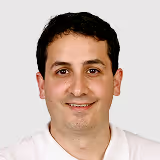
Marcel Kloos
Swiss-licensed dentist and founder of Medschool Experts
Marcel Kloos founded Medschool Experts while studying abroad; since then, over 500 study places have been secured. The Stuttgart-born dentist studied dentistry from 2015 to 2021 in Sofia and holds a Swiss dental licence.
Today he lives in Bern and runs Medschool Experts full-time as its owner.
More articles worth reading
Health Insurance for International Medical Students in Europe 2026
Scholarships and Funding for Medical Studies in Europe 2026
Medicine, Dentistry, Pharmacy or Veterinary Medicine? Choosing Your Degree Abroad in 2026
Ahmad
Sabrina
Rami
Noah
500+ students placed.
Now it's your turn!
No daydreaming, no empty promises. Just a clear plan — for the start of your medical degree.
40 minutes, no obligation