More Than Just Plan B: Why Studying Medicine Abroad Was the Best Decision for Many
17.09.2026

The degree counts across the whole EU
Anyone who wants to study dentistry in Germany needs excellent school-leaving grades or a great deal of patience. Anyone with neither can study within the European Union, because degrees in human medicine and dentistry are recognised in every member state of the EU. That is precisely the point many people are not aware of at the start: this is not a substitute qualification, but the same profession with the same rights.
When I started, around a thousand Germans were studying human medicine or dentistry in English or German at universities in almost every European member state. Today the figure is many times higher.
My own place of study: Sofia
I was born in Stuttgart and studied dentistry in English at the Medical University of Sofia, in the Bulgarian capital. In my time there were close to 500 German students there. The Faculty of Dentistry was founded on the German model, by Bulgarians who had studied dentistry in Germany.
Teaching took place in small groups of no more than ten people per instructor, with a mix of students from over 40 countries. Tuition fees were 8.000 Euro per academic year, but instruments and materials were largely provided by the university. On top of that came living costs well below German levels, which puts the fees into perspective.
Why do we study at all?
When the media reported on us, the catchphrase of the day was studying as a stopgap. To find an answer to that, I asked myself a question that starts further back: why do we study at all?
For me, studying means three things: acquiring a substantial body of specialist knowledge and competence, building a professional and social network, and developing your own personality.
And it is in exactly these three points that the strengths of studying human medicine or dentistry abroad lie, as I see it. Specialist competence grows through the small groups and early patient contact. The network becomes international, because you work for six years alongside fellow students from dozens of countries. And your personality develops, because in your early twenties you build a life in a foreign country, learn a new language and sort out things that others have never had to sort out.
{{cta}}
What has changed since I started my own degree
Three things are different today, and all three argue for the route abroad.
First, the choice has grown. Alongside Bulgaria, Serbia, Bosnia, Poland, Hungary, Slovakia, Romania, Latvia and Malta are established options, with annual fees that vary widely by location. Anyone starting today can match location and budget far more precisely than I could then.
Second, preparing for working life in Germany has become easier. German-language online courses, clinical clerkships and placements during the semester breaks can be organised alongside your studies. If you want, you will have built a network in Germany by the time you graduate.
Third, there is far more information available today. When I started, I had to piece everything together myself. We are proud to have been the first agency to make these insights freely accessible, with near-daily videos and interviews with real medical students abroad. That foundation is exactly what I lacked at the time.
What this degree makes possible for me today: my life in Bern
If I am to explain what became of my plan B, a look out of my window is enough. Today I live with my family in Bern, the federal city of Switzerland. What made that possible was exactly this route: studying dentistry abroad, the EU-wide recognised degree and the subsequent Swiss recognition through MEBEKO.
I grew up in southern Germany, experienced a great deal of good there and still enjoy going back. That I am now allowed to live and work in Switzerland I owe to a country that welcomes well-trained people. My recognised degree was an open door here, and I am immensely grateful for that.
What I am most grateful for is that my son gets to grow up here: in a manageable, quiet city where children walk to school on their own and where a great deal simply works reliably. It reminds me of how my own childhood in southern Germany felt in the nineties — and that feeling is exactly what I wanted to pass on to my son.
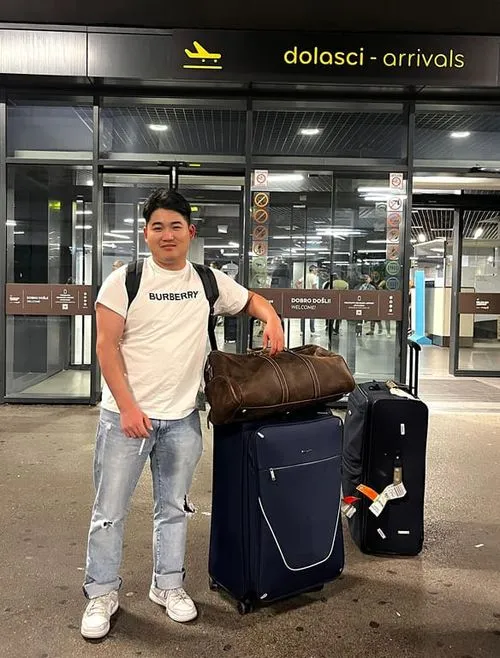
This is the thought I would like to give to every young person currently considering studying abroad: a degree in human medicine or dentistry is not only a professional qualification. It is an international entry ticket. Where you later live, work and raise your children is to a considerable extent something you decide with it. I could not have guessed that in my early twenties, unpacking my suitcase in Sofia.
The way back stays open
One point reassures many people: the route back to Germany is open. If you wish, after the preclinical years you can apply to German faculties for a higher clinical semester on the basis of a credit-transfer decision from the state examination office. What is striking, though, is how many no longer want to take that route at all and prefer to graduate abroad, because they feel at home there.
If you want to know which location matches your grades, your budget and your plans, get free advice: Book a free advisory session.
The author's view
When I first wrote about this subject in 2019, I was in my sixth semester and still had to justify myself. Today, as a Swiss-licensed dentist and a father, I no longer do. The degree was my entry ticket — professionally and, as it turned out, also for where my family lives today.
What I took for a detour at the time was in truth the most direct route. Plan B becomes a virtue, and with a few years' distance it becomes simply this: plan A. To anyone facing this decision now, I wish a choice made without a guilty conscience.
Summary
When I wrote the first piece on this subject, I was in my sixth semester in Sofia and could only hope the calculation would work out. Today I write from a different position: as a Swiss-licensed dentist in Bern, as an entrepreneur and as a father.
And my verdict is clearer than it was then. The degree delivered what EU recognition promises. It made recognition in Switzerland possible for me, it allowed me to live where I want to live, and it is the foundation for everything I have built since. What many would have called a detour has turned out to be the most direct route to the life I would have wished for in my early twenties, without ever being able to put it so clearly.
Studying abroad comes with different challenges, and that is part of the truth too. But a great many of us, myself included, look back and speak of the best decision of our lives. Plan B becomes a virtue — and with a few years' distance it becomes simply this: plan A.
- Degrees in human medicine and dentistry are recognised in every member state of the European Union.
- Marcel Kloos studied dentistry in English at the Medical University of Sofia and works in 2026 as a Swiss-licensed dentist in Bern.
- Recognition in Switzerland runs through MEBEKO; in Austria the same EU professional recognition directive applies as in Germany.
- At the Medical University of Sofia, teaching took place in small groups of no more than ten people per instructor, with students from over 40 countries.
- Alongside Bulgaria, Serbia, Bosnia, Poland, Hungary, Slovakia, Romania, Latvia and Malta are established options for studying medicine abroad today.
- The way back to Germany stays open, because after the preclinical years an application for a higher clinical semester is possible on the basis of a credit-transfer decision from the state examination office.
By the way: I have written about this before
I published a similar piece many years ago during my own studies with Thieme Verlag, in the student portal via medici, back then still as a sixth-semester dentistry student in Sofia. If you would like to read more, the original article is here: Medizinstudium im Ausland: Mehr als nur Plan B (via medici, Thieme, 11 February 2019, in German). Comparing the two texts shows well how the view of one and the same route changes over seven years.
Further reading
- Studying medicine in Sofia: the main guide — my own place of study with all the universities, costs and questions of recognition
- Studying medicine & dentistry in Foča — one of the most affordable locations today
- Studying medicine without a numerus clausus: the location comparison — fees and recognition side by side
- Studying medicine & dentistry in Varna — my own country of study, Bulgaria, today
- One in eleven German medical students is enrolled abroad — a thousand has become many thousands
- My professors in Sofia (archive 2018) — another text from my student days
Frequently Asked Questions about studying medicine abroad
Is studying medicine abroad just a plan B?
It is a route in its own right with the same destination. A degree from a state EU university is valid throughout the European Union, teaching takes place in small groups, and you start immediately instead of after waiting semesters.
Is the degree recognised in Germany?
Yes, within the EU under professional recognition Directive 2005/36/EC. There is no equivalence or knowledge examination if the entire degree was completed at a listed EU university. The German medical licence (Approbation) is issued by the responsible state examination office.
Is the degree also valid in Austria and Switzerland?
Yes. In Austria the same EU directive applies; in Switzerland recognition runs through MEBEKO. I myself work as a Swiss-licensed dentist in Bern with a degree obtained in Sofia.
How large are the groups when studying abroad?
In practical subjects, typically around ten students per instructor. As a result, patient contact begins early and you accumulate considerably more hands-on treatment time than the length of the degree alone would suggest.
What does an academic year cost?
Depending on the location, between roughly 3.500 and 20.000 Euro per year, plus living costs of about 350 to 700 Euro a month. German student finance for studies abroad (Auslands-BAföG), education funds and scholarships cover a substantial part of this.
Does the way back to Germany stay open?
Yes. Transferring into a higher clinical semester is possible through credit transfer for completed course certificates and generally becomes attractive after four completed semesters. Clinical clerkships and parts of the final practical year can be completed in Germany in any case.
What does the international environment actually bring?
A network across several countries, confident specialist English, and the experience of finding your way in an unfamiliar system. Those three things help more in professional life later than you believe while studying.
What students say about Medschool Experts
Over 500 placements at more than 25 partner universities across 10+ countries. Read independent student reviews on Trustpilot.
About the author
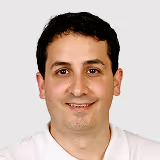
Marcel Kloos
Swiss-licensed dentist and founder of Medschool Experts
Marcel Kloos founded Medschool Experts while studying abroad; since then, over 500 study places have been secured. The Stuttgart-born dentist studied dentistry from 2015 to 2021 in Sofia and holds a Swiss dental licence.
Today he lives in Bern and runs Medschool Experts full-time as its owner.
More articles worth reading
Health Insurance for International Medical Students in Europe 2026
Scholarships and Funding for Medical Studies in Europe 2026
Medicine, Dentistry, Pharmacy or Veterinary Medicine? Choosing Your Degree Abroad in 2026
Ahmad
Sabrina
Rami
Noah
500+ students placed.
Now it's your turn!
No daydreaming, no empty promises. Just a clear plan — for the start of your medical degree.
40 minutes, no obligation