My First Year of Medical School in Bulgaria
17.09.2026

What was the start of medical school in Bulgaria like?
I came to Sofia in 2015 to study dentistry in English. The beginning was a plunge into the deep end: an unfamiliar city, Cyrillic script on every street sign, and a degree whose workings I knew only second-hand. After twelve months it was clear the decision had held up.
The overview below summarises my first year of study, as I wrote it down in 2017.
| Phase | What happened | What came of it |
|---|---|---|
| Arrival | unfamiliar city, no contacts | a flatshare with a fellow student from Munich |
| First weeks | teaching entirely in English | routine after about a semester |
| First exam period | considerable nerves, oral examinations | the material was manageable with hard work |
| Second semester | anatomy and the dissection course | the academic core of the year |
| After twelve months | initial scepticism about the teaching | the scepticism proved unfounded |
Why a flatshare makes such a difference in the first year
Right at the start I met another German student from Munich at the Medical University of Sofia. Without much deliberation we set up a two-person flatshare. Everything was easier together: the supermarket run just as much as revising during the exam period.
That sounds banal. But it is the point at which many people find out whether their first year abroad holds up or turns into a slog. Anyone sitting alone in an unfamiliar city while learning anatomy has two problems instead of one.
How much do you miss home?
I almost never felt homesick. The main reason was distance on paper against distance in practice: Sofia is around two hours’ flight from Germany, and during my studies I rarely paid more than the price of a train ticket for a weekend at home.
An honest note on that: the flight prices I noted down in 2017 are no longer the rule today. The connection has stayed; the price varies considerably by season and booking date. Anyone planning with a fixed travel budget should allow more generously than I did back then.
{{cta}}How good is the training really?
At first I was sceptical about the quality of the training. On the websites of various placement agencies I read about good teaching at the Medical University of Sofia; I was not convinced. That scepticism disappeared during the first year.
Three things were decisive for me: the group size of no more than ten students per tutor, direct access to teaching staff, and the oral examinations, where you have to explain rather than tick a box. Anyone who has not understood the material stands out immediately in that format, which is uncomfortable and instructive at the same time.
How does the degree change in the second year?
My first semester was exciting and demanding. I was nervous before the exams and did not know which way was up. At the start it was not easy to learn anything at all in English. Over time it turned out that the material was manageable with hard work and that you did not have to be a genius for it.
In the second year the pace picks up noticeably. More is demanded, but you are also capable of more, because the settling-in phase is over.
What I judge differently today, in 2026
Two points I read differently now, with distance. First, the language: I treated Bulgarian as a side issue in the first year. On the wards from the third year onwards it is no longer that, because you have to speak with patients. Second, money: Bulgaria adopted the euro on 1 January 2026 at a conversion rate of 1.95583 lev to the euro; since 1 February 2026 the lev is no longer legal tender. All price figures in older accounts, including mine, have to be read accordingly.
What has stayed the same: the first year decides less about subject knowledge than about whether you build a life in a new place. What that looks like at a specific location is something we are happy to clarify free of charge in a personal conversation.
The author’s view: the first year is not an academic problem
When someone asks me today what makes a first year abroad fail, my answer is rarely anatomy. It is organising your own life: accommodation, connections, rhythm.
My assessment: anyone who has a settled study group and a functioning living situation within the first eight weeks almost always gets through. That is based on my own cohort in Sofia and on the students we have supported since; it is an observation from advisory practice, not a collected statistic.
What I do not want to claim: that it goes the same way for everyone as it did for me. I was lucky with my flatmate, and luck cannot be arranged. The rest can be planned.
Summary
- I went to Sofia in 2015 without any reliable information in advance and would have made the same decision again after a year.
- The biggest hurdles in the first year were English as the language of instruction and adjusting to oral examinations, not the material itself.
- Sharing a flat with a fellow student made everyday life and revision periods noticeably easier.
- Short flights of around two hours meant homesickness never became much of an issue for me.
- From the second year the workload rises considerably, while the settling-in period is behind you.
- Bulgaria adopted the euro on 1 January 2026; price figures in older accounts have to be converted accordingly.
If you want to know what your first year abroad would actually look like, talk to someone who has been through it. In a free consultation we go through your case together.
Further reading
- Studying medicine in Sofia: the main article – the organised facts about the city where my first year began.
- How the medical degree in Bulgaria is structured – explained year by year.
- The dissection course with body donors – how anatomy teaching works in Sofia.
- Why Bulgaria? – the reasons for this study location.
- Arriving in Bulgaria – accommodation, insurance and flights.
- More than just a plan B – my assessment after graduating.
Frequently Asked Questions about the first year in Bulgaria
How hard is the first year of medical school in Bulgaria?
The first year is above all an adjustment: a new country, a new language of instruction, first assessments at the specimen. The material is manageable with hard work; nobody needs to be exceptionally gifted.
Is my school-level English enough for the degree?
For the start yes, provided you are willing to work on the language as well during the first months. For me it took about a semester before studying in English felt normal.
How often can you fly home?
Sofia is reachable from most German airports in around two hours’ flying time. During my studies I regularly flew home for a weekend; prices today vary considerably by season and booking date.
Do German students get homesick?
Homesickness barely arose for me, because the journeys were short and because the German-speaking group on the ground is large. Anyone who experiences it differently is not alone; the first weeks are the hardest for almost everyone.
Is a flatshare worth it?
In my experience yes. I shared a flat with a fellow student from Munich in the first year, and both everyday life and revision periods ran considerably more easily with two of us.
Do people still pay in lev in Bulgaria?
No. Bulgaria adopted the euro on 1 January 2026 at a conversion rate of 1.95583 lev to the euro. Since 1 February 2026 the lev is no longer legal tender.
How large are the teaching groups?
At the Medical University of Sofia I was taught in groups of no more than ten students per tutor. For me that was the biggest difference from the picture of university I had beforehand.
Does the second year get harder?
Yes, the workload increases. At the same time the settling-in phase is over and you can achieve more than in the first year. For me the two effects roughly balanced out.
What would I do differently today?
I would start with Bulgarian earlier. In the first year I treated the language as a side issue; on the wards at the latest it is no longer that.
Can you still transfer to Germany after the first year?
A transfer is possible in principle; the receiving German university decides on credit for your work case by case. What is realistic in your case is something we discuss in a free consultation.
What students say about Medschool Experts
Over 500 placements at more than 25 partner universities across 10+ countries. Read independent student reviews on Trustpilot.
About the author
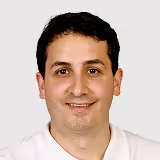
Marcel Kloos
Swiss-licensed dentist and founder of Medschool Experts
Marcel Kloos founded Medschool Experts while studying abroad; since then, over 500 study places have been secured. The Stuttgart-born dentist studied dentistry from 2015 to 2021 in Sofia and holds a Swiss dental licence.
Today he lives in Bern and runs Medschool Experts full-time as its owner.
More articles worth reading
Health Insurance for International Medical Students in Europe 2026
Scholarships and Funding for Medical Studies in Europe 2026
Medicine, Dentistry, Pharmacy or Veterinary Medicine? Choosing Your Degree Abroad in 2026

Ahmad

Sabrina

Rami

Noah
500+ students placed.
Now it's your turn!
No daydreaming, no empty promises. Just a clear plan — for the start of your medical degree.
40 minutes, no obligation