Studying Medicine in Szeged: Programme, Costs and Recognition
17.09.2026

Studying medicine in Szeged at a glance
The University of Szeged teaches human medicine in Hungarian, English and German. The programme takes twelve semesters, comprises 360 credit points, and concludes with the title dr. med. Dentistry and pharmacy run over ten semesters and are only offered in English. The key facts for the 2026/2027 academic year:
| Feature | Details (as of 08/2026) |
|---|---|
| University | Founded in Kolozsvár in 1872, in Szeged since 1921, twelve faculties |
| Faculty of Medicine | Albert Szent-Györgyi Faculty, name held since 2021 |
| Students | approx. 22,000, including 4,800 international students from around 120 countries |
| Human medicine | 12 semesters, 360 ECTS, German or English, dr. med. |
| Dentistry and pharmacy | 10 semesters each, 300 ECTS, English only |
| Fee, human medicine | €7,600 per semester (German), €7,900 (English) |
| Start of studies | Winter semester only |
| Accreditation | To WFME standards via the Hungarian MAB, valid until 15 Dec 2031 |
| Ranking, medicine | QS by Subject 2026: rank 401–450 worldwide |
| Cost of living | approx. €590 per month (our own calculation, see below) |
What defines the University of Szeged?
The University of Szeged traces back to the Hungarian royal university founded in Kolozsvár in 1872, and has operated in Szeged since 1921. In 2000, it merged with the medical university and other institutions to form today's comprehensive university with twelve faculties. Around 22,000 students and about 2,500 academic staff work there, with 4,800 students coming from abroad. The Faculty of Medicine is named after Albert Szent-Györgyi, who won the Nobel Prize in Medicine in 1937, among other things for isolating vitamin C from Szeged paprika. The faculty has officially carried his name since 2021.
In the Times Higher Education World University Ranking 2026, published on 9 October 2025, Szeged sits in the 1001–1200 group out of 3,118 ranked universities. The subject rankings are more informative: in the QS Subject Rankings of 25 March 2026, Szeged reaches rank 401–450 in medicine, 251–300 in pharmacy, and 451–500 in life sciences. In pharmacy, that's the best result of any Hungarian university. My assessment: for choosing where to study, subject-level placement matters more than the overall list, because teaching quality and subject reputation come through more strongly there.
Clinical training is anchored at the university's Szent-Györgyi Albert Clinical Centre, the largest healthcare provider in the southern Hungarian plain. Its catchment area extends well beyond the city limits, giving students a correspondingly broad range of patients. From the third year onward, students are regularly present in the clinics and teaching hospitals, and the sixth year includes 40 consecutive weeks of clinical rotation.
What programmes does the University of Szeged offer?
Szeged offers four foreign-language programmes in the medical field: human medicine in German and English, dentistry and pharmacy in English, and, since September 2024, an English-language bachelor's degree in psychology. Veterinary medicine is only taught in Hungary at the University of Veterinary Medicine in Budapest.
| Programme | Language | Duration / ECTS | Degree |
|---|---|---|---|
| Human medicine | German, English | 12 semesters / 360 | dr. med. (MD) |
| Dentistry | English | 10 semesters / 300 | D.M.D. |
| Pharmacy | English | 10 semesters / 300 | Doctor of Pharmacy |
| Psychology (BA) | English | 6 semesters / 180 | BA Human Behavior Analyst |
The German-language human medicine programme has existed since the 1999/2000 academic year. Until 2023, it ended after the second year, after which students had to switch to English or Hungarian. Since the 2023/2024 academic year, it has run across all six years. This makes Szeged one of the few places in Europe where you can study human medicine in German from day one right through to the state examination.
The psychology bachelor's degree costs €3,500 per semester. It's the newest of the four programmes, with the first cohort starting in September 2024. For a later career in psychotherapy in Germany, it's a starting point, not a finished path. Why, is explained further below, in the section on the legal position by profession.
How do you get into Szeged, and where can we place you reliably?
We deliberately don't publish checklists, document lists or deadlines. They vary by university, by programme and by intake year, and what applies in one cycle can already be different in the next. What matters is your profile.
Send us your transcript, along with proof of any semesters already completed and your preferred countries. We'll review it personally and tell you which university, in which country, can take you with exactly this profile — and where we can place you reliably, instead of leaving you to wait a year on a wing and a prayer.
For that, we draw on the largest network of official partner universities for medicine, dentistry, pharmacy, nursing and veterinary medicine at Medschool Experts. If Szeged is right for you, we'll tell you so. If another location gets you to a study place faster and more reliably, we'll tell you that too. The first step is a free consultation.
How is the medical programme in Szeged structured?
The human medicine programme is divided into four modules across twelve semesters. A minimum of 360 credit points is required for the diploma and the title dr. med. Mandatory subjects account for 99, 52, 116 and 51 credit points per module respectively, with the remainder made up of compulsory electives and electives.
| Module | Year of study | Mandatory credits |
|---|---|---|
| Foundation module | Years 1–2 | 99 |
| Pre-clinical module | Year 3 | 52 |
| Clinical module | Years 4–5 | 116 |
| Practical year | Year 6 | 51 |
A continuous four-week nursing placement and a summer placement in surgery are mandatory. The sixth year is a single practical year with 40 weeks of clinical rotation. The programme concludes with a state examination in three parts: a thesis with defence, a comprehensive written examination, and an oral examination with a patient.
Hungarian is a mandatory subject, including in the German- and English-language programmes. The Albert Szent-Györgyi Faculty's study and examination regulations require students on the foreign-language programmes to learn Hungarian and sit a comprehensive examination in the language. This replaces the foreign-language certificate otherwise required. In dentistry, two semesters of Hungarian are listed as a pass/fail requirement, alongside a dentist–patient communication course. From the clinical stage onward, you'll take medical histories from Hungarian-speaking patients.
What does studying medicine in Szeged cost in 2026/2027?
Tuition fees depend on the academic year you start in. For human medicine in German, it's a flat €7,600 per semester throughout. In English, you pay €7,100 in the first semester plus an €800 deposit, then €7,900 thereafter. The fee includes health insurance valid in Hungary.
| Programme | First semester | Following semesters | Total fees |
|---|---|---|---|
| Human medicine, German | €7,600 | €7,600 | approx. €91,200 |
| Human medicine, English | €7,100 plus €800 deposit | €7,900 | approx. €94,000 |
| Dentistry | €6,400 plus €1,600 deposit | €7,600 | approx. €74,800 |
| Pharmacy | €5,420 | €5,000 | approx. €50,420 |
The deposit comes on top of this and is not counted as part of the fees. Textbooks, summer placements and accommodation are not included.
How much does life in Szeged cost? Our calculation, to be understood as an estimate: around €590 per month, made up of €220 for a room in a shared flat, €70 for utilities, €260 for food, local transport, phone and leisure, and €40 for study materials. That's €7,080 per year, or roughly €45,500 over six years including around €500 a year for trips home. Anyone living alone in their own flat will pay more: the faculty itself cites €350 to €500 for cold rent on a flat, with €600 to €1,000 per month typical in Szeged for accommodation and food. Combined with tuition fees, human medicine in English comes to around €140,000 for the whole programme, and around €137,000 in German.
{{cta}}How can you finance your studies in Szeged?
Full international BAföG is available for a complete degree in Hungary, because Hungary is an EU member. The KfW student loan, on the other hand, is not an option: according to its information sheet, degree programmes completed entirely abroad are explicitly not eligible. Very few people know this distinction, and it can make a difference of tens of thousands of euros.
| Instrument | Amount | Usable for Szeged? |
|---|---|---|
| International BAföG | Maximum rate €992 per month, plus up to €5,600 tuition fee subsidy | Yes — handled by Studentenwerk Chemnitz-Zwickau |
| Education loan (Bundesverwaltungsamt) | €100–300 per month, up to €7,200 total, 3.53% effective annual interest | Yes, but only from an advanced stage of study |
| KfW student loan | Up to €650 per month | No — a full degree abroad is excluded |
| Income-share agreement | Repayment as a share of future gross income | Depends on the provider, usually only from the pre-clinical stage |
| Merit-based scholarship foundations | Income-dependent base grant plus a €300 flat-rate study allowance | Yes — universities within the EU are eligible |
It's worth looking closely at the details of international BAföG. The tuition fee subsidy of up to €5,600 is paid out as a full grant, but only for a maximum of twelve months. Over six years, that covers roughly a third of a single academic year in Szeged. There's no cost-of-living supplement for studying abroad within the EU, but there is a travel allowance of €250 per round trip, plus supplements of €102 for health insurance and €35 for long-term care insurance. Our calculation: a student receiving the maximum rate of €992 across twelve semesters ends up with around €71,400, half of which is a grant and half an interest-free government loan with a legally capped repayment. The application doesn't go to the office in your home town, but to Studentenwerk Chemnitz-Zwickau, which handles Hungary — ideally submitted six months before your studies start.
The rates are set to rise soon. The Federal Cabinet approved the 30th BAföG Amendment Act on 12 August 2026. It provides for the housing cost allowance to rise from €380 to €440 from the 2027 summer semester, and for the basic requirement rate to increase in two steps from €475 to €563 by 2029. The Bundestag still needs to approve it. Anyone starting in 2027 should keep an eye on this legislation.
There's not much left on the tax side: a medical degree in Szeged is, in almost all cases, a first degree, and its costs are only deductible as special expenses up to €6,000 per year, with no loss carryforward. The Federal Constitutional Court confirmed this rule on 19 November 2019. Without taxable income of your own in the same year, the deduction has no effect. Anyone who completed vocational training before their studies, however, can claim the fees as income-related expenses without limit and carry the loss forward. Which of these building blocks apply in your case is something we've broken down in detail in our article on financing a medical degree abroad.
Where can you practise as a doctor with a degree from Szeged?
The Hungarian medical diploma falls under the automatic recognition provisions of EU Directive 2005/36/EC on the recognition of professional qualifications; Hungary is listed in Annex V under item 5.1.1. That means the degree is recognised in every EU and EEA state without a substantive equivalence assessment. What still needs to be done in the main destination countries:
| Country | Path to practise | Basis |
|---|---|---|
| Germany | Approbation via the relevant state authority; automatic recognition | 2005/36/EC, Annex V 5.1.1 |
| Austria | Recognition plus entry in the physicians' register, followed by basic training | 2005/36/EC and the Physicians Act |
| Switzerland | Federal recognition of the EU diploma, followed by a cantonal practising licence | Free Movement Agreement |
| Rest of EU/EEA | Automatic recognition, national registration | 2005/36/EC, Annex V |
| United Kingdom | Case-by-case assessment by the General Medical Council since Brexit | GMC registration |
| United States | ECFMG certification, USMLE Step 1 and Step 2 CK, listing in WDOMS | ECFMG and WFME |
| Canada | Medical Council of Canada examinations, followed by the CaRMS match | MCC |
| Australia | Registration via Ahpra after AMC examinations | AMC |
One date is decisive for the path to the US. Since 1 January 2023, the ECFMG has required that a medical school be accredited by an agency recognised by the World Federation for Medical Education. The Hungarian accreditation commission MAB accredited the Albert Szent-Györgyi Faculty to the 2020 WFME standards by decision number 2023/9/XI of 24 November 2023; the faculty announced the recognition on 21 December 2023. The accreditation runs until 15 December 2031, with an interim review due by 31 December 2027. This means the US route is formally open to graduates from Szeged.
There's an exemption for the language exam in Germany that often gets overlooked: anyone with German citizenship, or who completed school or training in Germany in German, does not need to take either the general language exam or the specialist language exam. Both only apply to applicants without a German-language school or training background. In Switzerland, an equivalent proof of language proficiency at B2 level applies.
Dentist, pharmacist and psychologist: the legal position by profession
Dentistry, pharmacy and veterinary medicine are regulated by sector in the EU, just like human medicine. Dentistry is listed in Annex V of Directive 2005/36/EC under item 5.3.2, veterinary medicine under 5.4.2, and pharmacy under 5.6.2. The same automatic recognition applies to all three: the diploma is accepted without a substantive review, and the licence to practise is issued by the authority where you work. The dentistry degree from Szeged leads to a D.M.D. after ten semesters; a pharmacy degree is followed in Germany by Approbation as a pharmacist, and here too the specialist language exam is waived for those with a German-language school or training background.
Psychology is the outlier. The profession is not harmonised across the EU, there is no Annex V entry, and therefore no automatic recognition. Anyone wanting to work in psychotherapy in Germany follows the path set out in the reformed Psychotherapist Act; the relevant state authority decides on a case-by-case basis whether a foreign degree is equivalent. An English-language bachelor's degree from Szeged is not sufficient on its own. Anyone aiming for this profession should think through the full chain — bachelor's, master's, Approbation — from the very start. That's exactly what we go through together in a free consultation.
Career paths after graduation
A diploma from Szeged is a European entry ticket, not just a Hungarian one. Switzerland is the most attractive destination for German-speaking graduates: FMH statistics for 2025 count 44,612 practising physicians, 43% of whom hold a foreign diploma, compared with an OECD average of 19.6% of foreign-trained doctors for the years 2021 to 2023. In Austria, basic medical training is being shortened from nine to six months from 1 August 2026, a decision made on 7 July 2026. In Germany, specialist training under the 2018 model training regulations, as amended on 3 July 2025, takes 48, 60 or 72 months depending on the specialty; in 2026, the first year of specialist training is paid €5,792.90 per month under the Länder collective agreement, or €5,722.05 in the municipal sector.
Anyone looking to go further afield should know the numbers. The 2026 NRMP Match in the US allocated 44,344 positions to 53,373 registered applicants; the match rate was 70.0% for US citizens with a foreign diploma and 56.4% for other international graduates. In Canada, the 2026 CaRMS match placed 931 internationally trained doctors, up from 851 in 2025 and 671 in 2024. On the question of quality: Tsugawa and colleagues, writing in the BMJ in 2017 (volume 356, j273), analysed 1,215,490 hospital admissions treated by 44,227 internists. Adjusted 30-day mortality was 11.2% for internationally trained doctors, compared with 11.6% for US-trained doctors. The difference is small and plausibly explained by selection effects. The study doesn't prove that studying abroad produces better-trained doctors, but it does disprove the assumption that it produces worse ones. This is covered in detail in our article on career paths with an EU medical degree.
Switching into Szeged and transferring back to Germany
Switching from an ongoing degree is possible, and this is exactly where advice pays off the most. How far along you can enter depends on your existing academic record, the target university's curriculum, and how much study time remains there. Blanket statements are regularly misleading on this point.
That's why we check the highest possible entry point for you. You send us your academic records, we match them against our partner universities, and we tell you where you can enter furthest along, and where we can place you reliably. Entry into the final two years of study is often achievable. This applies to medicine just as much as to dentistry, pharmacy, nursing and veterinary medicine.
How we approach the reverse path — switching from a university abroad back to a German institution — is covered in our article on switching back to Germany. We're happy to talk through your specific case in a free consultation.
Life in Szeged: the city, housing and everyday life
Szeged is located in southern Hungary on the river Tisza, close to the Serbian and Romanian borders, with around 160,000 residents. The city is compact: faculty buildings, the clinical centre and the city centre are all within cycling distance, so nobody needs a car. With around 22,000 students among 160,000 residents, student life visibly shapes the cityscape. In the 2025/2026 academic year, around 1,500 international students from 132 countries began their studies in Szeged, a quarter more than the year before; around 1,000 of them are self-funded.
There's one point about housing that surprises many people: the university runs ten dormitories with several thousand places, but assigns them primarily to scholarship holders under state programmes such as Stipendium Hungaricum. Students paying tuition fees generally look on the private market instead. The Faculty of Medicine helps with this free of charge through its housing service, which is busiest in the weeks before the semester starts. A deposit of one to three months' rent plus utilities on top is standard. A practical tip: rents are agreed in forints and fluctuate with the exchange rate. Anyone budgeting in euros should build in a 10% buffer.
Who Szeged is right for — and who it isn't
Szeged is particularly well suited to three groups. First, anyone who wants to study in German: a complete six-year path in one language is rare in Europe. Second, pharmacy applicants, since rank 251–300 in the QS Subject Rankings 2026 is the best result of any Hungarian university, and at around €50,400 in total fees the programme costs noticeably less than human medicine. Third, anyone who wants to keep the US path open, since the WFME-based accreditation is documented through 2031.
Szeged is less suited to you if you're not willing to take on Hungarian as a mandatory subject, if you were counting firmly on an affordable dormitory place or on the KfW student loan, or if you're planning from the outset to treat it only as a stopover before switching to Germany after the pre-clinical years — nobody can remove that credit-transfer risk in advance. Whether Szeged fits your starting position, or another location in our partner network is a better fit, is something we can work out fastest in a free consultation.
Author's opinion
I studied dentistry in Sofia from 2015 to 2021, so I've completed a degree myself in a language nobody speaks back home. That's why I'm persistent about the mandatory Hungarian requirement. In Sofia, it was Bulgarian, and from my very first patient contact, the language course was the most useful thing on my weekly schedule — not because of the grammar, but because I had to understand what a person was telling me about their pain. Anyone who goes to Szeged and writes off Hungarian as an annoyance is wasting the clinical year they're paying for.
On the subject of recognition, many people underestimate the second step. When I had my Bulgarian degree recognised in Switzerland, the EU part of it was unremarkable. What took time was the cantonal practising licence that comes after. It's the same logic in Germany: Directive 2005/36/EC governs the recognition of the diploma, not the administrative procedure at the state authority. Anyone who asks early which documents are required in certified translation saves months.
What convinces me about Szeged is the consistency of its German-language programme. Carrying six years through in one language, rather than pushing students into another after the second year, is a decision made for students, against the more convenient route. Anyone who believes studying abroad is automatically the easier path, though, is mistaken: it's the same material, just further from home.
And the limitation I'll state plainly: around €140,000 over six years is a lot of money, and my living-cost estimate of €590 a month applies to a shared flat with its own kitchen. It's higher if someone lives alone, and it fluctuates with the forint exchange rate. The fact that the KfW student loan specifically excludes a full degree abroad hits families who were counting on exactly that. As a father myself, I know the feeling of adding up sums like these for the first time. Better now than in the third semester — and best done together with someone who knows the locations.
Conclusion
Studying medicine in Szeged is well worth exploring with the right guidance behind you. Medschool Experts maintains the largest network of official partner universities in Europe, and we individually assess the highest possible year of entry for every student — entry into the final two years of the programme is often possible. Reach out to Medschool Experts to find out where you stand, and book a free consultation to take the next step.
Frequently asked questions about studying medicine in Szeged
How do I find out if Szeged is the right place for me?
By sending us your profile. Requirements, documents and deadlines vary by university and by intake year, so we don't publish lists for them. We review your transcript, along with any proof of previous studies and your preferred countries, and tell you which university, in which country, can take you — and where we can place you reliably. Our partner network covers medicine, dentistry, pharmacy, nursing and veterinary medicine; it all starts with a free consultation.
Can I complete the entire medical degree in Szeged in German?
Yes. Since the 2023/2024 academic year, the University of Szeged has offered all six years of study in German. Before that, the German-language offering ended after the second year, after which a language switch was required. The German-language programme has existed since the 1999/2000 academic year.
What does a semester of medicine in Szeged cost in 2026?
The German-language programme costs €7,600 per semester. The English-language programme costs €7,900, or €7,100 plus an €800 deposit in the first semester.
How much does the entire medical degree in Szeged cost?
Our projection for 2026/2027 comes to around €94,000 in tuition fees over twelve semesters in the English-language programme, and around €91,200 in the German-language programme. Including approximately €45,500 for living costs and trips home, the complete degree comes to around €140,000.
Can I get international BAföG for Szeged?
Yes, a full degree programme in Hungary is eligible for funding, because Hungary is an EU member. Studentenwerk Chemnitz-Zwickau handles this. Alongside the maximum rate of up to €992 per month, a tuition fee subsidy of up to €5,600 is available, though only for a maximum of twelve months.
Can I finance the programme with a KfW student loan?
No. The KfW student loan's information sheet excludes degree programmes completed entirely abroad; only a semester abroad while still enrolled in Germany is eligible. International BAföG, the Bundesverwaltungsamt's education loan, and income-share education funds remain options.
Do I have to learn Hungarian in Szeged?
Yes, Hungarian is a mandatory subject. The study and examination regulations require students on the foreign-language programmes to learn Hungarian and sit a comprehensive examination in the language. In dentistry, two semesters of Hungarian are listed as a pass/fail requirement. From the clinical stage onward, you'll need the language for patient conversations.
Is the diploma from Szeged recognised in Germany?
Yes. Hungary is listed in Annex V, item 5.1.1 of EU Directive 2005/36/EC. The Hungarian medical diploma is therefore recognised without a substantive equivalence assessment; Approbation is granted by the relevant state authority. Item 5.3.2 applies to dentistry, and item 5.6.2 to pharmacy, under the same directive.
As a German citizen, do I need to take a specialist language exam?
No. Anyone with German citizenship, or who completed school or training in Germany in German, does not need to take either the general language exam or the specialist language exam. Both only apply to applicants without a German-language school or training background. This applies equally to doctors and pharmacists.
Can I go to the US with a degree from Szeged?
Formally, yes. Since 1 January 2023, the ECFMG has required accreditation by an agency recognised by the World Federation for Medical Education. The Hungarian commission MAB accredited the Albert Szent-Györgyi Faculty to WFME standards on 24 November 2023, valid until 15 December 2031. USMLE Step 1 and Step 2 CK are required on top of that.
Can I switch to Szeged from an ongoing degree?
A lateral switch is possible in principle. How far along you can enter depends on your existing academic record and the target university's curriculum. Send us your academic records, and we'll check the highest possible entry point — often into the final two years of study — and tell you at which partner university we can place you reliably.
Can I get a dormitory place in Szeged?
Generally not. The University of Szeged runs ten dormitories, but assigns places primarily to scholarship holders under state programmes such as Stipendium Hungaricum. Students paying tuition fees look on the private market instead; the Faculty of Medicine helps find accommodation free of charge before the semester starts.
Is veterinary medicine offered in Szeged?
No. Hungary has exactly one veterinary university, the University of Veterinary Medicine in Budapest. It teaches in English and German, the programme takes five and a half years, and concludes with the Doctor Veterinariae Medicinae degree. This qualification falls under Annex V, item 5.4.2 and is automatically recognised EU-wide.
What does pharmacy cost in Szeged?
The Faculty of Pharmacy quotes €5,420 for the first semester and €5,000 for each subsequent one. Over ten semesters, that comes to around €50,420. This makes pharmacy the least expensive of the three medical programmes in Szeged, while also being the best-ranked Hungarian programme in the QS Subject Rankings 2026.
How well does the University of Szeged rank?
In the Times Higher Education Ranking 2026, published on 9 October 2025, the University of Szeged sits in the 1001–1200 group out of 3,118 universities. In the QS Subject Rankings of 25 March 2026, it reaches rank 401–450 in medicine and 251–300 in pharmacy.
What students say about Medschool Experts
Over 500 placements at more than 25 partner universities across 10+ countries. Read independent student reviews on Trustpilot.
About the author
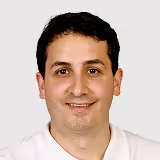
Marcel Kloos
Swiss-licensed dentist and founder of Medschool Experts
Marcel Kloos founded Medschool Experts while studying abroad; since then, over 500 study places have been secured. The Stuttgart-born dentist studied dentistry from 2015 to 2021 in Sofia and holds a Swiss dental licence.
Today he lives in Bern and runs Medschool Experts full-time as its owner.
More articles worth reading
Health Insurance for International Medical Students in Europe 2026
Scholarships and Funding for Medical Studies in Europe 2026
Medicine, Dentistry, Pharmacy or Veterinary Medicine? Choosing Your Degree Abroad in 2026

Ahmad

Sabrina

Rami

Noah
500+ students placed.
Now it's your turn!
No daydreaming, no empty promises. Just a clear plan — for the start of your medical degree.
40 minutes, no obligation