Medical Degree Recognition: Norway and Pakistan Explained
22.09.2026

Norway is not an EU member, but it is part of the European Economic Area, and for professional recognition purposes that distinction barely matters. A medical or dental degree earned at a university in an EU or EEA country is treated, under the terms of the EEA Agreement, almost the same way a Norwegian-earned degree would be. This is the starting point that makes the whole picture more manageable than it first appears.
{{cta}}Automatic Recognition Instead of a Foreign Credentials Review
Directive 2005/36/EC, as updated by 2013/55/EU, sets out a system of automatic recognition for regulated professions including medicine and dentistry, and Norway applies it through the EEA Agreement in the same way EU member states do. In practice, this means Helsedirektoratet, the Norwegian Directorate of Health, does not run a discretionary assessment of whether a degree from, say, Poland, Hungary, Romania, Slovakia, or Bulgaria is "equivalent enough." The qualification is listed under the directive, and the authorization process is administrative rather than evaluative. This is a fundamentally different track from the one facing graduates of universities outside the EU/EEA and Switzerland, who face a separate, considerably heavier process involving a knowledge and skills assessment, and in many cases a structured adaptation period before Helsedirektoratet will even consider granting authorization.
Why LIS1 Matters More Than the Degree Itself
The part that surprises people who assume the degree is the whole story is LIS1, the mandatory first stage of specialist training that replaced the old turnustjeneste internship system in 2017. Every physician who wants to practice independently in Norway, regardless of where they studied, has to complete LIS1: roughly a year and a half of supervised clinical service split between hospital and municipal primary care. Holding autorisasjon as a doctor is not the same as being cleared to work unsupervised. LIS1 positions are competitive and allocated through a national application system, and this step, not the degree recognition itself, is usually where timing and planning matter most for someone finishing a European medical programme.
The Norwegian Language Threshold
There is no formal legal language requirement written into the EEA recognition rules themselves, but in practice no Norwegian employer will place a doctor or dentist in a patient-facing role without solid Norwegian, and Helsedirektoratet can require documented language proficiency where there is doubt about a candidate's ability to communicate safely with patients. For someone who grew up in Norway with Pakistani heritage, this is usually the easiest part of the whole process rather than the hardest, since Norwegian is very often already a first or dominant language at home.
Bringing the Same Degree Back to Pakistan
Pakistan's medical regulator, the Pakistan Medical and Dental Council, has been through real institutional turbulence in the past decade. It was dissolved and replaced by the Pakistan Medical Commission in 2019, that replacement was later struck down by the courts, and PMDC was formally re-established under new legislation in 2023. Its current processes for foreign graduates have also been tightened and restructured recently, so anyone taking this seriously should treat the details as something to verify close to the time, not something to lock in years in advance.
NEB and NRE: Two Separate Checks, Not One
As things currently stand, a Pakistani doctor or dentist who studied abroad has to clear two distinct stages. The National Equivalence Board exam, referred to as NEB, checks whether the foreign degree's academic content lines up with PMDC's benchmarks for Pakistani medical education. Passing NEB does not grant a licence; it only confirms degree equivalence. The National Registration Examination, or NRE, is the separate licensing exam that actually leads to registration to practice as a general practitioner in Pakistan, and it is run in stages of its own. Both exams are held periodically through the year, and PMDC has been known to change eligibility rules and formats between sittings.
What Comes After Passing
Historically, foreign graduates who clear these exams have also been expected to complete a period of supervised house job training in Pakistan before being fully registered to practice independently, similar in spirit to LIS1 in Norway, though structured quite differently. Given how often PMDC's rules have shifted recently, this is exactly the kind of detail worth confirming directly with PMDC or with someone tracking it closely, rather than assuming today's rule will still apply whenever it becomes relevant.
What Citizenship Actually Changes
For the Norway side, none of this depends on which passport is in your pocket. Recognition of an EEA-earned degree, LIS1 eligibility, and Norwegian authorization all run through your qualification and your residence status, not your citizenship. For the Pakistan side, citizenship carries more practical weight, since PMDC's foreign-graduate pathway is generally built around Pakistani nationals. Here it helps to know that Pakistan and Norway have a bilateral dual nationality arrangement, one of a limited number of countries on that list, so a Norwegian-born citizen with Pakistani heritage who also holds Pakistani nationality is not forced to choose between the two. Someone who never took up Pakistani citizenship would need to look into that separately before any of the Pakistan-side process becomes relevant at all.
Two Systems, One Degree, and No Need to Choose Yet
None of this needs deciding now. A European medical or dental degree already gives you a clear, well-trodden route into practicing in Norway, and the additional knowledge that the same degree could, with a few extra steps, also open a path in Pakistan is simply useful information to have in your back pocket for whichever future actually arrives.
Fifty years is a long time, and plans made at twenty rarely account for where life ends up. If you would like to talk through what any of this means for your specific situation, our team offers a free individual consultation. Book yours through /contact, and we'll help you think it through properly.
What students say about Medschool Experts
Over 500 placements at more than 25 partner universities across 10+ countries. Read independent student reviews on Trustpilot.
About the author
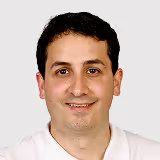
Marcel Kloos
Swiss-licensed dentist and founder of Medschool Experts
Marcel Kloos founded Medschool Experts while studying abroad; since then, over 500 study places have been secured. The Stuttgart-born dentist studied dentistry from 2015 to 2021 in Sofia and holds a Swiss dental licence.
Today he lives in Bern and runs Medschool Experts full-time as its owner.
More articles worth reading
Biology or Chemistry Degree to Medicine: Credit Transfer into a Higher Semester at European Universities
UK-Bangladeshi Heritage: How Your EU Medical Degree Is Recognised in the UK and in Bangladesh
Irish Heritage in the UK: How Medical Degree Recognition Works in Both Countries
Ahmad
Sabrina
Rami
Noah
500+ students placed.
Now it's your turn!
No daydreaming, no empty promises. Just a clear plan — for the start of your medical degree.
40 minutes, no obligation