Medical Degree Recognition in Denmark and Turkey: A Guide for Danish-Turkish Students
22.09.2026

If you study medicine or dentistry at a university inside the EU or EEA, and later want to practice in Denmark, the starting point is favourable. Denmark does not treat an EU-earned degree as something to be re-examined from scratch. The Danish Patient Safety Authority, Styrelsen for Patientsikkerhed, works from the assumption that a degree earned under an EU member state's own regulated system already meets the required standard.
{{cta}}Why an EU-Earned Degree Clears Authorisation Automatically
Under EU Directive 2005/36/EC, updated by 2013/55/EU, medical and dental qualifications obtained in another EU or EEA member state are subject to automatic recognition. Denmark cannot demand that you retake exams or complete a Danish equivalency test simply because your degree was issued in Romania, Bulgaria, Poland or elsewhere in the bloc. Styrelsen for Patientsikkerhed checks that your diploma appears on the list of qualifications covered by the Directive, verifies your identity and good standing, and issues autorisation. No aptitude test, no adaptation period, none of the extra steps that apply to degrees earned outside the EU.
That last part matters if your path ever takes you outside the EU for training. Degrees earned in a non-EU country go through a longer route at STPS: an individual assessment of your education, then either a supervised adaptation period in a Danish clinical setting or a formal aptitude test, plus proof of Danish through the Prøve i Dansk 3 exam. For someone who studies within the EU, none of that applies, but it is worth knowing, since family circumstances change and not every relative ends up studying inside the EU.
What Comes After Autorisation
Getting autorisation is not the same as being allowed to treat patients unsupervised. Denmark still requires a separate step, tilladelse til selvstændigt virke, before you can practice independently, and most regional employers expect solid Danish regardless of what the authority formally requires. Doctors trained inside Denmark also complete a mandatory clinical foundation year, klinisk basisuddannelse or KBU, before applying for independent practice. Doctors and dentists trained abroad, including within the EU, generally do not repeat this step, since their degree already included equivalent supervised clinical training. Recognition on paper comes fast. Being fully operational in a Danish hospital or clinic takes a little longer.
The Rule That Decides Everything in Turkey
Turkey's system runs on an entirely different logic, overseen by the Turkish Higher Education Council, YÖK. It does not ask where you were born or what passport you hold. It asks where you studied. For your foreign medical or dental degree to be granted denklik, the equivalence that lets you register as a practitioner or continue into postgraduate training there, YÖK checks whether your university appeared, in the year you enrolled, among the top 1,000 institutions in at least two of four major global rankings: Shanghai (ARWU), CWTS Leiden, QS World University Rankings and Times Higher Education. Meet that bar and the equivalence process moves ahead without any additional entrance exam.
If your university falls outside that threshold, YÖK falls back on a second route: a Turkish national university entrance exam score, YKS, from the year you actually enrolled abroad, within a defined ranking cutoff, roughly the top 50,000 nationally for medicine and a wider top 80,000 for dentistry. In practice this second path only exists for people who sat the Turkish exam system in the first place, typically because they finished secondary school in Turkey. Someone who grew up and finished school in Denmark generally never takes the YKS, which means the university ranking is, for most people in this situation, the only door that is actually open. That is exactly why the choice of university matters more for the Turkey option than it does for the Denmark one.
Citizenship Is Not the Gatekeeper Here
YÖK's equivalence process does not require Turkish citizenship. Holding only Danish citizenship, dual citizenship, or Turkish citizenship inherited through parents makes no difference to how the process runs. What YÖK evaluates is the qualification and the institution behind it, not the passport in your drawer. Dentistry runs on a parallel but separately defined set of thresholds within the same framework, so the two fields should not be assumed to follow identical numbers, and because YÖK periodically revisits both the ranking list and the cutoff figures, this is worth checking again for the current year rather than assumed fixed.
Keeping Both Doors Open
Most people who study medicine or dentistry abroad never end up needing the Turkish side of this. They build a career in Denmark, using the same EU-based automatic recognition that thousands of European medical graduates rely on every year. But knowing the Turkish mechanism now, while you are still choosing where to study, is worth more than looking it up later. A university that meets YÖK's ranking criteria keeps a door open that a university outside that list simply does not, and there is no way to fix that retroactively once you have already graduated.
Fifty years is a long time, and the circumstances that make a second country's licensing option worth having tend to become clear only in hindsight. If you would like to talk through how your choice of university affects both the Danish and the Turkish path, our team offers a free individual consultation to walk through your options.
What students say about Medschool Experts
Over 500 placements at more than 25 partner universities across 10+ countries. Read independent student reviews on Trustpilot.
About the author
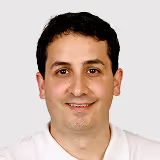
Marcel Kloos
Swiss-licensed dentist and founder of Medschool Experts
Marcel Kloos founded Medschool Experts while studying abroad; since then, over 500 study places have been secured. The Stuttgart-born dentist studied dentistry from 2015 to 2021 in Sofia and holds a Swiss dental licence.
Today he lives in Bern and runs Medschool Experts full-time as its owner.
More articles worth reading
Biology or Chemistry Degree to Medicine: Credit Transfer into a Higher Semester at European Universities
UK-Bangladeshi Heritage: How Your EU Medical Degree Is Recognised in the UK and in Bangladesh
Irish Heritage in the UK: How Medical Degree Recognition Works in Both Countries
Ahmad
Sabrina
Rami
Noah
500+ students placed.
Now it's your turn!
No daydreaming, no empty promises. Just a clear plan — for the start of your medical degree.
40 minutes, no obligation