Medical Degree Recognition in Sweden and Syria: A Guide for Swedish-Syrians
22.09.2026

Sweden does not leave recognition to chance or negotiation. A single authority, Socialstyrelsen (the National Board of Health and Welfare), decides whether a medical or dental degree lets you use the protected titles läkare or tandläkare, and the path it puts you on depends almost entirely on where in the world you studied.
{{cta}}
Why an EU-earned degree moves faster than people expect
If your degree comes from another EU or EEA country, Sweden treats it under the mutual recognition rules set out in Directive 2005/36/EC. Socialstyrelsen checks your documents, a certificate confirming you are not under any professional restriction, and proof that your training matches the directive's standards, and if everything is in order it issues a Swedish licence without asking you to sit an exam or repeat coursework. That is the part people usually hear about and assume covers everything.
The part that is not automatic
The language requirement sits outside that automatic process and is checked separately, and it is a real hurdle. Socialstyrelsen requires Swedish at C1 level on the Common European Framework, and this applies even to Swedish, Danish or Norwegian citizens. A basic integration course will not clear it; you need a university-level certificate, an upper secondary qualification taught in Swedish, or a formal assessment from a Swedish healthcare employer. Depending on which country you trained in, you may also need to complete AT, allmäntjänstgöring, a supervised general internship of at least eighteen months rotating through internal medicine, surgery, psychiatry and general practice, before the licence is granted.
What changes if the degree was earned outside the EU
A degree from a country outside the EU and EEA is assessed individually rather than automatically. Socialstyrelsen first evaluates whether your education is broadly equivalent to a Swedish one, then requires you to pass a kunskapsprov, a knowledge test covering clinical medicine or dentistry, sit a course on Swedish law and healthcare regulation, and complete supervised clinical training before you can apply for a licence. Several Swedish universities also run complementary programmes that combine this into a single one-to-three-year track. None of this is relevant if you study medicine or dentistry at a university inside the EU, which is the route most Swedish-Syrian students considering study abroad actually take, but it matters if you are weighing a non-EU option and want to know what it would cost you in time.
Syria's equivalency process runs through a different ministry entirely
Recognition in Syria is handled by the Ministry of Higher Education, through its degree equivalency committees, and it works nothing like Socialstyrelsen's system. Rather than an automatic pathway for degrees from friendly countries, Syria applies a formal equivalence test to every foreign qualification: your program's length, structure and content are compared line by line against the Syrian curriculum, and the process has historically been slow, paper-based and short on published timelines. Since the end of 2024 the transitional government has issued several decrees aimed at unblocking cases that stalled under the old administration, but people close to the process describe the practical effect so far as partial. Some backlogs have moved, others have not, and the ministry's own procedures are still being rebuilt alongside the rest of the state. Anyone planning around this should expect the picture to keep shifting rather than treat any single description of it as final.
The exam every graduate sits, Syrian or foreign
What is clearer is the exam itself. Syria runs a unified national medical exam that both local sixth-year graduates and holders of foreign medical degrees must pass to practise or to register with the Syrian Medical Syndicate, and dentistry has its own equivalent overseen alongside the dental syndicate. It is a demanding, broad-based test covering the core clinical specialties, and passing it is a prerequisite for registration regardless of where you studied. In practice, a foreign-trained graduate typically needs both the ministry's degree equivalency and a pass on this exam before the syndicate will register them to practise.
Citizenship shapes the process more than heritage does
If you hold Syrian citizenship, even alongside Swedish citizenship, you go through the same equivalency and exam process as any other Syrian degree holder returning from abroad. If you hold only Swedish citizenship and no Syrian nationality, you would typically be treated as a foreign national seeking to practise in Syria, which can mean additional steps around residency or work authorisation on top of the degree and exam requirements. Either way, being of Syrian descent does not itself simplify or complicate the paperwork; what matters is the passport you hold and the degree you present.
Two systems, one degree, and a decision you do not have to make now
The reassuring part of all this is that nothing about choosing a European medical or dental programme locks you into one country. A degree recognised under Directive 2005/36/EC keeps the Swedish path open in the straightforward way described above, and the same diploma, sitting in the same folder, is also the document a Syrian equivalency committee would eventually assess if you ever wanted that option too. You do not have to decide today whether you will end up practising in Stockholm, Malmö, Damascus or Aleppo.
What helps most is choosing your degree programme with both systems in mind from the start, so that neither door quietly closes while you are focused on the other. If you would like to talk through what that looks like for your specific situation, our team offers a free, no-obligation individual consultation. Book yours here and we will go through the options with you.
What students say about Medschool Experts
Over 500 placements at more than 25 partner universities across 10+ countries. Read independent student reviews on Trustpilot.
About the author
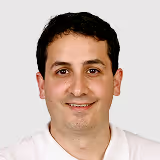
Marcel Kloos
Swiss-licensed dentist and founder of Medschool Experts
Marcel Kloos founded Medschool Experts while studying abroad; since then, over 500 study places have been secured. The Stuttgart-born dentist studied dentistry from 2015 to 2021 in Sofia and holds a Swiss dental licence.
Today he lives in Bern and runs Medschool Experts full-time as its owner.
More articles worth reading
Biology or Chemistry Degree to Medicine: Credit Transfer into a Higher Semester at European Universities
UK-Bangladeshi Heritage: How Your EU Medical Degree Is Recognised in the UK and in Bangladesh
Irish Heritage in the UK: How Medical Degree Recognition Works in Both Countries
Ahmad
Sabrina
Rami
Noah
500+ students placed.
Now it's your turn!
No daydreaming, no empty promises. Just a clear plan — for the start of your medical degree.
40 minutes, no obligation