Study Medicine or Dentistry Abroad from Ireland: Medical Council Recognition and the Best Destinations
23.09.2026

Why So Many Irish Students Study Medicine Abroad
Undergraduate Medicine in Ireland is offered at a small number of universities, and the number of places reserved for EU applicants is limited. Although more than 200 extra places have become available across all undergraduate medicine programmes since 2022, demand still far outstrips supply.
The selection system adds pressure. Applicants need a minimum of 480 Leaving Certificate points and must sit the HPAT in the year of entry. Leaving Certificate points above 550 are currently scaled, and the combined maximum is 865. From 2027, the calculation changes: points above 550 will no longer be reduced, the HPAT will be weighted to a maximum of 150 instead of 300, and the new combined maximum will be 775. The system becomes different, but it does not become less competitive.
Graduate Entry and Dentistry
Graduate-entry Medicine, selected through the GAMSAT, offers another route, but places are few. Dentistry in Ireland is offered at only two dental schools, which makes admission extremely competitive as well.
How a Foreign Degree Is Recognised in Ireland
For Irish students, the key word is Europe. Ireland is an EU member state, and that brings a clear legal framework.
Medicine: Automatic Recognition Under EU Law
Directive 2005/36/EC on the recognition of professional qualifications sets minimum training standards for medical degrees across the EU and lists the recognised qualifications of each member state in its Annex V. The Medical Council recognises these qualifications for EU nationals. An Irish citizen with a medical degree from another EU country therefore registers through the EU route, without a separate licensing exam.
Registration and First Posts
After graduation, you apply to the Medical Council for registration and, like every doctor, provide proof of your qualification, a certificate of good standing and the required documentation. You can then apply for posts in the Irish health service. Many graduates of European medical schools begin as non-consultant hospital doctors and move on to specialist training.
Degrees From Outside the EU
Graduates of medical schools outside the EU usually complete the Medical Council's Pre-Registration Examination System (PRES) before registration. This route works well, but an EU degree is the more direct option.
Dentistry: The Dental Council
For Dentistry, the Dental Council applies the same EU logic. Dental qualifications listed in Annex V of Directive 2005/36/EC are recognised for EU nationals, and Irish dentists trained in another EU country can register without an additional exam.
{{cta}}Which Destination Countries Suit Irish Students?
For Irish students, EU countries offer the smoothest route home. The following destinations are particularly popular.
Bulgaria and Romania
Both countries have long-established English-language programmes in Medicine and Dentistry and large communities of Irish and British students. Living costs are moderate and the degrees fall under EU recognition.
Poland
Poland offers numerous English-language MD programmes in lively university cities. Irish students value the strong clinical training and the international atmosphere.
Hungary, the Czech Republic and Slovakia
These countries have taught Medicine and Dentistry in English for decades. Their six-year programmes follow EU standards and are well known in Ireland.
Lithuania, Latvia and Croatia
These countries offer English-language programmes with smaller cohorts and a very personal learning environment. They are an excellent fit for students who prefer a close-knit study community.
{{callout}}Practical Tips for Irish Students
Stay With an EU Programme
An EU degree gives you automatic recognition as an Irish citizen. This makes it the most straightforward choice for a career at home.
Keep Your Options Open in the UK
Many Irish doctors spend part of their careers in the UK. The GMC currently recognises medical qualifications from the EEA as relevant European qualifications, so an EU degree also keeps this door open.
Plan Clinical Electives at Home
Electives in Irish hospitals during your summers help you build contacts, understand the Irish system and collect references for your first applications.
Learn the Local Language
Teaching is in English, but patients often speak the local language. Basic language skills make your clinical years far more rewarding.
Plan Your Finances Early
Tuition for English-language programmes and living costs vary a lot between countries. A clear budget over six years helps you choose the right destination with confidence.
How We Help You Find the Right Programme
Choosing the right EU programme is the most important step towards a smooth return to Ireland. We offer solutions for exactly this. Contact us and we check individually which of our 25+ partner universities fits you, your results and your budget. Marcel or another experienced consultant on our team will look at your situation and give you a clear recommendation.
The Author's View
Irish students are in a fortunate position, even if it does not feel like that on results day. Their EU citizenship gives them access to medical and dental programmes across the whole European Union, with automatic recognition when they return. Few students worldwide have such a clear path home.
In consultations, I often meet Irish students who have narrowly missed the points they needed. They are strong candidates, and many of them go on to thrive abroad. The six years in another country give them independence, clinical confidence and an international outlook that the Irish health service values.
What I tell parents is that the decision does not have to be made in a rush after the CAO offers come out. The best results come from families who look at European options during the final school year, compare countries calmly and keep a place abroad as a secure plan. That way, results day becomes a moment of choice rather than a moment of disappointment, whichever way the points fall.
If you want to become a doctor or a dentist, a missed CAO offer should not decide your future. Book a consultation and let us show you the options that are open to you.
Conclusion
- Undergraduate Medicine in Ireland combines Leaving Certificate points and the HPAT, with a current maximum of 865 and a new maximum of 775 from 2027.
- Directive 2005/36/EC provides automatic recognition of medical and dental qualifications from other EU countries for EU nationals.
- Irish citizens with an EU degree register with the Medical Council or the Dental Council without a separate licensing exam.
- Bulgaria, Romania, Poland, Hungary, the Czech Republic, Slovakia, Lithuania, Latvia and Croatia are popular destinations for Irish students.
A missed place at home is not the end of your medical career. With an EU degree, you return to Ireland with a qualification that is recognised by law and opens doors across Europe. Book your free consultation and take the first step.
Frequently Asked Questions
Is a medical degree from another EU country recognised in Ireland?
Yes. Directive 2005/36/EC provides automatic recognition of medical qualifications listed in its Annex V for EU nationals. As an Irish citizen, you register with the Medical Council through the EU route.
Do I need to sit an exam after studying Medicine in the EU?
No separate licensing exam is required for Irish citizens with a recognised EU medical degree. Graduates of schools outside the EU usually complete the PRES.
What changes in Irish medical admissions from 2027?
From 2027, Leaving Certificate points above 550 will no longer be reduced and the HPAT will be weighted to a maximum of 150. The new combined maximum will be 775.
Can I study Dentistry abroad and practise in Ireland?
Yes. The Dental Council recognises dental qualifications listed in Annex V of Directive 2005/36/EC for EU nationals.
Can I also work in the UK with an EU degree?
Currently yes. The GMC classifies medical qualifications from the EEA as relevant European qualifications, which allows registration without PLAB.
Do European universities require the HPAT?
No. European programmes use their own admission criteria, usually based on your Leaving Certificate results in biology and chemistry and, depending on the programme, an entrance exam or interview. A strong Leaving Cert that fell just short of the CAO cut-off can open many doors abroad.
How long does a European medical degree take?
Most European medical programmes last six years, with extensive clinical training in the later years. Dentistry programmes usually take five to six years. Both lead to qualifications recognised across the EU.
Do I need to speak the local language?
Teaching in English-language programmes is fully in English. Many universities include courses in the local language, which help with patient contact during clinical placements and make daily life easier.
Can I come back to Ireland for specialist training?
Yes. After registration with the Medical Council, graduates of European medical schools can apply for posts and specialist training in Ireland. Many also gain experience in other EU countries or the UK before returning.
Is it worth repeating the Leaving Cert instead?
Repeating can work for some students, but it costs a year and the outcome remains uncertain. Studying in another EU country gives you a guaranteed start and an automatically recognised degree, so many families consider both options side by side.
Which university abroad is right for me?
That depends on your results, budget and goals. Contact us and we check individually which of our 25+ partner universities fits you.
What students say about Medschool Experts
Over 500 placements at more than 25 partner universities across 10+ countries. Read independent student reviews on Trustpilot.
About the author
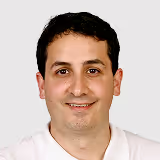
Marcel Kloos
Swiss-licensed dentist and founder of Medschool Experts
Marcel Kloos founded Medschool Experts while studying abroad; since then, over 500 study places have been secured. The Stuttgart-born dentist studied dentistry from 2015 to 2021 in Sofia and holds a Swiss dental licence.
Today he lives in Bern and runs Medschool Experts full-time as its owner.
More articles worth reading
Study Medicine or Dentistry Abroad from Brazil: Revalida, EU Passports and the Best Destinations
Study Medicine or Dentistry Abroad from the Gulf States: Licensing in Saudi Arabia, the UAE, Kuwait, Qatar, Oman and Bahrain
Study Medicine or Dentistry Abroad from Nigeria: MDCN Assessment Exam, Recognition and the Best Destinations
Ahmad
Sabrina
Rami
Noah
500+ students placed.
Now it's your turn!
No daydreaming, no empty promises. Just a clear plan — for the start of your medical degree.
40 minutes, no obligation