Transfer from Caucasus University Tbilisi: Where to Continue Medicine in 2026
23.09.2026

Transfer from Caucasus University Tbilisi: is it possible in 2026?
Quick answer
Yes. A transfer from Caucasus University Tbilisi to another medical faculty is possible in 2026. Your 360-ECTS programme produces a transcript that receiving universities can recognise. Medschool Experts checks your profile free of charge and frequently places transfer students in year 4 or year 5 at top universities worldwide.
A transfer from Caucasus University is possible because the MD programme in Tbilisi is built on the European Credit Transfer System. Six years, 360 ECTS, teaching in English: that structure is what a receiving university reads when it looks at your transcript. Modules such as anatomy, physiology, biochemistry and the clinical rotations have names, hours and credits. They can be compared. That is the whole basis of a transfer.
What a transfer is not: a fresh application in year 1. A student who has passed three or four years in Tbilisi brings those results along. The receiving faculty decides which modules it recognises and in which year the student continues. Medschool Experts is the leading expert in this field worldwide and frequently achieves placements in year 4 or year 5 at top universities worldwide. Every profile is different. That is why the check is free and individual.
| Item | Details |
|---|---|
| University | Caucasus University, School of Medicine and Healthcare Management (private) |
| City | Tbilisi, Georgia |
| Programme | Medicine (MD) |
| Tuition 2026 | 6,000 USD per year (approx. 5,500 EUR) |
| Language | English, with compulsory Georgian language modules |
| Degree | Medical Doctor (MD), master-level one-cycle programme |
| Duration and ECTS | 6 years, 12 semesters, 360 ECTS |
| Living costs | approx. 500 to 750 EUR per month |
| University page | Caucasus University on Medschool Experts |
The reasons for a transfer are personal, and the next sections take them one by one.
Failed exams at Caucasus University: what now?
Failed exams at Caucasus University in 2026 do not end a medical career. A student who did not pass an exam block in Tbilisi has three realistic options: sit the exam again, repeat the academic year, or transfer to another medical faculty where the passed modules are recognised and the remaining ones are taken in a new environment. All three are normal. None of them is a verdict on your ability.
Each option has its own cost. A resit is the cheapest option when the gap was small. A repeated year costs twelve months and another 6,000 USD of tuition. A transfer changes the setting: new professors, a different exam culture, sometimes a curriculum that suits the way you learn better. Many students who struggled with one specific subject in Tbilisi passed it at the first attempt elsewhere. Same student, different setting.
One thing matters more than the choice itself: timing. A student who contacts us in January after a difficult winter session has eight months until a September start. A student who waits until August has weeks. Both can be helped. The first one has more options.
Why do students consider a transfer from Caucasus University?
Students consider a transfer from Caucasus University for five typical reasons in 2026: exam difficulties in a specific subject, the wish for a degree from an EU or OECD country, tuition and living costs that no longer fit the family budget, a strained relationship with a course or a professor, and a career goal in the United States that calls for early USMLE preparation. Each reason has a solution, and each solution starts with a transcript check.
Exam difficulties: a change of faculty resets the exam culture without resetting your credits. EU degree: a transfer moves you into a system where Directive 2005/36/EC applies to your final qualification. Costs: Tbilisi is affordable, but a different tuition model or a city closer to home can still lower the total. Friction with a course or professor: it is rarely personal, but it can block progress, and a transfer removes the block. USA goal: some faculties integrate USMLE-style assessment from the pre-clinical years onward.
Marcel Kloos knows the feeling from the inside. He studied dentistry in Sofia from 2015 to 2021, a long way from Bern, and saw classmates change faculties for exactly these reasons. Some of the students on our student stories page describe the same turning point.
How does ECTS credit transfer work after Caucasus University Tbilisi?
ECTS credit transfer after Caucasus University works module by module. The receiving university takes the Tbilisi transcript of records, compares each completed course (name, content, contact hours, credits, grade) with its own curriculum, and issues a recognition decision that sets the year of entry. The 360-ECTS structure of the Caucasus University MD programme, with 60 ECTS per year, makes that comparison straightforward for a European faculty.
Three documents carry the decision. The transcript of records lists the credits. The course descriptions (syllabi) show what was taught. The enrolment certificate confirms your status. Medschool Experts requests and checks all three before any application goes out, because a missing syllabus can cost a full semester of recognition.
How many credits are recognised depends on the overlap between the two curricula and on the receiving faculty's rules. We do not quote caps. What we can say from experience: Medschool Experts frequently achieves placements in year 4 or year 5 at top universities worldwide, and each recognition decision is negotiated with the faculty, not simply accepted. The transfer service covers that negotiation. Book a free check at /contact to see what your transcript supports.
Which universities accept transfer students from Caucasus University?
Which universities accept transfer students from Caucasus University depends on the individual profile: year of study, grades, passed modules, language skills, budget and licensing goal. Medschool Experts checks each profile individually against its partner universities and does not publish lists of accepting faculties, because a list would be wrong for half of its readers. The consultation that replaces the list is free.
Why no list? A faculty that admits a year-4 student with strong clinical grades may not admit a year-2 student with two open exams. A published table would be outdated within months and would push students toward a name instead of a fit.
A study transfer is a complex undertaking. Our experts have almost 10 years of experience in study transfers worldwide, which is why they plan and carry it out confidently. The consultation is free.
What does Israel's Yatziv reform mean for Israeli students at Caucasus University?
Israel's Ministry of Health ties admission to the Israeli medical licensing exam to the institution where a doctor studied. Under the Yatziv reform, for Israelis who began their studies in 2019 or later, all institutions in OECD member states count as approved, plus institutions in other countries that the Ministry lists individually. Georgia is not an OECD member state, so for Israeli students at Caucasus University the Ministry's individual list is the reference.
Some Israeli students therefore plan their degree with a university in an OECD member state in mind, and a transfer is one way to do that. Others continue in Tbilisi. Both are valid plans. Medschool Experts advises Israeli students on both paths, free of charge, in a personal consultation.
Can I continue Medicine after Caucasus University without losing a year?
Continuing Medicine after Caucasus University without losing a year is the goal of every transfer that Medschool Experts plans, and it is achieved regularly. The mechanism is credit recognition: passed modules from Tbilisi are mapped to the new curriculum, and the student enters the year that matches the recognised credits. A transfer prepared in winter for a September start leaves no gap in the academic calendar.
Where a gap appears, it has one of two causes: a late application that missed the intake, or a missing syllabus that blocked recognition of a module. Both are avoidable.
What does a transfer from Caucasus University cost, and how do living costs compare?
A transfer from Caucasus University has two cost layers in 2026: the one-off transfer costs (translations, apostilles, application fees, travel, a housing deposit) and the running costs at the new university (tuition and living). The consultation and profile check at Medschool Experts are free. Today's baseline in Tbilisi: 6,000 USD tuition per year, or roughly 5,500 EUR, plus 500 to 750 EUR per month for living.
That baseline of roughly 11,500 to 14,500 EUR per year is the number to compare. A receiving university can be cheaper, similar or more expensive. Cheaper does not always mean better value: a faculty with strong clinical training, a shorter route to licensing and a placement in year 4 may cost more per year and less in total. Fewer remaining years, lower total. We calculate the full remaining cost, not just the annual fee.
| Cost item | Caucasus University today | What to ask about the new university |
|---|---|---|
| Tuition per year | 6,000 USD | Amount, currency, payment in instalments |
| Living costs per month | 500 to 750 EUR | Rent, food, transport, insurance |
| Remaining years | depends on your year | Placement year after credit recognition |
| One-off transfer costs | n/a | Translations, apostilles, travel, deposit |
| Consultation | free at Medschool Experts | free at Medschool Experts |
Ask for written confirmation of every fee at the new university, including insurance, registration and exam fees. We request those confirmations for you.
Why is Georgia still an attractive place to study Medicine in 2026?
Georgia remains an attractive place to study Medicine in 2026 because it combines an English-taught six-year MD worth 360 ECTS with tuition clearly below Western European levels: at Caucasus University 6,000 USD per year, roughly 5,500 EUR. Georgia's National Center for Educational Quality Enhancement holds WFME recognition status since 2018, which keeps the USMLE and ECFMG route and the UK PLAB route open for graduates. Tbilisi and Batumi host international students from many countries, and lecture halls in both cities are used to a mix of languages and backgrounds. Daily life in Georgia is welcoming, safe and affordable.
For Iranian students, Georgia has one more advantage. Iranian citizens can enter Georgia without a visa and stay for up to 45 days, and the study visa and the residence permit are then arranged inside Georgia. Many Iranian students face long waiting times or refusals when they apply for student visas elsewhere, so Georgia is one of the most accessible places for them to study Medicine in English.
A transfer is one option among good ones. Both paths can work. Whether you stay at Caucasus University or move to another university, Marcel or another experienced consultant on our team advises you free of charge.
{{cta}}Is the USMLE or USA route open after a transfer from Caucasus University?
The USMLE route is open both at Caucasus University and after a transfer. Georgia's National Center for Educational Quality Enhancement has held WFME recognition status since 19 October 2018, which is the basis for ECFMG certification of graduates. The UK PLAB route is open as well. A student who transfers to a faculty in an OECD or EU country keeps those routes and adds a third: a degree that is assessed under Directive 2005/36/EC inside the EU or that meets the Israeli Ministry of Health criteria automatically.
For students with a clear USA goal, the timing of USMLE Step 1 preparation matters more than the country of study. Step 1 is taken after the pre-clinical phase. A transfer into year 3 or year 4 at a faculty with integrated USMLE-style teaching can align the curriculum with the exam calendar. We discuss that alignment in the consultation, because it changes which faculties fit.
Inside the EU, a Georgian degree is a third-country qualification assessed case by case; Directive 2005/36/EC does not apply automatically. That is a fact to plan around, not a flaw. A transfer before graduation is the cleanest way to bring the final degree under the Directive. Graduation from Tbilisi followed by an equivalence procedure is the alternative. Both routes work. They differ in time and paperwork.
How does the transfer with Medschool Experts work step by step?
The transfer with Medschool Experts works in four steps over roughly eight months: a free consultation in month 1, a transcript check in month 2, document preparation and application in months 3 to 4, and admission with credit recognition, visa and housing in months 5 to 8. The student stays enrolled at Caucasus University until the admission letter is in hand. No bridge is burned early.
Step 1 (month 1)
Free consultation with Marcel or another experienced consultant on our team. Goals, budget, timeline, licensing route.
Step 2 (month 2)
Transcript and course descriptions from Caucasus University are checked module by module.
Step 3 (months 3 to 4)
Documents prepared, translated, apostilled where needed. Application submitted to the chosen faculty.
Step 4 (months 5 to 8)
Admission, credit decision, visa or residence permit, housing. First day in the new lecture hall.
Marcel Kloos, who has placed more than 500 students since founding Medschool Experts, or another experienced consultant on our team, leads the case from the first call to the first lecture. Partner universities are approached directly. The full list of faculties we work with is on the universities page; which of them fit you is a question for the consultation.
When is the best time to start planning a transfer from Caucasus University?
The best time to start planning a transfer from Caucasus University is the winter semester before the intended September start, ideally January or February 2027 for a September 2027 entry. That window leaves time to request transcripts, chase a missing syllabus, sit a language test if one is required, and apply before intake deadlines. A student who starts in spring still has options. A student who starts in August has fewer.
Three signals tell you it is time to talk. You have failed the same exam twice. Your family budget has changed. Your licensing goal (Israel or the EU) calls for a degree without an extra recognition procedure. Any one of them justifies a free call.
The call costs nothing. It gives you a written picture of where your Tbilisi credits can take you, in which year, and at what remaining cost. Reach Marcel or another experienced consultant on our team via /contact.
The author's view
I studied dentistry in Sofia from 2015 to 2021, so I know what it feels like to sit in a foreign lecture hall after a failed exam and wonder whether the whole plan was wrong. It was not. What I needed then was someone who could read my transcript and tell me, in numbers, what my options were. That is what I do today from Bern for students in Tbilisi.
My advice to a student at Caucasus University who is thinking about a transfer: do not decide in a bad week. Get the transcript, get the syllabi, and let us map them. More than 500 placements have taught me that most students have more options than they think, and that the ones who start in January end up with the best of them.
The consultation is free. Use it, even if you end up staying in Tbilisi. Marcel Kloos, Medschool Experts
Summary
- A transfer from Caucasus University Tbilisi is possible in 2026; the 360-ECTS MD programme produces a transcript that receiving universities can recognise.
- Failed exams have three normal answers: resit, repeat, or transfer with credit recognition. Timing decides how many options remain.
- Credit recognition is negotiated module by module; Medschool Experts frequently achieves placements in year 4 or year 5 at top universities worldwide.
- For Israeli students who started in 2019 or later, the Israeli Ministry of Health's individual list is the reference, because Georgia is not an OECD member state; some plan a transfer, others continue.
- Baseline costs in Tbilisi: 6,000 USD tuition plus 500 to 750 EUR per month; the consultation at Medschool Experts is free.
- USMLE, PLAB and EU routes stay open; a transfer before graduation brings the final degree under Directive 2005/36/EC.
Conclusion
Medicine in Tbilisi is a solid start. A transfer from Caucasus University is one of several ways to finish, and for some students with a licensing goal in the EU or Israel it is the most direct one. The credits you have earned keep their value. The world needs more doctors, and a change of faculty does not change that.
Every case is different, which is why we check every case individually and free of charge. Book your free consultation with Marcel or another experienced consultant on our team at /contact.
Frequently Asked Questions about a transfer from Caucasus University
Is an agency necessary for a transfer from Caucasus University?
An agency is not legally required for a transfer from Caucasus University, but the process involves credit negotiation, deadlines, translations and visa steps at the same time. Medschool Experts has almost 10 years of experience in study transfers worldwide, works directly with its partner universities and has placed more than 500 students. The first consultation is free, so the check costs nothing.
Will I lose a year if I transfer from Caucasus University?
A transfer from Caucasus University planned in the winter semester for a September start normally does not cost a year. Passed modules from Tbilisi are recognised, and the student enters the year that matches the recognised credits. Medschool Experts frequently achieves placements in year 4 or year 5 at top universities worldwide. Late applications and missing syllabi are the two usual causes of a gap, and both are avoidable.
I failed a year at Caucasus University. Can I still transfer?
Yes. A failed year at Caucasus University does not block a transfer. The receiving university looks at the modules you passed, not only at the year you did not complete. Many students who struggled with one subject in Tbilisi pass it at another faculty in a different exam culture. Bring your full transcript to the free consultation, and we show you which options remain open.
How does ECTS credit transfer work after Caucasus University?
The receiving university compares each completed module from the Caucasus University transcript with its own curriculum: content, hours, credits and grade. The 360-ECTS MD programme with 60 ECTS per year makes that comparison clear. The result is a recognition decision that sets your year of entry. Medschool Experts prepares transcript, course descriptions and enrolment certificate before any application is submitted and negotiates the decision with the faculty.
Which universities accept transfer students from Caucasus University?
That depends on your year of study, grades, passed modules, language level, budget and licensing goal. Medschool Experts checks each profile individually against its partner universities and does not publish lists of accepting faculties, because a fixed list is wrong for many readers and outdated within months. The individual consultation that replaces the list is free.
What does Israel's Ministry of Health recognition mean for Israeli students at Caucasus University?
Israel's Ministry of Health ties admission to the Israeli licensing exam to the institution. For Israelis who began studying in 2019 or later, all institutions in OECD member states count as approved, plus individually listed institutions elsewhere. Georgia is not an OECD member, so the Ministry's individual list is the reference. Some Israeli students plan a transfer to an OECD-country university, others continue. Medschool Experts advises on both paths for free.
How much does a transfer from Caucasus University cost?
The consultation and profile check at Medschool Experts are free. One-off transfer costs cover translations, apostilles, application fees, travel and a housing deposit. Running costs at the new university depend on the faculty and city; today's baseline in Tbilisi is 6,000 USD tuition per year plus 500 to 750 EUR per month for living. We calculate the full remaining cost, including the placement year, before you decide.
When should I start planning a transfer from Caucasus University?
Start in the winter semester before the intended September entry, ideally January or February. That leaves time to request transcripts and course descriptions from Caucasus University, chase any missing document, take a language test if required, and meet intake deadlines. Students who contact us in spring still have options. Students who wait until August have fewer, though we help in both cases.
Can I keep the USMLE route after a transfer from Caucasus University?
Yes. Georgia's accreditation agency has held WFME recognition status since 19 October 2018, and a transfer to a faculty in an OECD or EU country keeps the ECFMG and USMLE route open while adding an EU-assessable degree. For students with a USA goal, we align the placement year with the USMLE Step 1 calendar so that exam preparation and the clinical years fit together.
Is Georgia a good place to study Medicine for Iranian students?
Yes. Iranian citizens can enter Georgia without a visa and stay for up to 45 days, and the study visa and residence permit are then arranged inside Georgia. Many Iranian students face long waiting times or refusals when applying for student visas elsewhere, so Georgia is one of the most accessible places for them to study Medicine in English, in a six-year MD worth 360 ECTS.
Do I have to leave Caucasus University before the transfer is confirmed?
No. Students stay enrolled at Caucasus University until the admission letter and the credit recognition decision from the new faculty are in hand. Medschool Experts plans the transfer so that no enrolment is given up early. Only then is the deregistration in Tbilisi arranged, together with the final transcript that the receiving university needs for enrolment.
What students say about Medschool Experts
Over 500 placements at more than 25 partner universities across 10+ countries. Read independent student reviews on Trustpilot.
About the author
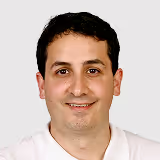
Marcel Kloos
Swiss-licensed dentist and founder of Medschool Experts
Marcel Kloos founded Medschool Experts while studying abroad; since then, over 500 study places have been secured. The Stuttgart-born dentist studied dentistry from 2015 to 2021 in Sofia and holds a Swiss dental licence.
Today he lives in Bern and runs Medschool Experts full-time as its owner.
More articles worth reading
Israeli Medical Students in Georgia: What the Yatziv Reform Means and Your Options in 2026
Transfer from Avicenna Batumi Medical University: Where to Continue Medicine in 2026
Transfer from Kutaisi University: Where to Continue Medicine in 2026
Ahmad
Sabrina
Rami
Noah
500+ students placed.
Now it's your turn!
No daydreaming, no empty promises. Just a clear plan — for the start of your medical degree.
40 minutes, no obligation