Clinician Scientist in Tübingen – Twelve Months of Research Count Towards Specialist Training
17.09.2026

How many months of research does Tübingen credit towards specialist training in 2026?
On 6 May 2026 the Faculty of Medicine in Tübingen and the Regional Medical Association of South Württemberg agreed that up to twelve months of patient-oriented research within a structured clinician scientist programme may be credited towards specialist training time. The conditions are a 36-month programme and a 50 percent release from clinical duties. The agreement runs until the end of 2029 and can be extended.
| Rule | Creditable research time | Conditions | Status |
|---|---|---|---|
| (Model) Specialist Training Regulations of the German Medical Association | in principle none, at most six weeks’ interruption per calendar year | scientific assignments do not count where no training takes place alongside them | 2018 version, last updated 3 July 2026 |
| Faculty of Medicine Tübingen with the Regional Medical Association of South Württemberg | up to twelve months | structured programme, 36-month duration, 50 percent release, patient-oriented project, joint review | agreement of 6 May 2026, valid until the end of 2029 |
| BIH Charité Clinician Scientist Programme with the Berlin Medical Association | up to 18 months | participation in the Berlin Institute of Health programme | Berlin Institute of Health figures, as at 2026 |
The review is project-specific rather than blanket. Faculty assessors, together with the training committee of the regional medical association, judge whether the research project is compatible with the requirements of specialist training. The faculty’s dean, Professor Stephan Zipfel, described the point of it in the press release of 29 May 2026 as follows: scientific findings are „not a sprint but a marathon“, and the agreement provides a tailwind along the way.
Specialist training lasts five to six years depending on the field. Twelve creditable months therefore amount to 17 to 20 percent of the total. That is not a symbolic figure. It is a year of one’s life at a stage when many doctors are planning a family and a career at the same time.
Why has research time so far not been credited automatically?
The (Model) Specialist Training Regulations of the German Medical Association in the 2018 version, last updated on 3 July 2026, provide in section 4(4) that interruptions to training do not count as training time. „Scientific assignments, where no training takes place“ are named explicitly. Interruptions of no more than six weeks per calendar year are exempt.
At first glance that contradicts the Tübingen agreement. It does not, and the resolution is worth reading carefully. First, the model regulations are only advisory; what is legally binding is the training regulation of the regional medical association you belong to. Second, the exclusion clause bites only where no training takes place during the research. With a 50 percent release that is precisely not the case: the other half of the working time remains clinical care under training conditions. Incidentally, the same wording as in the model regulations is found in the 2020 training regulations of the Baden-Württemberg Medical Association.
In its 2025 interim assessment of the clinician scientist programmes, the German Research Foundation names exactly this point as one of the central open tasks: uniform rules on the recognition by the regional medical associations of the competencies acquired during research time. As long as those are missing, the association district decides. Berlin recognises up to 18 months for the BIH Charité Clinician Scientist Programme; the programme started in 2011 with eight fellows, now counts more than 140 active participants and around 150 alumni, and the external evaluation appeared in May 2021.
How is a clinician scientist programme structured in practice?
Clinician scientist programmes are not scholarships but employment models. Part of the working time is contractually released for research and cross-financed through rotation posts, so that the hospital can absorb the gap in clinical care. Added to that are a structured curriculum, mentoring and central programme coordination. The German Research Foundation describes these elements as the minimum standard of its funding line.
In Tübingen the route is tiered. It begins with the Junior Clinician Scientist for doctors at the start of their specialist training, continues through the MINT-CS programme for translational work, and for now ends with the Advanced Clinician Scientist for qualified specialists, which according to the faculty provides for 30 percent research time over three years. Junior TüFF and TüFF Habil are complementary lines supporting women in science.
- protected research time of as a rule 50 percent, contractually guaranteed and cross-financed through rotation posts
- a curriculum covering methodology, statistics, study design and the fundamentals of clinical trials
- mentoring by one clinical and one scientific supervisor
- a defined research project with milestones and regular review
- onward prospects such as advanced programmes, junior research groups or professorships with a research component
Who funds clinician scientist programmes in Germany?
Since 2018 the German Research Foundation has funded a total of 23 clinician scientist programmes at faculties of medicine across two calls, 13 in the first round in 2018 and ten in the second round in 2022, with durations of up to five years. The Federal Ministry for Research, Technology and Space funds advanced programmes for the period after specialist certification; the relevant guideline was published on 24 September 2024.
| Funding route | Target group | Core conditions |
|---|---|---|
| DFG clinician scientist programmes | doctors in specialist training | 23 funded programmes since 2018, duration up to five years, protected research time through rotation posts, curriculum and mentoring |
| BMFTR advanced programmes | qualified specialists | guideline of 24 September 2024, continuation of a research career after specialist certification |
| Else Kröner Clinician Scientist Professorships | advanced candidates with a completed programme or at least one year of research release | 50 percent protected research time guaranteed by the institution, age limit as a rule under 38; first three professorships at the end of 2020 with up to one million euros over up to ten years |
| Institutional and faculty funds | all career stages | Tübingen example: around ten million euros for InnoSyn.2 and MINT-CS, reported in April 2026 |
Tübingen shows how much can come together at a single location. In April 2026 the Deutsches Ärzteblatt reported around ten million euros for two Tübingen programmes: roughly 7.9 million euros from the Federal Ministry for Research, Technology and Space for the ten-year programme „Medical Innovation through Synergy.2“ and 1.6 million euros from the German Research Foundation to continue MINT-CS.
Our own calculation, because this context is otherwise missing: the German Medical Faculty Association counts 40 voting faculties of medicine in Germany. Twenty-three DFG-funded programmes therefore correspond to around 58 percent of locations. Put differently: at roughly four in ten faculties there is no DFG-funded clinician scientist programme. The qualification here is that faculties may run their own or differently financed programmes; as far as our research goes, no complete public list of all programmes exists.
How research-intensive is German medicine in figures?
The Federal Statistical Office counted 1,571 habilitations in Germany for 2025, an increase of 0.4 percent on 2024. Of those, 911, or 58 percent, were in human medicine and health sciences, by some distance the largest share of any subject group. The proportion of women in this group was 36 percent, and the average age at habilitation across Germany was 42.
The subject dominates doctorates as well. Of the 212,400 doctoral candidates in 2024, around 28 percent were in human medicine and health sciences. On the care side: as at 31 December 2025 the German Medical Association records a total of 446,120 practising doctors, of whom 233,519 work in hospitals.
At first glance these figures look like a contradiction of the research-bottleneck thesis. My assessment of that, clearly marked as such: habilitations count titles, not protected time. In medicine a large share of this work is produced alongside clinical care, in evenings and at weekends. The average age of 42 is the most telling value in the whole dataset. It describes how long this dual path takes when nobody underwrites it structurally.
How do other countries combine research and specialist training?
Other health systems place the link at a different point in a career. The United States front-loads research through MD-PhD programmes before entry into practice, the United Kingdom integrates 25 and later 50 percent research time into specialist training, Switzerland funds a standalone MD-PhD phase, and the Netherlands interlocks it with the degree itself.
| Country | Model | Research share | Relationship to specialist training |
|---|---|---|---|
| Germany | clinician scientist programmes after medical licensing | as a rule 50 percent | credited by the regional medical association, up to twelve months in Tübingen and up to 18 in Berlin |
| United States | MD-PhD, partly funded as an MSTP through T32 | doctorate before entering practice | research comes before residency, 620 MD-PhD graduations in 2020 |
| United Kingdom | Academic Clinical Fellowship, then Clinical Lectureship | 25 percent, later 50 percent | integrated into specialist training, progress assessed on competencies |
| Switzerland | national MD-PhD scholarship programme since 1992 | two to three years of full-time research | standalone phase, 18 of 40 applications approved in 2025 |
| Netherlands | MD-PhD track during the degree | planned individually | starts in the first master’s year, master’s degree completed before the defence |
Behind these lines sit figures that make the price of each model visible. According to an analysis in JCI Insight from 2022, there are around 50 NIGMS-funded MD-PhD programmes in the United States and almost as many without NIH funding; in 2020, 620 MD-PhD graduations stood against 20,387 straight MD graduations, and the average time to completion rose from 6.69 years in the 1975 to 1984 cohort to 8.25 years in the 2005 to 2014 cohort. The report of the NIH Physician-Scientist Workforce Working Group of 4 June 2014 puts the share of research-active doctors at 1.5 percent of the medical profession; the average age of NIH-funded researchers holding an MD rose from 48 to 51 between 2003 and 2012. Early structured support has a measurable effect: those who had previously held a K award achieved a project funding success rate of 44.1 percent, against 9.2 percent without such prior support.
The United Kingdom shows the flip side of integration. The NIHR Academic Clinical Fellowship lasts up to three years, and up to four in general practice and dentistry, reserving 25 percent of the time for research; the clinical 75 percent counts towards specialist training as normal. The Medical Schools Council survey of 2025 counts 3,105 full-time equivalents of clinical academics in total, but a fall from 140 to 105 full-time equivalents in the under-36 age group. A Medical Research Council report from January 2025 therefore recommends increasing the number of permanent research posts by 40 a year over five years.
Switzerland has supported the MD-PhD since 1992 through a national scholarship programme, run jointly with the Swiss National Science Foundation until 2024 and today carried by the Swiss Academy of Medical Sciences. In the 2025 call, 18 of 40 applications were approved, with a total volume of 3,028,273 francs. At Amsterdam UMC the MD-PhD track starts in the first master’s year; the master’s degree must be completed before the defence.
Is the clinician scientist route also open with a degree from elsewhere in the EU?
Yes. Article 21(1) of Directive 2005/36/EC obliges every member state to recognise the evidence of formal qualifications listed in Annex V. Article 24(2) sets the minimum requirement at at least five years of study and at least 5,500 hours of theoretical and practical training. With the German medical licence (Approbation) in hand, access to specialist training, and therefore to the programmes, is the same as after a German degree.
I studied dentistry in Sofia from 2015 to 2021 and later had my own diploma recognised, in Switzerland through the Medical Professions Commission MEBEKO. I am not a clinician scientist, and I will not pretend to have walked this route myself. What I took away from the recognition procedure fits here nonetheless: the European framework does not ask where you trained but whether the training meets the minimum requirements. That single distinction decides more about career paths than any ranking.
The second building block is the doctorate. The doctoral regulations of the Tübingen Faculty of Medicine for the Dr. med. and Dr. med. dent. require in section 3(1) a degree completed in Germany as a general rule, but make clear in subsection 1(b) that degrees from foreign universities can be recognised if they are equivalent. In cases of doubt the Central Office for Foreign Education can be consulted, and language skills must as a rule be evidenced at C1 level. For EU degrees covered by automatic recognition, equivalence is in substance already secured under European law.
One area of uncertainty remains, stated honestly: doctoral regulations differ from faculty to faculty, and some require additional evidence. Studying in Sofia, Plovdiv, Pécs or Zagreb does not rule out an academic career in Germany, but it does not replace reading the regulations of the faculty you have in mind. If you want to know which locations and study models fit such a goal, you can arrange a free consultation with us.
What can students do early on for a research career?
The clinician scientist route does not begin with an application for a programme place but considerably earlier. Anyone who wants to keep the option open chooses a doctoral project with a clinical or translational focus, builds methodological skills, and pays attention when taking a first training post to how the responsible regional medical association recognises research time.
- choose a doctoral project with a clinical or translational focus rather than treating it as a formality
- build methodological skills: statistics, study design, the fundamentals of good clinical practice
- do clinical placements deliberately at research-active hospitals and build contacts there
- aim for first publications or conference contributions, including as a co-author
- before taking a first training post, check whether the location has a structured programme and how the association recognises research time
The last point has become more important since the Tübingen agreement, because recognition practice has turned into a genuine criterion for choosing between hospitals. Anyone planning both, specialist training and research, should raise this question at interview. It costs three sentences and can be worth a year.
This article reflects the position as at August 2026 and is intended as general information; it does not replace legal advice in an individual case. What is decisive are the training regulations of the responsible regional medical association in force at the time and the doctoral regulations of the faculty concerned.
The author’s view
I studied dentistry in Sofia from 2015 to 2021 and am today a Swiss-licensed dentist; I run Medschool Experts from Bern. What strikes me first about the Tübingen agreement is something that is not in the foreground at all: it shows how much in medicine is decided by time and how little by talent alone. Twelve creditable months are not a prize for particularly bright minds. They are a structural permission to do two things at once that otherwise crowd each other out.
What I find convincing is that the faculty and the regional medical association review jointly. That protects the quality of specialist training while still creating predictability. That combination is exactly what young doctors need when choosing between a straight specialist career and a path with a research component. Such decisions are rarely made out of idealism. They are made when the arithmetic works.
I say openly that I am not a clinician scientist myself. As a father and as a clinician, though, I know the quantity at stake here very well: time. Anyone who moves into practice after graduating quickly notices that the day is structured from the outside, by appointments, emergencies and people in pain. Anything meant to happen alongside that needs a contract to protect it. That is precisely what these programmes provide.
The second point comes up in almost every conversation. Many prospective students believe that a degree from elsewhere in the EU is a second-class route that runs into a wall at the latest when it comes to research. That is not true. Automatic recognition under Directive 2005/36/EC is not an act of grace but the European norm. Anyone who completes the required five years and 5,500 hours in Sofia, Plovdiv or Pécs stands on the same footing as any German graduate when it comes to licensing and access to specialist training.
One qualification belongs here nonetheless, and I would rather state it myself: a programme place is not thereby guaranteed. Places are scarce, selection is competitive, and at four in ten faculties there is no DFG-funded programme. The same starting line does not mean the same result.
When we started Medschool Experts, all of this was harder to convey. We were the first agency to show for free, in near-daily YouTube videos and interviews with real medical students abroad, what this route actually looks like, with lecture halls, exams, flat-hunting and everyday life. I now see graduates from those cohorts working, taking doctorates and specialising in German and Swiss hospitals.
My practical advice: treat the doctoral project as your first real piece of work, not as a box to tick. And before your first training post, check which hospital offers a structured programme and how the responsible association handles it. That single question can decide a whole year of your professional life, and at interview it costs thirty seconds.
Summary
- On 6 May 2026 the Tübingen Faculty of Medicine and the Regional Medical Association of South Württemberg agreed to credit up to twelve months of patient-oriented research towards specialist training.
- The condition in Tübingen is a structured clinician scientist programme with a 36-month duration and a 50 percent release; the agreement runs initially until the end of 2029.
- The German Medical Association’s 2018 (Model) Specialist Training Regulations do not in principle credit research time without concurrent training; the binding decision rests with the responsible regional medical association.
- For the BIH Charité Clinician Scientist Programme, the Berlin Medical Association recognises up to 18 months of research activity, according to the Berlin Institute of Health.
- Since 2018 the German Research Foundation has funded a total of 23 clinician scientist programmes; with 40 faculties of medicine in Germany, that corresponds to around 58 percent of locations.
- The clinician scientist route is also open with a degree from elsewhere in the EU, because Article 21 of Directive 2005/36/EC recognises those qualifications without an equivalence assessment of course content.
With the agreement of 6 May 2026, Tübingen turns a case-by-case decision into a rule. Because the model training regulations do not in principle credit research time without concurrent training, and because the regional medical associations set the binding rules, such agreements are the decisive lever. Berlin goes further at up to 18 months; other association districts remain more cautious.
Internationally there is no single right moment for research. The United States front-loads it with MD-PhD programmes before entry into practice, the United Kingdom integrates 25 and later 50 percent research time into specialist training, Switzerland funds a standalone MD-PhD phase, and the Netherlands interlocks it with the degree. Germany takes the route of protected time after medical licensing and is making it more dependable location by location.
For prospective students one thing matters above all: this route does not depend on where in the EU the degree was taken. Automatic recognition under Article 21 of Directive 2005/36/EC and the recognition rules in the doctoral regulations keep the door open. Anyone wanting to plan their studies with such a goal in mind can get their bearings with us in a free consultation.
Further reading
- The German medical licence (Approbation) and recognition of an EU medical degree, the legal basis for the clinician scientist route being open with an EU degree.
- Recognition of foreign qualifications in the healthcare professions in 2026, with the difference between the EU route and the non-EU route.
- How the medical degree in Bulgaria is structured, how the five years and 5,500 hours of the EU directive are put into practice.
- Transferring back to Germany and credit for semesters, credit as a principle, here applied to the degree itself.
- The practical year in 2026 and the state of the reform, the phase where clinical practice and scientific work first meet.
Frequently Asked Questions about the clinician scientist route
What exactly did Tübingen agree with the regional medical association?
On 6 May 2026 the Tübingen Faculty of Medicine and the Regional Medical Association of South Württemberg agreed that up to twelve months of patient-oriented research within one of the faculty’s structured clinician scientist programmes may be credited towards specialist training time. The agreement runs until the end of 2029 and can be extended.
What conditions must the programme meet?
According to the published information it must be a structured clinician scientist programme with a 36-month duration and a 50 percent release for research. Faculty assessors and the training committee of the regional medical association additionally review together whether the specific project is compatible with training requirements.
Why is research time not credited automatically?
The German Medical Association’s 2018 (Model) Specialist Training Regulations provide in section 4(4) that interruptions to training, expressly including those for scientific assignments, do not count as training time where no training takes place alongside them. Up to six weeks per calendar year are exempt. In any case it is not the model regulations that bind, but those of the responsible regional medical association.
Does the Tübingen agreement contradict the model training regulations?
No. The model regulations are only advisory, and their exclusion clause applies only where no training takes place during the research. With a 50 percent release, the other half of the working time remains clinical care under training conditions, which is why the association can credit the time.
Are there locations that recognise more than twelve months?
Yes. For the BIH Charité Clinician Scientist Programme, up to 18 months of research activity is recognised by the Berlin Medical Association, according to the Berlin Institute of Health. The rules differ between association districts, so it is worth looking at practice at the location you have in mind.
What is a clinician scientist in the first place?
The term refers to doctors who combine clinical care and research on a lasting basis. The route usually runs through structured programmes with contractually protected research time, a curriculum, mentoring and defined project milestones. In Tübingen it is tiered from Junior Clinician Scientist through MINT-CS to Advanced Clinician Scientist.
Who funds such programmes in Germany?
Since 2018 the German Research Foundation has funded a total of 23 clinician scientist programmes across two rounds, 13 in 2018 and ten in 2022, with durations of up to five years. The Federal Ministry for Research, Technology and Space funds advanced programmes on the basis of a guideline of 24 September 2024. Foundations and faculty funds come on top of that.
At how many faculties is there a DFG-funded programme?
The German Medical Faculty Association counts 40 voting faculties of medicine in Germany. Twenty-three DFG-funded clinician scientist programmes therefore correspond to around 58 percent of locations. Individual faculties additionally run their own or differently financed programmes; no complete public list exists.
What share of German habilitations is in medicine?
According to the Federal Statistical Office there were 1,571 habilitations in 2025. Of those, 911, or 58 percent, were in human medicine and health sciences. The average age at habilitation across Germany was 42, and the proportion of women in this subject group was 36 percent.
Is the route also open with a medical degree from elsewhere in the EU?
Yes. Article 21(1) of Directive 2005/36/EC obliges every member state to recognise the evidence of formal qualifications listed in Annex V. Article 24(2) requires at least five years of study and at least 5,500 hours of theoretical and practical training. With the medical licence in hand, access to specialist training, and therefore to the programmes, is the same.
Can you take a doctorate in Germany with an EU degree from abroad?
The doctoral regulations of the faculties of medicine provide for it. The Tübingen regulations for the Dr. med. and Dr. med. dent. provide in section 3(1)(b) that degrees from foreign universities can be recognised if they are equivalent. In cases of doubt the Central Office for Foreign Education can be consulted; language skills must as a rule be evidenced at C1 level.
How is the route organised in the United States and the United Kingdom?
In the United States the MD-PhD before entry into practice dominates; in 2020, 620 MD-PhD degrees were awarded against 20,387 straight MD degrees, and the average programme duration rose to 8.25 years in the 2005 to 2014 cohort. In England the entry point is the Academic Clinical Fellowship with up to three years and 25 percent research time, followed by the Clinical Lectureship with up to four years and 50 percent research time.
How does Switzerland support research-active doctors?
Through a national MD-PhD scholarship programme that has existed since 1992 and was run jointly with the Swiss National Science Foundation until 2024; today it sits with the Swiss Academy of Medical Sciences. In the 2025 call, 18 of 40 applications were approved, the total volume was 3,028,273 francs, and funding runs for two to three years.
What students say about Medschool Experts
Over 500 placements at more than 25 partner universities across 10+ countries. Read independent student reviews on Trustpilot.
About the author
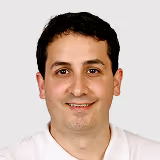
Marcel Kloos
Swiss-licensed dentist and founder of Medschool Experts
Marcel Kloos founded Medschool Experts while studying abroad; since then, over 500 study places have been secured. The Stuttgart-born dentist studied dentistry from 2015 to 2021 in Sofia and holds a Swiss dental licence.
Today he lives in Bern and runs Medschool Experts full-time as its owner.
More articles worth reading
Health Insurance for International Medical Students in Europe 2026
Scholarships and Funding for Medical Studies in Europe 2026
Medicine, Dentistry, Pharmacy or Veterinary Medicine? Choosing Your Degree Abroad in 2026
Ahmad
Sabrina
Rami
Noah
500+ students placed.
Now it's your turn!
No daydreaming, no empty promises. Just a clear plan — for the start of your medical degree.
40 minutes, no obligation