Studying Medicine at IUS in Sarajevo: Costs and Recognition
17.09.2026

Sarajevo at a glance
| Feature | Details (as of 2026) |
|---|---|
| University | International University of Sarajevo (IUS), founded 2004 |
| Campus | Ilidža district in the west of Sarajevo, close to the airport |
| Programmes | Human medicine, dentistry |
| Language of instruction | English |
| Standard duration | 6 years, 12 semesters, 360 ECTS |
| Tuition fee, international | 13,750 EUR per academic year |
| Tuition fee, Balkan region | 8,250 EUR per academic year |
| Programme start | Winter semester, one intake per year |
| Selection | The university's own application procedure with separate quotas |
| Living costs | around 600 EUR per month |
| Recognition in Germany | Equivalence assessment under section 3 of the Federal Medical Practitioners Act, otherwise a knowledge examination |
This overview answers the questions that come up in the first five minutes of a consultation. Everything else depends on your personal situation, and that is where it gets interesting: the location is more expensive than the state faculties in the region, but it is English-language, has no entrance examination in the classic sense, and offers a second degree route via Turkey.
University and hospital
The International University of Sarajevo was established in 2004 as a private institution with an international profile. It is divided into six faculties, from engineering through business and law to the Faculty of Medical Sciences, which is responsible for human medicine and dentistry. The campus is in Ilidža, a suburb in the west of the city connected to the centre by tram. The language of instruction is English throughout, and the teaching staff come from around a dozen countries.
The university has been assessed several times for quality assurance. IUS programmes, including medicine, hold accreditation from the German agency ASIIN for the period 2026 to 2031; ASIIN is listed in the European Quality Assurance Register (EQAR). Added to this is state recognition via the Bosnian agency HEA, as well as institutional accreditation from the Turkish quality agency YÖKAK. This combination is unusual and is explained by the dual-degree programme with the University of Health Sciences in Istanbul.
Clinical training takes place at facilities in Sarajevo. The city's largest hospital is the Clinical Centre of the University of Sarajevo, founded in 1894 as the regional hospital and today running 37 clinical departments with, according to a 2020 report, around 3,317 staff. The faculty also names the Institute for Emergency Medicine of Sarajevo Canton, among others, as a site for practical placements. Sarajevo is therefore the medical centre of the country, and the distances between hospitals are short.
The same thing strikes me about this location every year: the students who arrive underestimate the size of the campus and overestimate the distance to the city centre. Ilidža looks remote on the map, but it is not in daily life.
Which programmes are offered, and in which language?
| Programme | Standard duration | Language of instruction |
|---|---|---|
| Human medicine | 6 years, 360 ECTS | English |
| Dentistry | 6 years, 360 ECTS | English |
| Pharmacy | not offered at this location | – |
| Veterinary medicine | not offered at this location | – |
Both medical programmes follow the same model: six years, twelve semesters, 360 ECTS credits, organised as a dual-degree programme with the Turkish partner university. You study in Sarajevo, and the curriculum and degree are aligned with the University of Health Sciences. No change in the language of instruction is planned during the programme; the entire path to graduation runs in English.
For daily life in the hospital you will nonetheless need Bosnian. Patients in Sarajevo speak Bosnian, Croatian, or Serbian, and you notice this at the latest during your first patient history. Anyone who starts learning the language on the side in the first year will find things considerably easier from the third year onwards. The university does not require a language certificate for this; what it does require is proof of adequate English.
How does admission work?
The International University of Sarajevo selects through its own application procedure. It provides separate quotas for domestic, Turkish, and international applicants, so you are not competing with the entire applicant field but within your own contingent. Your secondary school qualification and your proof of English are assessed. There is no multi-hour entrance examination in the style of a medical aptitude test, and there is no numerus clausus.
Access is broader than many expect. Alongside the general university entrance qualification, Bosnia and Herzegovina also recognises the subject-specific entrance qualification (Fachhochschulreife) as a basis, and a completed vocational qualification in healthcare, in nursing for instance, can also open the door. This is expressly not automatic: the university assesses each educational background individually. Whether your route works is something we assess individually in a free consultation, before anything is submitted.
Medschool Experts handles the process in full. We take care of the documents, submit them on time, and maintain contact with the university. The procedure can generally be completed entirely online; you do not need to travel to Sarajevo for the application. What you have to bring is time to prepare.
We prepare you for the academic side in biology and chemistry, that is, upper secondary school material. In addition there is the interview with the university, in which your motivation counts: why medicine, why study abroad, how you will organise the six years. Anyone who is prepared for it comes across differently from someone thinking about it for the first time.
What does the programme cost?
| Item | Amount | Frequency |
|---|---|---|
| Tuition fee, international | 13,750 EUR | per academic year |
| Tuition fee, Balkan region | 8,250 EUR | per academic year |
| Total living costs | around 600 EUR | per month |
| Flat outside the centre | 552 KM, around 282 EUR | per month |
| Monthly public transport pass | 60 KM, around 31 EUR | per month |
The fees are taken from the official fee schedule of the International University of Sarajevo for the 2026/2027 academic year, and the housing and transport figures from Numbeo as of 7 August 2026. The Bosnian convertible mark is pegged to the euro, so the amounts convert cleanly. On top of this come textbooks, working materials, and one-off costs around the application.
| Item | Calculation | Total |
|---|---|---|
| Tuition fees | 6 x 13,750 EUR | 82,500 EUR |
| Living costs | 72 x 600 EUR | 43,200 EUR |
| Books, materials, trips home | estimate over six years | around 6,000 EUR |
| Total cost (estimate) | sum of the items | around 131,700 EUR |
This total is an estimate, not a commitment from the university. It assumes constant fees over six years and an average lifestyle. Anyone living in a shared flat and cooking for themselves will come in below on living costs; anyone flying home frequently will come in above. What matters is that the funding is in place from the outset, because the fee falls due annually rather than all at once.
| Location | Tuition fee | Language |
|---|---|---|
| International University of Sarajevo | 13,750 EUR per year | English |
| Sarajevo School of Science and Technology | 13,200 EUR per year | English |
| University of East Sarajevo, Foča Faculty | 3,500 EUR per year | English |
| University of Mostar | 4,600 EUR per semester | English |
The range within Bosnia and Herzegovina is wide, and it is explained by ownership: IUS and the Sarajevo School of Science and Technology are private institutions, while the state faculty in Foča is considerably cheaper. What the price difference means in daily study life we have set out in detail in our guide to the University of East Sarajevo. In the end, what counts for the decision is not the lowest price but the fit between programme, language, and your timetable.
{{cta}}
How is the programme structured?
| Stage | Years of study | Focus |
|---|---|---|
| Pre-clinical stage | Years 1 to 2 | Anatomy, physiology, biochemistry, histology, embryology |
| Clinical stage | Years 3 to 5 | Internal medicine, surgery, paediatrics, gynaecology, neurology, psychiatry |
| Final year | Year 6 | predominantly practical, at hospitals in Sarajevo |
| Total | Years 1 to 6 | 12 semesters, 360 ECTS, dual-degree programme |
The first two years are foundational work: anatomy, physiology, biochemistry, histology, and embryology, along with the natural science subjects. From the third year the weight shifts towards the clinic, and the placements at the Sarajevo hospitals begin. The final year is largely practical, so you work mostly with patients rather than in the lecture theatre.
The technical vocabulary is new to everyone at the start, regardless of native language. Anatomy brings its own vocabulary, and after a semester that vocabulary is routine. Clinical placements during the semester breaks can also be completed in Germany; the body responsible for your later Approbation decides on recognition, so you should clarify this before making a firm booking.
Where may you work as a doctor with this degree?
| Country | Route to professional authorisation |
|---|---|
| Germany | Equivalence assessment under section 3 of the Federal Medical Practitioners Act, otherwise a knowledge examination, then Approbation |
| Austria | Nostrification at a medical university, then entry in the physicians' register |
| Switzerland | Recognition procedure for third-country diplomas, usually with an additional examination |
| Rest of the EU | no automatic recognition, national third-country procedure in each case |
| United Kingdom | Registration with the General Medical Council, usually via the PLAB examinations |
| USA | ECFMG certification; since 01.01.2023 only with WFME-recognised accreditation of the university |
The most important point first: Bosnia and Herzegovina is not a member of the European Union. Automatic recognition of medical training qualifications is governed by Directive 2005/36/EC via Annex V, in the version of Delegated Decision (EU) 2023/2383 of 23.05.2023, applicable since 09.10.2023; doctors appear there under number 5.1.1. Bosnian degrees are not listed in that annex. For Germany the route therefore runs via section 3 of the Federal Medical Practitioners Act: the competent state authority assesses whether your training is equivalent to the German medical degree. If the outcome is positive, the Approbation follows without further examination. If it is negative, you sit the knowledge examination, an oral and practical examination covering the material of the German state examination, and receive the Approbation afterwards. Many graduates already work during this phase under a temporary practice permit.
A separate logic applies to the United States. Since 01.01.2023, ECFMG certification has required the medical school to be accredited by an agency recognised by the World Federation for Medical Education. The Bosnian national agency HEA, responsible for the development of higher education and for quality assurance and a member of the European network ENQA, does not appear on the list of WFME-recognised agencies as of August 2026; nor does the German agency ASIIN. Anyone seriously planning the US route should clarify this point individually in advance. How the procedures in Germany work in detail we have broken down in our article on the recognition of foreign qualifications in the health professions.
Dentist, pharmacist, psychologist, veterinarian: the legal position for each profession
Dentist. The International University of Sarajevo offers dentistry on the same model: six years, 360 ECTS, taught in English, within the dual-degree programme. Directive 2005/36/EC lists dentists in Annex V under number 5.3.2, but here too the listing applies only to degrees from member states. For a Bosnian degree, the competent state authority assesses equivalence under the German Dental Practice Act; if the outcome is negative, a knowledge examination follows and then the Approbation as a dentist.
Pharmacist. Pharmacy is not part of the International University of Sarajevo's programme, so this profession cannot be studied at this location. For context, the legal framework nonetheless: Directive 2005/36/EC lists pharmacists in Annex V under number 5.6.2, and automatic recognition applies only to training qualifications from EU member states. A degree from a third country goes through an equivalence procedure under national law here too.
Psychologist. Psychology and psychotherapy are not harmonised under European law; they simply do not appear in Annex V of Directive 2005/36/EC. Each member state regulates access and professional title itself, in Germany via the Psychotherapists Act and the associated licensing regulations. A qualification obtained abroad is therefore always assessed individually, regardless of whether it comes from the EU or not. This route is not offered in the medical field at IUS.
Veterinarian. Veterinary medicine is likewise not part of the programme at the International University of Sarajevo. In legal terms, veterinary surgeons appear in Annex V of Directive 2005/36/EC under number 5.4.2, with the same basic rule: automatic recognition within the Union, case-by-case assessment for degrees from third countries. Anyone who wants to study veterinary medicine is better served at another location, and we discuss that openly in a free consultation.
Career paths after graduation
Once equivalence has been established or the knowledge examination passed, specialist training in Germany is open to you. It follows the training regulations of the relevant state medical association, lasts five to six years depending on the specialty, and takes place at approved training institutions. From this point the path no longer differs from that of a colleague trained in Germany, because the Approbation is the entry ticket, not the place of study.
The dual degree with the University of Health Sciences is what distinguishes this location. It additionally opens routes in Turkey, whose health system is growing strongly and whose medical education is overseen by the agency TEPDAD, recognised by the World Federation for Medical Education until July 2033. Working as a doctor in Bosnia and Herzegovina itself is also possible, as is entering research, public health, or the pharmaceutical industry. What doors a European medical degree opens internationally is shown in our overview of career paths with an EU medical degree.
Lateral entry, transfers, and switching back to Germany
The programme works with 360 ECTS credits, and you receive a Transcript of Records for your performance. A transfer to a German faculty is therefore conceivable in principle, but it is never automatic. The receiving university decides on each individual credit recognition, and places in higher semesters are scarce, particularly in human medicine. Anyone wanting to switch back from Sarajevo therefore needs stamina and a willingness to finish the degree in Sarajevo if necessary.
In the other direction, lateral entry is easier. Anyone who has already accumulated semesters in a natural science subject in Germany, or who comes from a healthcare training background, brings prior knowledge that helps noticeably in the first year. It is not credited automatically at IUS, as the university assesses this individually. What I encounter again and again in conversations: the switch back is planned as a self-evident option, even though it is the least certain variant in the whole process. Details on this can be found in our article on switching back to Germany.
Living in Sarajevo: city, distances, costs
Sarajevo has around 275,000 inhabitants within the city area and lies in a basin in the Dinaric Alps. Ottoman, Austro-Hungarian, and socialist architecture meet in a small space; the historic centre is Baščaršija with its workshops and coffee houses. The Jahorina and Bjelašnica ski areas are less than an hour away, which noticeably raises the city's recreational value in winter.
The campus in Ilidža is close to the airport, so connections to Germany, Austria, and Switzerland are correspondingly short. Within the city, the monthly public transport pass costs 60 KM, around 31 EUR; a flat outside the centre costs 552 KM or around 282 EUR a month, and in the centre 813 KM, around 416 EUR (Numbeo, as of 7 August 2026). A meal in a simple restaurant costs about 15 KM, around 8 EUR.
In total, around 600 EUR a month covers rent, food, transport, and insurance. Sarajevo is therefore among the most affordable university cities in Europe, and that circumstance noticeably cushions the tuition fee. Anyone living in a shared flat will come in below. English gets you a good way in daily life; a few words of Bosnian get you considerably further, especially outside the centre.
Who this location suits
The International University of Sarajevo suits you if you want to study in English, are looking for an international environment, and have funding secured over six years. It suits you if you want to start without a numerus clausus and are coming with a subject-specific entrance qualification or a completed healthcare training that leaves other doors closed. And it suits you if the second degree route via Turkey appeals to you.
The location is a less good fit if you are looking for the cheapest programme in the region, or if you are firmly counting on switching back to Germany after two years. Both are more realistic at other locations, and we have a suitable partner university in our portfolio for almost every case.
My assessment: anyone who commits to Sarajevo gets an English-language degree in a city you do not forget after six years, and should plan the recognition route to Germany from day one rather than in the final year. That is exactly what we work through together in the free consultation.
The author's view
I studied dentistry in Sofia from 2015 to 2021, in English, far from home and with all the detours such a path brings with it. Sarajevo reminds me of that time: a city that seems foreign at first and is self-evident after six months, a campus where nobody asks where you come from, and a curriculum that makes no allowance for homesickness. That parallel helps me in every conversation about this location.
Three things about the International University of Sarajevo convince me. First, the firmness of the programme: six years, 360 ECTS, a clear progression from the pre-clinical to the clinical stage. Second, the quality assurance, which is secured several times over by the ASIIN accreditation for 2026 to 2031 and by the institutional review carried out by the Turkish agency. And third, living costs of around 600 EUR a month, which gives a family a great deal of room over six years.
To be honest: the degree comes from a country that is not part of the European Union, and that lengthens the route to Germany. Instead of automatic recognition, the equivalence assessment under section 3 of the Federal Medical Practitioners Act applies, and in the unfavourable case a knowledge examination as well. That is manageable, but it costs time and nerves, and anyone who discovers this point only in their final year has made life unnecessarily hard for themselves.
Today I run Medschool Experts in Bern as my main occupation and am a Swiss-licensed dentist. We are the exclusive representative for the International University of Sarajevo, which means we do not administer the location from a distance but know the procedures and keep an eye on the deadlines. My advice remains the same as it was for me ten years ago: choose the location where you actually want to live for six years.
Summary
- The International University of Sarajevo is a private institution founded in 2004, with a campus in Ilidža and just under 3,000 students from more than 45 countries.
- Human medicine and dentistry last six years, comprise 360 ECTS, and are taught entirely in English, organised as a dual-degree programme with the Turkish University of Health Sciences.
- The tuition fee is 13,750 EUR per year for international students and 8,250 EUR for applicants from the Balkan region (academic year 2026/2027).
- There is no numerus clausus; alongside the general university entrance qualification, the subject-specific entrance qualification and a completed healthcare training may be considered, each on a case-by-case basis.
- Living costs are around 600 EUR per month, and a flat outside the centre around 282 EUR (Numbeo, as of 7 August 2026).
- Because Bosnia and Herzegovina is not part of the EU, the route in Germany runs via the equivalence assessment under section 3 of the Federal Medical Practitioners Act, otherwise via the knowledge examination, and ends with the Approbation.
Conclusion
Sarajevo is a location for anyone who wants to study in English, values an international environment, and has funding under control over six years. The combination of a clear curriculum, a dual degree route, and low living costs is rare in Europe. Anyone who considers the recognition route early on reaches the German Approbation in a predictable way.
Whether this location fits your educational path depends on details that cannot be answered in general terms: your qualification, your timetable, and your funding. That is exactly what we take time for; we assess your case individually and then handle the entire organisation – simply arrange a free consultation.
Further reading
- Studying medicine abroad without a numerus clausus – all locations, costs, and funding routes at a glance.
- Tuition fees compared – what a medical degree costs at Europe's numerus clausus-free universities.
- Approbation and recognition – how a degree from abroad becomes a German professional licence.
- Living costs 2026 – what life costs each month at the European study locations.
- Switching back to Germany – credit recognition, deadlines, and applying for a higher semester.
Frequently Asked Questions About Studying Medicine in Sarajevo
What does the medical programme at the International University of Sarajevo cost?
International students pay 13,750 EUR per academic year, and applicants from Bosnia and Herzegovina and the rest of the Balkan region 8,250 EUR. Over six years that comes to around 82,500 EUR in fees alone for international students. The amount falls due annually rather than all at once, and should be secured from the outset.
Is there a numerus clausus at IUS Sarajevo?
No, the university does not use a school-leaving grade as an admission hurdle. Selection is through its own application procedure with separate quotas for domestic, Turkish, and international applicants. Your secondary school qualification and your proof of English are assessed. There is no multi-hour entrance examination in the style of a medical aptitude test. What matters is a complete application submitted on time.
Do the subject-specific entrance qualification or a nursing qualification count?
Both routes may be considered in Bosnia and Herzegovina. Alongside the general university entrance qualification, the university also assesses the subject-specific entrance qualification (Fachhochschulreife) as well as a completed vocational qualification in healthcare, in nursing for instance. This is not automatic, as every application is assessed individually. Whether your route works is something we check in advance in a free consultation.
In which language is the programme taught?
The entire programme runs in English, from the pre-clinical subjects to the practical final year. Proof of adequate English is required; upper secondary school English is generally a sound basis for this. Medical terminology is new to everyone at the start of the programme and becomes routine after about a semester. For contact with patients you will also need Bosnian.
How long is the programme and how many ECTS does it carry?
The programme comprises six years, twelve semesters, and 360 ECTS credits, that is around 30 credits per semester. The first two years are pre-clinical; from the third year the clinical subjects follow, with placements at hospitals in Sarajevo. The sixth year is largely practical and takes place mostly with patients.
When does the academic year in Sarajevo begin?
The programme starts in the winter semester; there is no summer semester intake. You therefore have one attempt per year, and a missed intake costs twelve months. It is worth preparing the application early, ideally during your final year at school. We organise the whole process for you.
Is the degree recognised in Germany?
Not automatically, because Bosnia and Herzegovina is not part of the European Union and is not listed in Annex V of Directive 2005/36/EC. Instead, the competent state authority assesses whether your training is equivalent to the German medical degree. If the outcome is positive, the Approbation follows without further examination; otherwise a knowledge examination applies.
How does the equivalence assessment work in practice?
You apply for the Approbation to the authority in your federal state, which compares your training with the German degree under section 3 of the Federal Medical Practitioners Act. If equivalence is established, you receive the Approbation directly. Otherwise you sit the knowledge examination, an oral and practical examination covering the material of the German state examination, and the Approbation follows.
What does the dual degree with the University of Health Sciences mean?
The medical programme is organised jointly with the Turkish University of Health Sciences. You study in Sarajevo, and the curriculum and degree are aligned with the partner university. For you this means a second footing for later professional recognition, in Turkey for example. The dual degree has no automatic bearing on the German equivalence assessment.
Do I have to learn Bosnian?
Not for the teaching, but yes for the clinic. Lectures and examinations run in English, but patients in Sarajevo speak Bosnian, Croatian, or Serbian. From the clinical stage at the latest you notice this in every patient history. Anyone who starts with the language early on the side finds the placements considerably easier.
How high are the living costs in Sarajevo?
Around 600 EUR a month covers rent, food, transport, and insurance. According to Numbeo, as of 7 August 2026, a flat outside the centre costs 552 KM, around 282 EUR, and the monthly public transport pass 60 KM, around 31 EUR. Sarajevo is therefore among the most affordable university cities in Europe.
Can I also study dentistry at IUS?
Yes, dentistry follows the same model as human medicine: six years, 360 ECTS, taught in English and organised within the dual-degree programme. Pharmacy and veterinary medicine, by contrast, are not part of this university's programme. For recognition in Germany the same principle applies as in human medicine: the state authority assesses equivalence. Which programme fits your plans is something we clarify together in advance in a free consultation.
Can I transfer to Germany with my ECTS credits?
The programme works with 360 ECTS credits, and you receive a Transcript of Records for your performance. A transfer to a German faculty is therefore conceivable, but it is never automatic. The receiving university decides on each individual credit recognition, and places in higher semesters are scarce. Plan your degree, therefore, so that it can also be completed in Sarajevo.
What students say about Medschool Experts
Over 500 placements at more than 25 partner universities across 10+ countries. Read independent student reviews on Trustpilot.
About the author
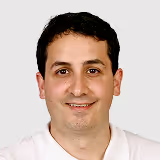
Marcel Kloos
Swiss-licensed dentist and founder of Medschool Experts
Marcel Kloos founded Medschool Experts while studying abroad; since then, over 500 study places have been secured. The Stuttgart-born dentist studied dentistry from 2015 to 2021 in Sofia and holds a Swiss dental licence.
Today he lives in Bern and runs Medschool Experts full-time as its owner.
More articles worth reading
Health Insurance for International Medical Students in Europe 2026
Scholarships and Funding for Medical Studies in Europe 2026
Medicine, Dentistry, Pharmacy or Veterinary Medicine? Choosing Your Degree Abroad in 2026
Ahmad
Sabrina
Rami
Noah
500+ students placed.
Now it's your turn!
No daydreaming, no empty promises. Just a clear plan — for the start of your medical degree.
40 minutes, no obligation