Rīga Stradiņš University: Studying Medicine in Latvia
17.09.2026

What distinguishes Rīga Stradiņš University?
Rīga Stradiņš University is Latvia's leading medical institution: 12,474 students, 63 study programmes and 35 clinical training sites. It was founded on 1 September 1950. The university teaches medicine and dentistry in English, and the staff-to-student ratio is one teacher to ten students.
| Feature | Detail (as of August 2026) |
|---|---|
| Founded | 1 September 1950 as the Riga Medical Institute, current name since 2002 |
| Named after | the Latvian surgeon Pauls Stradiņš |
| Students | 12,474, of whom 3,146 are international, from 86 countries |
| Students from Germany | 2,508 cumulatively from 2015 to 2025, 149 in 2025 alone |
| Staff-to-student ratio | 1 teacher to 10 students |
| Available in English | Medicine (6 years), dentistry (5 years), four master's programmes, one business bachelor's |
| Tuition, medicine | 13,500 euros per academic year, constant over the entire programme |
| Tuition, dentistry | 15,500 euros per academic year |
| Study starts | twice a year, September and February |
| Distinctive feature | Clinical campus at Elbe Klinikum Stade since 12 September 2024 |
| EU recognition | automatic under Annex V of Directive 2005/36/EC |
One figure in this table is stated differently elsewhere, and there is an explainable reason for that. 3,146 of 12,474 students is around 25 percent; various rankings quote up to 35 percent. The difference arises from the reference base: anyone counting only the full-time first-degree programmes, and excluding continuing-education and short-term students, arrives at a higher share. We deliberately quote the figure that can be checked.
What does studying at Rīga Stradiņš University cost?
At Rīga Stradiņš University, medicine costs 13,500 euros and dentistry 15,500 euros per year in the 2026/27 academic year. On top of that come a 100 euro application fee and a one-off registration fee of 1,800 euros. The fee stays constant over the entire duration of the programme and does not rise from year to year.
| Item | Amount 2026/27 |
|---|---|
| Medicine | 13,500 euros per year, i.e. 6,750 euros per semester |
| Dentistry | 15,500 euros per year, i.e. 7,750 euros per semester |
| Application fee | 100 euros, non-refundable |
| Registration and administration | 1,800 euros one-off, medicine and dentistry only |
| Student hall | from 105 euros in a triple room, 140 to 190 euros in a double room |
Our own total calculation for Riga
We calculated this breakdown ourselves; it appears in this form at no university. It is based on the 2026/27 fees, the one-off additional costs and the shared-flat budget of 1,050 euros per month that Rīga Stradiņš University itself quotes.
| Item | Medicine, 6 years | Dentistry, 5 years |
|---|---|---|
| Tuition fees | 81,000 euros | 77,500 euros |
| Application and registration | 1,900 euros | 1,900 euros |
| Living costs in the shared-flat scenario | 75,600 euros | 63,000 euros |
| Total | around 158,500 euros | around 142,400 euros |
| Total with the merit discount from year 3 | around 145,000 euros | – |
The merit discount of up to 25 percent is granted automatically from the third year of study, without an application, to 40 medical and 4 dental students with a grade average of 8.0 or above. In medicine it saves around 13,500 euros over four years. You should not rely on it. It is a bonus, not a basis for budgeting. Siblings, parents and alumni receive an additional 10 percent.
As a second option in Riga there is the University of Latvia, with an English-language medical programme for 11,850 euros per year. Over six years that is around 9,900 euros less. In return, only 35 places are available there, there is a compulsory online interview and no dentistry in English. Which of the two calculations works for you is something we look at together in a free consultation.
How does the clinical campus in Stade work?
On 12 September 2024, Rīga Stradiņš University opened its first site outside Latvia, at Elbe Klinikum Stade in Lower Saxony. Years one to three take place in Riga, the clinical years four and five in Stade, and the sixth year in Stade and Riga. Communication with patients in Stade is in German.
| Year of study | Location | Content |
|---|---|---|
| 1 to 3 | Riga | pre-clinical stage |
| 4 to 5 | Stade | clinical stage at Elbe Klinikum, patients in German |
| 6 | Stade and Riga | final practical year and state examination |
Elbe Klinikum Stade has over 800 beds, 2,800 staff and more than 45,000 inpatients a year. A room in a shared flat in Stade costs around 370 euros a month according to the university. A comparable arrangement exists otherwise only at Semmelweis with Hamburg and Kaiserslautern.
Stade is the question I am asked most reliably in consultations about Riga. Usually in this form: am I guaranteed the place in Stade? The honest answer is no; places are limited and nothing is automatic. Anyone who wants this route should treat it as a goal from the outset rather than as an option that will somehow materialise in the third year.
Which programmes at Rīga Stradiņš University are taught in English?
In 2026, only medicine over six years and dentistry over five years are available in English at Rīga Stradiņš University, along with some master's programmes. Pharmacy, psychology, physiotherapy and public health run exclusively in Latvian. Veterinary medicine belongs to a different institution in Latvia.
| Programme | Duration and ECTS | Language | Degree |
|---|---|---|---|
| Medicine | 6 years, 360 ECTS | English | Medical Doctor (MD) |
| Dentistry | 5 years, 300 ECTS | English | Doctor of Dental Surgery (DDS) |
| Pharmacy | 5 years | Latvian only | Bachelor |
| Psychology | 3 to 3.5 years plus master's | Latvian only | Bachelor / MSc Health Psychology |
| Physiotherapy | 4 to 5 years | Latvian only | Bachelor |
| Public health | 4 years plus master's | Latvian only | Bachelor / MSc |
Many overviews get this wrong. Dentistry in English is offered in Riga exclusively by Rīga Stradiņš University, and it is considerably more selective than medicine: 32 places per intake compared with 240 in medicine, plus a minimum grade of 80 rather than 70 percent in biology and chemistry. Veterinary medicine sits with the Latvia University of Life Sciences and Technologies in Jelgava.
How is the medical programme in Riga structured?
The medical programme at Rīga Stradiņš University runs for six years and 360 ECTS. Years one and two cover anatomy, physiology and biochemistry; patient contact begins in the third year. Years four and five are clinical, and the sixth year consists of three rotation cycles and ends with the state final examination.
| Year of study | Content |
|---|---|
| 1 to 2 | foundational subjects: anatomy, physiology, biochemistry |
| 3 | pre-clinical subjects and pathology, patient contact from here on |
| 4 to 5 | clinical subjects, teaching predominantly in medical facilities |
| 6 | final practical year in three cycles: internal medicine, invasive medicine, elective |
| Graduation | defence of a research thesis and the state final examination |
From the fourth semester onwards, teaching already takes place in specially equipped teaching rooms in Riga's largest hospitals: at Pauls Stradiņš Clinical University Hospital, at the children's hospital, at Rīga East University Hospital and at the Hospital of Traumatology and Orthopaedics. According to the university, the Medical Education Technology Centre is Latvia's only simulation centre and the largest in the Baltic states.
In dentistry, work begins on phantom heads and 3D equipment; real patients follow from the fifth semester at the Institute of Stomatology. Graduates additionally receive a certificate from the Latvian Dental Association.
{{cta}}
Do you have to learn Latvian at Rīga Stradiņš University?
Yes. At Rīga Stradiņš University, Latvian is an assessed compulsory subject, not an optional extra. In medicine, the course Medical Terminology in Latin and Latvian Language in Medicine carries 9 ECTS; in dentistry there are several compulsory courses in the first semesters. From the third year of study you need Latvian to take a patient history.
| Course | Programme | ECTS | Status |
|---|---|---|---|
| Medical Terminology in Latin and Latvian Language in Medicine | Medicine | 9 | compulsory |
| Latvian Conversation in a Medical Setting | Medicine | 3 each, several levels | elective |
| Medical Terminology in Latin | Dentistry, semester 1 | 3 | compulsory |
| Latvian Language in Dentistry | Dentistry, semesters 1 to 2 | 6 each | compulsory |
This is the point first-year students underestimate most often. I began my own studies in Sofia in 2015 and experienced the same thing there: teaching runs in English, everyday life does not, and at the bedside at the latest the national language counts. Anyone who starts practising twenty minutes a day in week one has no stress in the third year. Anyone who waits until the third year is learning the language and clinical medicine at the same time. That is the more uncomfortable option. Anyone completing the clinical stage in Stade shifts this point largely into German.
Where may you work as a doctor with a degree from Rīga Stradiņš University?
Latvia has been a member of the European Union since 1 May 2004. The Latvian evidence of formal medical qualification is listed in Annex V point 5.1.1 of Directive 2005/36/EC of 7 September 2005. Graduates of Rīga Stradiņš University therefore benefit from automatic recognition throughout the EU and the EEA, without any substantive equivalence assessment.
| Country | Status | Competent body | What to watch for |
|---|---|---|---|
| Germany | automatic recognition | the licensing authority of the federal state | no substantive equivalence assessment; language requirements are set by state law |
| Austria | automatic recognition | Austrian Medical Chamber | procedure takes up to three months; registration in the medical register before any activity |
| Switzerland | direct recognition | MEBEKO at the Federal Office of Public Health | Swiss or EU/EFTA nationality, language certificate at B2 in a national language |
| Sweden, Norway, Finland | recognition with a certificate of conformity | Socialstyrelsen and equivalents | language certificate at C1, fee in Sweden 990 to 3,300 kronor |
| USA | possible via ECFMG and USMLE | ECFMG / Intealth | the Latvian agency AIKA is not WFME-recognised as of August 2026; according to Intealth this does not expressly block ECFMG certification |
| Canada | possible | Medical Council of Canada | Canada Sponsor Note required in the World Directory, MCCQE and NAC examinations |
| United Kingdom | case-by-case assessment | General Medical Council | no automatic recognition since Brexit; as a rule PLAB or a recognised postgraduate qualification |
| Australia | possible | Australian Medical Council | primary source verification via the Intealth platform, then AMC examinations |
One contradiction should be resolved here. Some information pages still state that the Rīga Stradiņš University degree is equivalent to a British MBBS including a one-year internship. That statement dates from before Brexit and described the EU automatic recognition then in force. Since the United Kingdom's withdrawal, the General Medical Council assesses every qualification individually. Anyone planning for the United Kingdom should therefore not rely on older pages.
What applies to dentists, pharmacists, psychologists and vets in Latvia?
The Latvian dentistry degree is automatically recognised across the EU under Annex V point 5.3.2, the veterinary degree under point 5.4.2 and the pharmacy degree under point 5.6.2. This automatic recognition does not apply to psychologists, because the profession has no harmonised minimum training under Directive 2005/36/EC.
Dentist. In Germany, licensure runs via the Dental Practitioners Act and the licensing regulations for dentists; in Switzerland via MEBEKO. Rīga Stradiņš University is the only institution in Latvia offering dentistry in English. Further options are set out in our article on dentistry abroad without a grade cut-off.
Pharmacist. Pharmacy is offered at Rīga Stradiņš University exclusively in Latvian. For international applicants without Latvian, Riga is therefore not a pharmacy location. It is worth looking to Hungary or Bulgaria instead.
Psychologist and psychotherapist. Two obstacles coincide. Psychology is offered at Rīga Stradiņš University only in Latvian, and automatic EU recognition does not apply to psychologists in any case. A Latvian psychology degree is assessed in Germany as a higher education degree. Anyone wishing to become a psychotherapist takes the study route provided for under the reformed German Psychotherapists Act, with subsequent licensure.
Veterinarian. Veterinary medicine in Latvia sits with the Latvia University of Life Sciences and Technologies in Jelgava, around 45 kilometres southwest of Riga. We describe a particularly affordable EU alternative in our article on studying veterinary medicine in Bulgaria.
What should you watch for if you want to transfer to Germany later?
Anyone wanting to keep open the option of a later transfer to a German faculty should keep three assessed compulsory subjects at Rīga Stradiņš University in view, because they match German requirements: Medical Terminology in Latin and Latvian Language in Medicine with 9 ECTS, Medical Genetics with 6 ECTS and Bioethics and Sociology of Medicine with 6 ECTS.
There is nevertheless a gap. Medical psychology appears in the Rīga Stradiņš University programme only as an elective, whereas medical psychology and medical sociology are a compulsory credit in Germany for the first section of the state medical examination. Anyone with a transfer in mind should therefore actively take this elective and have it assessed. Which courses make sense in your case is something we plan together. More on this in our article on transferring back to Germany.
In the other direction there is a restriction you need to know about: Rīga Stradiņš University does not itself admit transfer students into higher semesters. Everyone begins in the first semester. Credit transfer is possible only for the first semester.
What does living in Riga cost per month?
Rīga Stradiņš University recommends a budget for Riga of at least 1,200 euros per month including accommodation, and calculates 1,050 euros in a shared flat and 1,500 euros living alone. A place in a student hall in a double room starts at around 140 euros including utilities. A monthly public transport pass costs 30 euros.
Market data are considerably lower: a one-bedroom apartment in the centre costs around 525 euros, outside the centre around 348 euros. The contradiction resolves as soon as you compare what is being measured. The university quotes a full-cost budget with rent, food, insurance, study materials and a buffer. The market data quote only the base rent. Both figures are correct. They describe different things.
Riga has around 600,000 inhabitants, an old town with UNESCO World Heritage status, Europe's largest Art Nouveau quarter and direct flights to Germany. That makes the city more expensive than Budapest or Pécs and cheaper than most German university cities. A full comparison is available in our monthly budget for studying medicine abroad.
Who is Rīga Stradiņš University the right choice for?
In 2026, Rīga Stradiņš University suits students who welcome English as the language of instruction, who are looking for a large international cohort and who need certainty about the price. The fee stays constant for six years. Anyone attracted by the clinical campus in Stade will find an arrangement that is rare across Europe.
The technical language of medicine is English in any case. Anyone who studies in that language for six years later reads research without a detour. That is an advantage which only becomes visible after graduation.
Riga is less suitable if you want to study in German, if pharmacy or psychology is your goal, or if you have no appetite for an assessed compulsory language subject. My own assessment: the combination of a constant fee and Stade currently makes Riga one of the most stable locations in the Baltic states for international applicants. Whether that also holds for your career goal is something we can clarify in a free consultation.
The author's view
When someone asks me which location abroad has developed the most in recent years, I say Riga. The reason is called Stade.
A Latvian university opens a clinical campus in Lower Saxony and lets its students learn years four and five with German patients. That is a structural answer to the biggest worry I encounter in consultations: "I am learning medicine in a foreign language and a foreign system, and afterwards I have to translate both." In Stade that translation step largely falls away. The place there is not guaranteed. Anyone who wants it plans early.
The second point I greatly appreciate is the constant price. Anyone who has experienced a tuition fee rising by eight percent in the third year knows what planning certainty means for a family. I am a father myself. In this decision, reliability matters more to me than a ranking position.
Where I would advise honesty: Latvian is compulsory and assessed, and with 9 ECTS in medicine it is not a minor subject. Psychology and pharmacy are in practice not open to international students in Riga, even if some comparison sites suggest otherwise. I would rather someone went there with realistic expectations than be talked into it by a pretty table.
I studied abroad myself, dentistry in Sofia from 2015 to 2021, and I am today a Swiss-licensed dentist, recognised via MEBEKO; I run Medschool Experts from Bern. From that experience comes my most important sentence about Riga: the degree is an international entry ticket. It is issued in Latvia. You have to redeem it yourself, and with a clear idea of which country you want to live in at the end.
Summary
- With 12,474 students from 86 countries, Rīga Stradiņš University is the largest medical location in the Baltic states; Germany is the largest country of origin, with 2,508 enrolments between 2015 and 2025.
- At Rīga Stradiņš University, medicine costs 13,500 euros and dentistry 15,500 euros per academic year; the fee stays constant over the entire duration of the programme.
- Our own calculation gives around 158,500 euros for six years of medicine including living costs, or around 145,000 euros with the merit discount from the third year.
- Since 12 September 2024, Rīga Stradiņš University has run a clinical campus at Elbe Klinikum Stade: pre-clinical years in Riga, clinical years in Lower Saxony.
- The Latvian medical degree is automatically recognised across the EU under Annex V of Directive 2005/36/EC; for Scandinavia, the C1 language certificate is the real hurdle.
- At Rīga Stradiņš University only medicine and dentistry can be studied in English; pharmacy, psychology, physiotherapy and public health run exclusively in Latvian.
Riga offers a staff-to-student ratio of 1 to 10, the largest simulation centre in the Baltic states and a degree automatically recognised across the EU. The distinguishing feature remains the clinical campus in Stade: pre-clinical years in Riga, clinical years at Elbe Klinikum in Lower Saxony. Anyone wanting to study pharmacy or psychology, however, is in the wrong place in Riga, and Latvian remains an assessed compulsory subject.
Whether this location fits your career goal is something we are happy to discuss in a free consultation.
Further reading
- Studying medicine in the Baltic states: Riga, Kaunas and Vilnius – all Baltic locations compared.
- Transferring back to Germany and credit for semesters – which courses you should take in Riga for this.
- Approbation and recognition of a medical degree from elsewhere in the EU – the procedure explained.
- A portrait of Wrocław Medical University – the Polish comparison location with the LEK examination and postgraduate internship.
- Monthly budget for studying medicine abroad – what Riga really costs by comparison.
Frequently Asked Questions about Rīga Stradiņš University
What does the medical programme at RSU cost?
Medicine costs 13,500 euros per academic year, dentistry 15,500 euros. On top of that come a 100 euro application fee and a one-off registration fee of 1,800 euros for medicine and dentistry. Over six years, that comes to around 81,000 euros in medicine.
Do the tuition fees rise during the programme?
No. RSU keeps the fee constant over the entire duration of the programme. In addition, from the third year of study there is an automatic merit discount of up to 25 percent for a grade average of 8.0 or above, plus 10 percent for siblings, parents and alumni.
Is there an entrance test at RSU?
No, no classic written entrance test. Selection is based on school grades in a competitive procedure, with minimum results in English, chemistry and biology. Optionally there is a four-week preparatory course in biology and chemistry for 980 euros, whose grade counts as the competition grade.
What is the RSU campus in Stade?
Since 12 September 2024, RSU has run its first site outside Latvia at Elbe Klinikum Stade in Lower Saxony. Years 1 to 3 take place in Riga, years 4 and 5 clinically in Stade, and the sixth year in Stade and Riga. Communication with patients there is in German.
Can you study in German at RSU?
No. The language of instruction in medicine and dentistry is English. During the clinical stage in Stade, communication with patients takes place in German, but the programme itself remains English-language.
Is the RSU degree recognised in Germany?
Yes. Latvia has been an EU member since 2004, and the Latvian evidence of formal medical qualification is listed in Annex V of Directive 2005/36/EC. Automatic recognition therefore applies, without a substantive equivalence assessment. The competent body is the licensing authority of the federal state in which you wish to work.
Do I have to learn Latvian?
Yes. Medical Terminology in Latin and Latvian Language in Medicine is a compulsory subject in medicine with 9 ECTS; in dentistry there are several assessed compulsory courses in semesters 1 to 3. From the third year of study you need Latvian to take a patient history.
Are pharmacy or psychology available in English at RSU?
No. Pharmacy, psychology, physiotherapy and public health are taught exclusively in Latvian. Only medicine and dentistry, plus some master's programmes, are available in English.
How many German students are there at RSU?
Between 2015 and 2025, 2,508 students from Germany enrolled, 149 of them in 2025 alone. Germany is therefore the largest country of origin, ahead of Sweden with 1,640 and Finland with 722.
Can I work in Sweden with the RSU degree?
Yes, though not automatically without additional evidence. Socialstyrelsen requires a certificate of conformity under Annex V and, without exception, a language certificate at level C1 in Swedish, Danish or Norwegian. The language is the real hurdle there, not the diploma.
Can I transfer to a German university later?
In principle yes. What matters is that you complete Latin and medical terminology, Medical Genetics, and Bioethics and Sociology of Medicine with a grade – all three are compulsory at RSU. You should additionally take medical psychology as an elective, because in Germany it is a compulsory credit for the first section of the state medical examination.
What does living in Riga cost?
RSU recommends at least 1,200 euros per month including accommodation and calculates 1,050 euros in a shared flat up to 1,500 euros living alone. A place in a student hall in a double room starts at around 140 euros including utilities; a one-bedroom apartment in the centre costs around 525 euros.
Can I study veterinary medicine in Riga?
Not at RSU. Veterinary medicine in Latvia belongs to the Latvia University of Life Sciences and Technologies in Jelgava, around 45 kilometres from Riga.
What students say about Medschool Experts
Over 500 placements at more than 25 partner universities across 10+ countries. Read independent student reviews on Trustpilot.
About the author
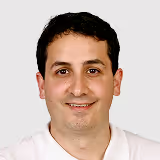
Marcel Kloos
Swiss-licensed dentist and founder of Medschool Experts
Marcel Kloos founded Medschool Experts while studying abroad; since then, over 500 study places have been secured. The Stuttgart-born dentist studied dentistry from 2015 to 2021 in Sofia and holds a Swiss dental licence.
Today he lives in Bern and runs Medschool Experts full-time as its owner.
More articles worth reading
Health Insurance for International Medical Students in Europe 2026
Scholarships and Funding for Medical Studies in Europe 2026
Medicine, Dentistry, Pharmacy or Veterinary Medicine? Choosing Your Degree Abroad in 2026
Ahmad
Sabrina
Rami
Noah
500+ students placed.
Now it's your turn!
No daydreaming, no empty promises. Just a clear plan — for the start of your medical degree.
40 minutes, no obligation