Rural Doctor Quota: 21 Years of Commitment — Cost Comparison with Studying Abroad
17.09.2026

What does a medical degree in Germany and in Foča cost over six years?
A state medical degree in Germany costs around EUR 77,900 over six years, and a medical degree at the Faculty of Medicine in Foča in Bosnia and Herzegovina around EUR 61,400. That is a calculation of Medschool Experts's own, as of August 2026. There are no tuition fees in Germany, and there are in Foča — the lower cost of living more than offsets that.
| Item (6 years) | Germany, state university | Foča, Bosnia and Herzegovina |
|---|---|---|
| Tuition fee or semester contribution | around EUR 3,600 | around EUR 21,480 |
| Living costs | around EUR 71,400 | around EUR 36,700 |
| Study materials | around EUR 2,900 | around EUR 2,900 |
| One-off fees | none | around EUR 280 |
| Total | around EUR 77,900 | around EUR 61,400 |
The gap comes to around EUR 16,500 in Foča's favour. For Germany I calculate with twelve semester contributions of EUR 300 each and with the maximum BAföG rate of EUR 992 a month. That rate has applied since the 2024/25 winter semester and is unchanged in 2026; it is made up of EUR 475 basic needs, EUR 380 housing allowance, EUR 102 health insurance and EUR 35 long-term care insurance. For Foča I calculate with a tuition fee of EUR 1,790 per semester and a monthly budget of EUR 510, which already includes rent, food, leisure, international health insurance and one flight home per month.
The BAföG needs rate is the cautious variant here. It describes what the legislature considers necessary — not what studying in Munich, Cologne or Hamburg actually costs. In August 2025, on the basis of the EU-SILC 2024 survey, the Federal Statistical Office reported that students running their own household spend an average of 53 per cent of their disposable income on housing; across the population as a whole it is 25 per cent. There, 62 per cent of student households are classed as overburdened by housing costs. Anyone who plugs in the real rents of an expensive university city widens the gap in favour of studying abroad still further.
Two qualifications: anyone who can live with their parents during their studies turns the calculation around. Germany is then clearly cheaper. And the table contains university and living costs only — placement, preparatory course and support are not included. What those services cost and what they cover is something we discuss in a free consultation.
{{callout}}
How long does the rural doctor quota really commit you for?
The rural doctor quota commits you considerably longer than the ten years stated in the state legislation. Anyone starting via the quota in the 2026/27 winter semester first completes six years and three months of standard study time, then around five years of specialist training in general practice. Only then do the ten years of obligatory service begin.
| Stage | Duration | End, rounded |
|---|---|---|
| Medical degree (standard period) | 6 years, 3 months | end of 2032 |
| Specialist training in general practice | around 5 years | end of 2037 |
| Service period in an underserved region | 10 years | end of 2047 |
| Total commitment from the start of studies | around 21 years | 2047 |
The projection assumes a course of events without delay. A student in the North Rhine-Westphalian quota describes her situation in the March 2026 issue of the Rheinisches Ärzteblatt as an "almost 20-year obligation". Twelve semesters plus three months of standard study time and five years of general-practice training, together with the ten years of obligatory service, add up to a good 21 years.
Anyone who signs at 19 will be around 40 by the end of the service period. On top of that comes a point that often gets lost in the discussion: which region specifically is in question is not fixed when the contract is signed. Underserved areas are redefined continuously through needs planning. So you are committing yourself to a map that does not yet exist at the time of signing.
How high is the contractual penalty under the rural doctor quota?
In most federal states the contractual penalty is EUR 250,000. It applies if the obligation is not fulfilled — regardless of whether someone drops out after the second semester or only gives up in the eighth year of service. Some states word it as "up to EUR 250,000" without specifying how the individual case is assessed.
The lawyer Joachim Rau, who represents several claimants, considers the amount disproportionate. His central argument is the prohibition of excess: a flat rate of EUR 250,000 hits the smallest breach as hard as complete withdrawal. He additionally points to an expert report commissioned by the Federal Ministry of Health in 2015, which recommended an upper limit of EUR 150,000.
EUR 250,000 is therefore around 67 per cent above the 2015 recommendation. Whether a court will infer invalidity from that is open; no published decision exists so far.
It is also unresolved whether several contractual penalties can be imposed one after another. No federal state regulates this expressly. And anyone seeking mitigation after a sanction must demonstrate hardship; a visible willingness to fulfil the obligation after all does not reduce the amount.
Why are 28 medical students suing over the rural doctor quota?
In early August 2026, 28 lawsuits were pending nationwide from students who obtained a study place via the rural doctor quota. North Rhine-Westphalia leads the statistics by some distance. The dispute is not about the quota as such but about individual contractual conditions.
| Federal state | Pending lawsuits |
|---|---|
| North Rhine-Westphalia | 17 |
| Hesse | 5 |
| Bavaria | 4 |
| Saarland | 2 |
| Total | 28 |
For North Rhine-Westphalia, the Administrative Court of Gelsenkirchen has exclusive statewide jurisdiction over first-instance proceedings under the rural doctor act. One action was brought in July 2024, the others between May 2025 and January 2026. As of the WDR reporting of 10 August 2026 there had been no decisions or settlements.
The points of dispute are specific:
- the level of the contractual penalty of EUR 250,000
- the interpretation of the word "without undue delay", with which specialist training and setting up a practice are supposed to begin — taking over a practice regularly takes longer than a year
- the retrospective removal of paediatric and adolescent medicine as a possible training route for older year groups
- the tie to the particular federal state
The national representative body of medical students in Germany calls the quota "ineffective, unfair and legally questionable" and argues for attracting doctors to rural areas through better working conditions rather than through an obligation (Deutsches Ärzteblatt, August 2026).
Nothing has been decided so far, and the state of proceedings allows no conclusion about the outcome. Moreover, 28 lawsuits among around 3,500 students nationwide in the quota is 0.8 per cent — the great majority are not suing.
{{cta}}
How many rural doctors has the quota produced so far?
Not a single one so far. In January 2026 North Rhine-Westphalia counted 1,048 students in the rural doctor quota. Thirty-five from the first cohort of the 2019/20 winter semester have completed their degree, and nine have begun general-practice training. Nobody from the quota is yet working as a GP in an underserved region — that lies in the nature of the timeline, not in the programme.
In figures: nine out of 1,048 is 0.86 per cent. After six and a half years of operation, therefore, less than one per cent of the quota cohort is on the training path that is later supposed to carry provision. The drop-out rate is 6.7 per cent, that is 79 students — comparable with the regular medical degree and considerably lower than in the humanities or STEM subjects.
In consultations I regularly see young people who treat the quota as a safe bet and only notice how far the commitment reaches when they read the contract. That is not a reproach against the instrument. It simply shows that the decision deserves more time than the application deadline allows.
What are the chances of a place via the rural doctor quota?
In North Rhine-Westphalia there were, across 14 selection rounds, an average of four applications per study place. That means around three in four applications do not lead to a place. With 227 places from the 2026/27 winter semester, that works out at around 900 applications and around 680 rejections per cohort, in North Rhine-Westphalia alone.
In figures: if 227 places correspond to 8.8 per cent, the total state provision in North Rhine-Westphalia comes to around 2,580 medical study places a year. The rural doctor quota is therefore just about every eleventh place. The North Rhine-Westphalian Ministry for Culture and Science announced the increase on 16 July 2026: from 7.8 to 8.8 per cent, a gain of 25 places or around twelve per cent. Health Minister Karl-Josef Laumann justified this by saying that graduates are "urgently needed for primary care, particularly in rural regions and smaller communities".
The selection procedure runs in two stages. In the first stage, the school-leaving grade (30 per cent), the medical aptitude test (30 per cent) and a completed vocational qualification in healthcare (40 per cent) count. The second stage, with interviews and role plays, makes up half of the overall score. The school-leaving grade is therefore only one component among several here — which is what makes the quota attractive to many.
In how many federal states does the rural doctor quota exist?
Ten federal states have introduced the rural doctor quota so far: North Rhine-Westphalia from the 2019/20 winter semester, Bavaria, Saarland and Saxony-Anhalt from 2020/21, Mecklenburg-Western Pomerania and Baden-Württemberg from 2021/22, Hesse, Saxony and Thuringia from 2022/23, and Rhineland-Palatinate from the 2026 summer semester.
Without a rural doctor quota are Schleswig-Holstein, Hamburg, Bremen, Brandenburg and Berlin. The size of the quota ranges from 5 per cent in Saxony-Anhalt to 8.8 per cent in North Rhine-Westphalia from the 2026/27 winter semester; some states give absolute numbers of places rather than percentages. The medical students' committee within the Hartmannbund has come out against the introduction of such quotas.
Why is studying in Bosnia and Herzegovina cheaper than a tuition-free degree in Germany?
Because the tuition fee makes up only a small part of the total costs. In the calculation above, around 92 per cent of all costs for the German degree fall on living expenses. In Foča it is around 60 per cent. The item that is free in Germany is therefore not the item that determines the total.
The monthly budget in Foča is made up as follows: around EUR 250 rent for a modern flat, around EUR 100 for food, around EUR 70 for leisure and eating out, around EUR 30 for international health insurance and around EUR 60 for a return flight to Germany once a month. That comes to EUR 510. The convertible mark is pegged to the euro at a fixed exchange rate, so the budget does not fluctuate with the currency market.
At Medschool Experts, semester fees for human medicine and dentistry start at EUR 1,750. For Foča the table above gives EUR 1,790 per semester, that is EUR 3,580 per academic year.
I studied in Sofia myself from 2015 to 2021 and experienced the same mechanics: the fee looks large on paper at the start, and after two years you notice that rent and everyday life make the difference. German fellow students with a place in a west German university city regularly had less left at the end of the month than I did.
On top of that come three points that tend to be forgotten in cost comparisons: entitlement to German child benefit (Kindergeld) continues while studying abroad. There is no numerus clausus and there are no waiting semesters in Foča. And access is also open with a vocational high school diploma (Fachhochschulreife) or a completed vocational qualification — for many people that, rather than the price, is the real difference.
What speaks against the route abroad?
A number of things, and they belong in the same article. Bosnia and Herzegovina is not a member state of the European Union. The degree is therefore not recognised automatically under Annex V of Directive 2005/36/EC but goes through the equivalence procedure in Germany. That is an established route, but it is a procedure that takes effort, and the competent state authorities alone decide on it.
Teaching is in English, daily life is in Bosnian. Foča is a manageable town on the Drina, not a metropolis. Anyone who needs to be close to family should factor that in honestly. And you pay tuition fees where the German study place would be free of charge — the financial advantage only emerges through the cost of living and only across the full six years.
What falls away, by contrast: an obligation. No contract over ten years of service, no contractual penalty, no commitment to a specialty, no tie to a federal state. After graduation the route is open — general practice in a rural area is one possibility, not the condition.
Rural doctor quota or studying abroad: what suits whom?
| Starting position | Rural doctor quota | Studying abroad |
|---|---|---|
| You want to become a GP anyway | a good fit | possible, without commitment |
| Specialty still undecided | tricky, the specialty is fixed | open until graduation |
| Vocational diploma instead of the Abitur | no access | regular access |
| You can live at home | financially advantageous | financially disadvantageous |
| You want to start in 2027 | selection procedure, around 4 applicants per place | no numerus clausus, start in the winter or summer semester |
Both are legitimate routes. The difference lies not in the standard of the training but in what you give up for it: with the quota, around 21 years of commitment; abroad, tuition fees and distance from home. Which price is the right one depends on your starting position — and can be clarified quickly in a conversation. Arrange a free consultation here.
The author's view
My assessment: the rural doctor quota solves a real problem with an instrument that places the burden one-sidedly on 18- and 19-year-olds. Anyone who signs today is making a decision that reaches into the 2040s — for a specialty they do not yet know, and for a region that is not even named at the time of signing. That this gives rise to disputes does not surprise me.
This assessment rests on the published figures from North Rhine-Westphalia, on the reporting about the 28 pending proceedings and on what I hear in consultations. It does not prove that the lawsuits will succeed, and it says nothing about whether the quota will ultimately bring doctors to rural areas. Both will become clear in the early 2030s at the earliest.
What I can say from my own experience: I studied dentistry in Sofia from 2015 to 2021, am today a Swiss-licensed dentist and run Medschool Experts from Bern. The route abroad was the less comfortable one at the time and in some respects still is. But it never committed me to a specialty or a place. That is precisely the point I would advise anyone to weigh against the saving that comes with a guaranteed place.
Summary
The key points at a glance:
- Around 21 years of commitment: six years and three months of study, around five years of general-practice training and then ten years of obligatory service — for a start in the 2026/27 winter semester that means commitment until around 2047 on paper.
- EUR 250,000 contractual penalty: a flat rate in most federal states, around 67 per cent above the upper limit of EUR 150,000 recommended by an expert report commissioned by the Federal Ministry of Health in 2015.
- 28 pending lawsuits in August 2026: 17 in North Rhine-Westphalia, 5 in Hesse, 4 in Bavaria, 2 in Saarland. There have been no decisions so far.
- No rural doctor from the quota yet: in North Rhine-Westphalia 1,048 people are studying via the quota, 35 have graduated and nine are in general-practice training (as of January 2026).
- Cost comparison over six years: around EUR 77,900 in Germany against around EUR 61,400 in Foča — the tuition-free study place is the more expensive one on balance, once the cost of living is counted.
- Without an obligation: studying abroad fixes neither the specialty nor the federal state nor the next two decades.
Further reading
To go with this comparison:
- North Rhine-Westphalia's rural doctor quota rises to 8.8 per cent — 227 study places from the 2026/27 winter semester and how the selection procedure is weighted in detail.
- 28 lawsuits against the rural doctor quota — the legal structure of the quota and international commitment models in comparison.
- Studying medicine and dentistry in Foča — the complete guide to the University of East Sarajevo, with recognition, structure and campus tours.
- Studying medicine abroad: a cost comparison with Germany — the comparison across several locations.
- Living costs while studying medicine in Europe — what a month in Sofia, Riga, Varna or Foča actually costs.
- Studying medicine with a vocational diploma — the route for everyone who would not even be admitted under the rural doctor quota.
Whether the rural doctor quota or a study place abroad fits your starting position better is something we clarify in a free, no-obligation conversation: book a consultation now.
Legal note: this article serves general information purposes and does not constitute legal advice. Details on quotas, contractual conditions, tuition fees and recognition are as of August 2026; subject to change and editorial error. Decisions on the recognition of foreign study credits and degrees rest solely with the competent authorities.
What is the rural doctor quota, simply explained?
The rural doctor quota is an advance quota in the allocation of medical study places. Federal states reserve a share of their state places for applicants who commit contractually to working as a GP in an underserved rural region for ten years after their degree and specialist training. The school-leaving grade is not the sole deciding factor.
How high is the contractual penalty under the rural doctor quota?
In most federal states it is EUR 250,000. Some states word it as "up to EUR 250,000" without specifying how individual cases are assessed. An expert report commissioned by the Federal Ministry of Health recommended a maximum of EUR 150,000 in 2015 — today's amount is around 67 per cent above that.
How long am I committed under the rural doctor quota?
On paper around 21 years from the start of studies: six years and three months of standard study time, around five years of general-practice training and then ten years of obligatory service. For a start in the 2026/27 winter semester the obligation therefore ends around 2047, provided everything runs without delay.
In which federal states is there a rural doctor quota?
Those that have introduced one include North Rhine-Westphalia, Bavaria, Saarland, Saxony-Anhalt, Mecklenburg-Western Pomerania, Baden-Württemberg, Hesse, Saxony and Thuringia; Rhineland-Palatinate starts from the 2026 summer semester. Without a quota are Schleswig-Holstein, Hamburg, Bremen, Brandenburg and Berlin.
How many applicants are there per place in the rural doctor quota?
In North Rhine-Westphalia there were, across 14 selection rounds, an average of four applications per study place. With 227 places from the 2026/27 winter semester, that works out at around 900 applications and around 680 rejections per cohort.
Why is the rural doctor quota being challenged in court?
In early August 2026, 28 lawsuits were pending nationwide. The disputes concern the level of the contractual penalty, the interpretation of the phrase "without undue delay" regarding specialist training and setting up a practice, the retrospective removal of paediatric and adolescent medicine as a training route, and the tie to a single federal state.
Is there a judgment on the rural doctor quota yet?
No. For North Rhine-Westphalia the Administrative Court of Gelsenkirchen has exclusive statewide jurisdiction. As of the reporting of 10 August 2026 there had been neither decisions nor settlements there. Nothing about the eventual outcome can be inferred from the state of proceedings.
Is a medical degree abroad more expensive than one in Germany?
Not necessarily. Calculated over six years, a state degree in Germany costs around EUR 77,900 and a degree in Foča around EUR 61,400 — tuition fees and living costs together. The tuition-free study place is more expensive because living costs make up the bulk of the total in Germany.
What does the medical degree in Foča cost per semester?
The tuition fee is around EUR 1,790 per semester, that is around EUR 3,580 per academic year. One-off fees of around EUR 280 at the start of the degree come on top. For living costs on the ground you should budget around EUR 510 a month, including rent, international health insurance and one flight home per month.
Do I need the Abitur to study medicine abroad?
Not necessarily for the Faculty of Medicine in Foča. What is required is twelve years of schooling, or alternatively schooling plus vocational training amounting cumulatively to twelve years. Access is also possible with a vocational high school diploma. Under the rural doctor quota in Germany, by contrast, an application without the general higher-education entrance qualification is not provided for.
Is a degree from Bosnia and Herzegovina recognised in Germany?
Bosnia and Herzegovina is not an EU member state, so automatic recognition under Annex V of Directive 2005/36/EC does not apply. The degree goes through the equivalence procedure at the competent state authority. The Faculty of Medicine in Foča is listed with the highest status, H+, in the ANABIN database of the Standing Conference of the Ministers of Education (Kultusministerkonferenz).
Can I transfer to a German university later from abroad?
A transfer into a higher subject semester at a German university is possible in principle; a German Abitur is a prerequisite, and the receiving institution decides on the scope of credit transfer case by case. What that looks like in your situation is something we clarify in the free consultation.
What students say about Medschool Experts
Over 500 placements at more than 25 partner universities across 10+ countries. Read independent student reviews on Trustpilot.
About the author
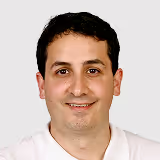
Marcel Kloos
Swiss-licensed dentist and founder of Medschool Experts
Marcel Kloos founded Medschool Experts while studying abroad; since then, over 500 study places have been secured. The Stuttgart-born dentist studied dentistry from 2015 to 2021 in Sofia and holds a Swiss dental licence.
Today he lives in Bern and runs Medschool Experts full-time as its owner.
More articles worth reading
Health Insurance for International Medical Students in Europe 2026
Scholarships and Funding for Medical Studies in Europe 2026
Medicine, Dentistry, Pharmacy or Veterinary Medicine? Choosing Your Degree Abroad in 2026
Ahmad
Sabrina
Rami
Noah
500+ students placed.
Now it's your turn!
No daydreaming, no empty promises. Just a clear plan — for the start of your medical degree.
40 minutes, no obligation