Studying Medicine in Georgia: All Universities, Costs and Recognition
17.09.2026

Which Universities in Georgia Offer Medicine in English?
The degree is called MD, not MBBS — even though many international portals use the English term. The programme uniformly lasts six years and comprises 360 ECTS.
State Universities
- Tbilisi State Medical University (TSMU), Tbilisi — the largest and most well-known medical university in the country, with its own American-oriented MD programme.
- Ivane Javakhishvili Tbilisi State University (TSU), Tbilisi — Georgia's oldest university, medical faculty with English-language programme.
- Ilia State University, Tbilisi
- Batumi Shota Rustaveli State University, Batumi — on the Black Sea.
- Akaki Tsereteli State University, Kutaisi
Private Universities
- David Tvildiani Medical University (AIETI), Tbilisi
- New Vision University, Tbilisi
- University of Georgia, Tbilisi — medicine 6,000, dentistry 5,500 US dollars per academic year.
- Caucasus University, Caucasus Medicine School, Tbilisi — 6,000 US dollars.
- Petre Shotadze Tbilisi Medical Academy, Tbilisi — 7,000 US dollars.
- Ken Walker International University, Tbilisi — 7,000 US dollars.
- Caucasus International University, Tbilisi
- Georgian American University, Tbilisi
- European University Tbilisi
- Alte University, International School of Medicine, Tbilisi
- Grigol Robakidze University, Tbilisi
- East European University, Tbilisi
- Georgian National University SEU, Tbilisi
- Teaching University Geomedi, Tbilisi
- BAU International University Batumi
- Avicenna Batumi Medical University
- East West University, School of Medicine, Tbilisi
English-language MD programmes could not be confirmed for Sulkhan-Saba Orbeliani University, International Black Sea University, and David Aghmashenebeli University — these names appear on placement portals without a verifiable accredited programme.
What Does a Medical Degree in Georgia Cost?
Fees range from approximately 3,400 US dollars at state universities to 8,000 US dollars at the most prominent private institutions. Directly confirmed by the institutions are the fees of the University of Georgia (6,000), Caucasus University (6,000), Tbilisi Medical Academy (7,000), and Ken Walker International University (7,000 US dollars per academic year).
Figures on international placement portals vary considerably, and some portals quote total costs as annual amounts. It is therefore worth planning only with a figure that has been confirmed at source — for the universities in our own network we check that for you, so that your calculation rests on real numbers.
How Do You Find Out Where You Can Get In?
There is no numerus clausus in Georgia, so a top school-leaving grade is not what decides this. What does differ, and differ considerably, are the details from one university to the next and from one year to the next. That is why you will find no checklists and no date tables on this page: a list that is one round out of date is worse than none at all.
Send us your profile instead — your school-leaving certificate, any study records if you have already started a programme somewhere, and the countries you can picture yourself in. We look at the whole picture and then tell you at which university in which country we can place you, and where a start is genuinely plannable rather than a matter of hope.
Behind that stands the largest selection of official partner universities we know of, for human medicine, dentistry, pharmacy, nursing and veterinary medicine. If you are already studying, we check the highest possible point of entry as a matter of course. A free consultation costs nothing and gives you a clear answer.
{{cta}}
Language of Instruction and Daily Student Life
Instruction is in English. However, the state education portal lists three programme categories: fully English-language, English-language with a Georgian component, and mixed English-Georgian. Georgian modules are a mandatory part of the curriculum at many universities, and by the clinical phase from the third or fourth year at the latest, patient contact takes place in Georgian. Those who factor this in will manage well; those who do not expect it lose time precisely where it matters most.
Living costs in Tbilisi and Batumi are significantly below Western European levels. Both cities are reachable directly from Germany.
What Is the Degree Worth in Germany?
Georgia is an EU candidate country but not a member — and the accession process is currently on hold. For professional practice in Germany this means: no automatic recognition under the EU Professional Qualifications Directive. The degree is followed by an equivalence assessment; otherwise a knowledge examination and then Approbation apply. Details are in the article Approbation and Recognition.
On the positive side: Georgia belongs to the European Higher Education Area, and the national agency NCEQE is recognised by the World Federation for Medical Education — the only country in this region to have that. Whether any individual university is listed in the World Directory of Medical Schools and how it is classified in ANABIN still needs to be checked university by university, and that is part of what we look at with you.
For Whom Georgia Is Suitable — And For Whom It Is Not
Georgia suits applicants who wish to work internationally, or who come from a non-EU country and plan to return there. Those who know for certain that they want to practise in Germany, Austria, or Switzerland should factor in the additional recognition procedure from the outset — or choose an EU location from the start. A comparable alternative in a similar price range is the Medical Faculty Foča at 3,500 euros per academic year; all further options are listed in the fee overview.
For those already studying in Georgia who wish to transfer to Europe: How the study transfer from Georgia works.
The author's view
Georgia is the best-positioned non-EU destination: having a nationally recognised, internationally acknowledged accreditation agency is not something to take for granted — neighbouring countries do not have this.
What I still tell prospective students: the question is not whether Georgia provides good training, but where you ultimately want to work. For the German-speaking job market, an additional recognition procedure comes on top. Those who know this and plan for it from the start make no mistake there. Those who overlook it are surprised six years later.
Conclusion
Georgia is a solid destination with clear rules, and for anyone with international plans it is one of the strongest options outside the EU. The decisive question is not the country but where you want to work later — and that is a question best answered before you enrol, not six years afterwards.
We deliberately publish no requirement lists and no dates here, because they differ per university and per year. What we do instead is look at your profile: send us your certificate, any study records and the countries that come into question, and we will tell you at which university in which country we can place you, and where the start is genuinely plannable. Behind that stands the largest selection of official partner universities we know of, for human medicine, dentistry, pharmacy, nursing and veterinary medicine; if you are already studying, we check the highest possible point of entry, which often falls in the last two years.
The first step is free and takes half an hour: book a free consultation and we will go through your options together.
Further Reading
Frequently Asked Questions About Studying Medicine in Georgia
How many universities offer medicine in English?
Around twenty, five of them state-run. Most are in Tbilisi, with further options in Batumi and Kutaisi.
What does the degree cost?
Between approximately 3,400 and 8,000 US dollars per academic year. Directly confirmed are the University of Georgia and Caucasus University at 6,000 each, and Tbilisi Medical Academy and Ken Walker at 7,000 US dollars each.
Do I need Georgian?
Instruction is in English, but Georgian modules are mandatory at many universities, and patient contact in the clinical phase takes place in Georgian.
Is there a numerus clausus?
No. Your school-leaving average does not decide whether you get a place. What your own profile makes possible is something we check individually — that is quicker and far more reliable than any list on a website.
Is the degree recognised in Germany?
Georgia is not an EU member. The degree is followed by an equivalence assessment; otherwise a knowledge examination and then Approbation apply.
How long does the degree take?
Six years with 360 ECTS, degree Doctor of Medicine.
How do I find out which university would take me?
By sending us your profile: school-leaving certificate, study records if you have already started somewhere, and your preferred countries. We tell you at which university in which country we can place you — in Georgia or at one of our other official partner universities for human medicine, dentistry, pharmacy, nursing and veterinary medicine. The free consultation is the shortest route to that answer.
Can I transfer to Europe later?
Yes. Completed courses are creditable; how this works is explained in the article on the study transfer from Georgia.
What students say about Medschool Experts
Over 500 placements at more than 25 partner universities across 10+ countries. Read independent student reviews on Trustpilot.
About the author
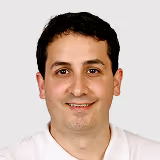
Marcel Kloos
Swiss-licensed dentist and founder of Medschool Experts
Marcel Kloos founded Medschool Experts while studying abroad; since then, over 500 study places have been secured. The Stuttgart-born dentist studied dentistry from 2015 to 2021 in Sofia and holds a Swiss dental licence.
Today he lives in Bern and runs Medschool Experts full-time as its owner.
More articles worth reading
Health Insurance for International Medical Students in Europe 2026
Scholarships and Funding for Medical Studies in Europe 2026
Medicine, Dentistry, Pharmacy or Veterinary Medicine? Choosing Your Degree Abroad in 2026
Ahmad
Sabrina
Rami
Noah
500+ students placed.
Now it's your turn!
No daydreaming, no empty promises. Just a clear plan — for the start of your medical degree.
40 minutes, no obligation