Studying Medicine in Rijeka: Costs, Structure and Recognition
17.09.2026

Rijeka at a Glance
Before going into detail, here are the hard facts in one overview. All figures refer to the English-language human medicine programme and to the 2026/2027 academic year.
| Feature | Detail (as of 2026) |
|---|---|
| University | University of Rijeka, Faculty of Medicine, founded 1955 |
| Programme | Human medicine, Medicine in English |
| Language of instruction | English, with Croatian alongside the programme |
| Standard duration | 6 years, 12 semesters, 360 ECTS credits |
| Tuition fee | 12,000 euros per academic year, 200 euros per ECTS credit |
| Places per cohort | maximum 50 in the 2026/2027 academic year |
| Admissions process | written test in biology, chemistry and physics |
| Start of studies | Winter semester, lectures begin 1 October 2026 |
| Degree | Diploma “doktor medicine”, Doctor of Medicine |
| Recognition in Germany | automatic under Directive 2005/36/EC |
| Living costs | approx. 500 to 700 euros per month |
University and Hospital
The University of Rijeka is a state comprehensive university in north-western Croatia. Its Faculty of Medicine is the oldest institution in the group and dates back to 1955. It trains doctors, runs its own research institutes and has for years operated an English-language programme aimed expressly at international applicants. The cohort is deliberately kept small.
The clinical partner is the Clinical Hospital Centre Rijeka, KBC Rijeka for short. It is one of five clinical centres in the country and, by its own account, serves around 600,000 people across three counties. The hospital has 1,069 beds, employs more than 3,800 staff and is organised into 18 clinics, six clinical institutes and seven independent institutes (KBC Rijeka, as of 2026). It is therefore not a teaching hospital at the edge of the system but the tertiary care centre for the entire Kvarner region.
Alongside teaching, academic work is carried out at the faculty's own institutes, from the foundational subjects to clinical questions. Those with a doctorate or a later academic career in mind will find an entry point for it. It is not compulsory: the programme is aimed first at clinical training, and everything else comes on top.
What strikes me most about this combination is the ratio: a cohort of at most 50 students meets a hospital with over a thousand beds. Arithmetically, far more patient contacts are available than a group of this size can take up. In the feedback from our students, that is exactly the point mentioned most often.
What programmes are available and in which language?
Through Medschool Experts we place students in Rijeka on the English-language human medicine programme. Its official name is “University Integrated Undergraduate and Graduate Study Programme of Medicine in English language”, and after six years it leads to the degree of Doctor of Medicine.
| Programme | Language | Duration and scope | Degree |
|---|---|---|---|
| Human medicine | English, with Croatian alongside | 6 years, 12 semesters, 360 ECTS credits | Diploma “doktor medicine” |
English is the working language for lectures, seminars and examinations. The faculty requires good English, because the entire programme is built on it. Solid upper-secondary English is a good starting point; you will build the medical vocabulary from scratch in the first year in any case, and that applies at every faculty in every language. Which proof the faculty expects in your case is something we clarify with you in advance.
Croatian runs alongside from the start and is not a side issue. By the clinical phase at the latest, you will be speaking at KBC Rijeka with patients who predominantly speak Croatian. The language courses are a fixed part of the timetable. The effort is real, but it also pays off professionally later, because it keeps Croatian hospitals open to you as employers.
How does admissions work?
There is no numerus clausus. The access requirement is a general higher education entrance qualification with a foundation in the sciences, and the decision is made through the faculty's own selection process. Your school-leaving grade is part of the calculation, but not the yardstick on which everything hangs.
The process works with a points system. A total of 150 points is achievable, 120 of them through the written entrance test and 30 through school grades (Faculty of Medicine Rijeka, Admission Requirements 2026/2027). Biology, chemistry and physics are tested at upper-secondary level, so school material and not university material. For the 2026/2027 academic year the faculty has announced three dates: 8 May, 3 July and 4 September 2026. At most 50 applicants are admitted.
Registration, application and the organisation of the entrance test run entirely through Medschool Experts. The process is generally possible online; a trip to the Kvarner Bay is not necessary for it. We take care of the documents.
Our preparation focuses on the three examination subjects. Experience shows that physics is the sticking point, because many applicants dropped the subject after lower secondary school and leave points on the table in the test that would long since be within reach. In addition there is the conversation about your own motivation, which we work through with you. With 50 places, preparation decides the outcome, not luck. Whether your route suits Rijeka is something we assess individually in a free consultation.
What does the programme cost?
The faculty charges the fee by ECTS credit: 200 euros per credit, 60 credits per academic year, so 12,000 euros per year or 6,000 euros per semester. The following items come from the faculty's Call for Applications for 2026/2027.
| Item | Amount (as of 2026) |
|---|---|
| Tuition fee per ECTS credit | 200 euros |
| Tuition fee per semester | 6,000 euros |
| Tuition fee per academic year | 12,000 euros |
| Total tuition fee, 360 ECTS credits | 72,000 euros |
| Fee for the entrance test | 200 euros |
| Enrolment fee 2026/2027 | around 55 euros |
| Optional preparatory course run by the faculty | 800 euros |
I work through the total amount in full with every family before a decision is made. The following breakdown is my own estimate over the full six years of study and not a commitment by the university. Living costs are set at 500 to 700 euros per month.
| Item | Calculation | Amount (estimate) |
|---|---|---|
| Tuition fees | 12,000 euros times 6 years | 72,000 euros |
| Living costs, lower end | 500 euros times 72 months | 36,000 euros |
| Living costs, upper end | 700 euros times 72 months | 50,400 euros |
| One-off ancillary costs | entrance test, enrolment, travel, textbooks, insurance | around 5,000 euros |
| Total, lower end | fees plus living costs plus ancillary costs | around 113,000 euros |
| Total, upper end | fees plus living costs plus ancillary costs | around 127,000 euros |
All told, the six-year Rijeka project therefore comes to an estimated 113,000 to 127,000 euros. That is a sum you should know before the offer arrives and not first in your third semester. How it can be financed is a topic of its own and a fixed part of our consultation.
For context, a comparison with other locations in our series. All fees refer to one semester; the source is Medschool Experts research, as of 2026.
| Location | Programme and language | Fee per semester | Admission |
|---|---|---|---|
| Rijeka, Croatia | Human medicine, English | 6,000 euros | test in biology, chemistry, physics |
| Split, Croatia | Human medicine, English | 6,000 euros | no written entrance test |
| Osijek, Croatia | Human medicine, German | around 8,000 euros | knowledge test and personal interview |
| Zagreb, Croatia | Dentistry, English | 5,100 euros | entrance test |
Those who would rather study in German and spend the clinical years in Germany should look at the neighbouring location; the details are in our guide Studying medicine without NC in Croatia: Osijek. Rijeka is the more affordable and more internationally oriented route.
{{cta}}
How is the programme structured?
The programme follows the classic European structure: two pre-clinical years, three clinical years, one practical final year. Each semester you conclude with a Transcript of Records listing subjects, ECTS credits and grades.
| Phase | Academic years | Focus |
|---|---|---|
| Pre-clinical phase | 1st to 2nd year | Anatomy, physiology, biochemistry, histology, embryology, accompanying Croatian courses |
| Clinical phase | 3rd to 5th year | Internal medicine, surgery, paediatrics, gynaecology, neurology, psychiatry with placements at KBC Rijeka |
| Practical final year | 6th year | predominantly ward work, equivalent to the German Praktisches Jahr |
The transition into the third year is the real dividing line. Before it you learn foundations; after it you are regularly in the hospital and working with patients. Those who take the Croatian courses in the first two years seriously find things noticeably easier from that point, because ward rounds do not take place in English. Clinical placements in Germany are possible and should be agreed with the faculty in advance.
Where can you work as a doctor with this degree?
Croatia has been a member of the European Union since 2013. The Croatian diploma “doktor medicine” is listed in Annex V point 5.1.1 of Directive 2005/36/EC, in the version of Delegated Decision (EU) 2023/2383 of 23 May 2023, applicable since 9 October 2023. The awarding bodies are the “Medicinski fakulteti sveučilišta u Republici Hrvatskoj”, with a reference date of 1 July 2013. That means: automatic recognition, no equivalency assessment, no knowledge examination, no German state examination.
| Country | Path to professional registration |
|---|---|
| Germany | automatic recognition under Directive 2005/36/EC; German medical licence (Approbation) from the competent authority of the federal state |
| Austria | recognition through the Austrian Medical Chamber, then entry in the medical register |
| Switzerland | recognition under the rules of the EFTA agreement, then registration in the register of medical professions |
| Rest of EU and EEA | automatic recognition, plus national registration with the respective professional body |
| Croatia | licence from the Croatian Medical Chamber, Hrvatska liječnička komora |
| United Kingdom | registration with the General Medical Council, generally via the PLAB examination |
| USA | ECFMG certification and USMLE; since 1 January 2023 the faculty must be accredited by a WFME-recognised agency |
For Germany the route works concretely as follows: after the sixth year you apply for the Approbation with the competent authority of the federal state where you want to work. Because the diploma is listed in Annex V, the authority does not review the individual course content. Processing times differ considerably from state to state, so it is worth submitting the application early. After that, specialist training is open to you at any hospital or practice with training authorisation, on the same footing as graduates of German faculties.
The last row of the table calls for context. The competent Croatian accreditation agency is the Agency for Science and Higher Education, ASHE for short. It appears on the WFME list in an ongoing recognition procedure; a conclusion of that procedure is not indicated for August 2026. Anyone firmly planning for the USA should therefore raise this early. For the German-speaking countries and the EU the point is irrelevant; there the directive alone applies.
Dentist, pharmacist, psychologist, veterinarian: the legal position by profession
Dentist. Dental training is likewise harmonised within the EU and appears in Annex V point 5.3.2 of Directive 2005/36/EC. A Croatian diploma listed there is automatically recognised in Germany, and the route leads directly to the licence to practise as a dentist. Through Medschool Experts we place students in Rijeka on the human medicine programme; for dentistry we have other partner universities in the programme, which we present in the consultation.
Pharmacist. Pharmaceutical training is also harmonised and listed in Annex V point 5.6.2. For graduates that means the same mechanism: the listed diploma is recognised, after which the licence to practise as a pharmacist follows from the competent state authority. In Rijeka, pharmacy is not among the programmes we place students on.
Psychologist. Psychology and psychotherapy are not harmonised across Europe. There is no Annex V entry and therefore no automatic recognition. Those who study psychology abroad and later want to work in Germany go through a case-by-case assessment by the respective state authority. That is a different mechanism from the four harmonised healthcare professions and should be clarified beforehand.
Veterinarian. Veterinary training is listed in Annex V point 5.4.2 and is therefore harmonised as well. A Croatian diploma from a programme listed there leads in Germany to the licence to practise as a veterinarian, without an equivalency assessment. Veterinary medicine in Croatia, however, is not offered in Rijeka but elsewhere.
Career paths after graduation
With the diploma from Rijeka you apply directly for junior doctor posts. In Germany, specialist training depends on the training regulations of the respective state medical chamber, in Austria on the Medical Chamber, in Switzerland on cantonal and federal rules. Your place of study appears in your CV, but what decides the interview is what you can do in practice and how you carry yourself on the ward.
The range is wider than many think at the start of their studies. Clinical training is the main route, alongside it research and a doctorate, the public health service, work with authorities and insurers, and roles in industry and medical technology. Those who spend the clinical years in Croatia and take Croatian with them additionally have a second labour market on their doorstep that most German graduates do not have.
Which options an EU degree specifically opens up, which countries require which additional steps and how a route into research or abroad can be planned, we have set out in detail: Career paths with an EU medical degree worldwide. The article is worth reading even before you start, because some of the decisions are made early.
Lateral entry, transfer and returning to Germany
Rijeka admits students in the regular way into the first year of study, with the start in the winter semester. Those who have already accumulated semesters in a science subject in Germany bring an academic head start, but normally begin here from the beginning. That is not a disadvantage; it creates a clean foundation for the English-language structure of the programme.
For a return to Germany the familiar framework applies: every German faculty decides for itself which credits earned in Rijeka it recognises, and a place must be free in the appropriate semester. The ECTS credits and the Transcript of Records are the basis for that, but they are not a guarantee. Collect these records in full from the first semester.
A different attitude has proved its worth: plan the programme as a six-year project in Croatia. The degree is automatically recognised in Germany, so you do not need the transfer in order to work as a doctor here. If it comes about, it is a bonus. Those who eye the transfer from the outset, by contrast, study with the handbrake on.
Living in Rijeka: city, distances, costs
Rijeka is a port city on the Kvarner Bay with around 108,000 inhabitants and was European Capital of Culture in 2020. It is not a tourist hotspot but a working city with shipyards, a university and an active cultural life. That keeps prices more stable across the year than further south on the Adriatic coast.
On housing costs, Numbeo provides orientation: a one-bedroom apartment in the centre is 621 euros, outside the centre 477 euros per month, and a monthly public transport pass costs 48 euros (Numbeo, as of 28 July 2026). Most students live more cheaply because they share an apartment; a room in a shared flat is quoted at around 250 euros and a hall of residence place at around 120 euros (Medschool Experts research, as of 2026). All in all you manage on about 500 to 700 euros per month, including rent, food, transport and leisure.
Part of daily life is that Rijeka, as a port and university city, functions all year round and does not fall asleep outside the season. Public transport is manageable, much can be done on foot, and the Kvarner Bay is right on the doorstep. Those who need a counterbalance to the study material will find it here without much effort.
Location is the second argument. Rijeka lies close to the Slovenian and Italian borders, so travel by car or rail from the German-speaking countries is correspondingly short. A long weekend at home is more realistic from here than from most other locations in our series. Because the city is compact, distances between accommodation, faculty and hospital are also short.
Who this location suits
Rijeka suits you if you want to study in English, can engage with a subject-based entrance test and prefer a small cohort to a large mass operation. It also suits you if proximity to the German-speaking countries matters to you and you are looking for a city where life remains affordable.
The location is less suitable if you want to study in German or if you want to tick off the language courses as a tiresome obligation. Croatian is part of the programme here, not an accessory. And the tuition fee of 12,000 euros per year is in the upper middle range of our locations, which should be worked through beforehand.
My assessment: Rijeka is one of the most solid Croatian locations, because a very small cohort meets a tertiary care hospital here and the degree leads without detours to the German Approbation. Those prepared to work on biology, chemistry and physics have a realistic chance at one of the 50 places. Whether that suits your situation is something we look at together – book a free consultation.
The author's view
I studied dentistry in Sofia from 2015 to 2021, so I spent six years learning in an unfamiliar language and an unfamiliar system myself. Rijeka reminds me of that time, even though Croatia is closer than Bulgaria. The core is the same: you arrive with school knowledge, spend the first semester poring over vocabulary that does not even exist in German, and notice after a year that you have got used to it. That adjustment is demanding. But it is manageable, and along the way it makes you more resilient.
What convinces me about this location is the size of the cohort in relation to the hospital. At most 50 students meet a hospital with 1,069 beds – that ratio is rare. Add to that the location: Rijeka is quickly reachable by car or rail, and for families that is an argument which comes up in almost every consultation. Those who do not want their child at the other end of Europe have a good answer here.
To be honest: costs are the point I look at most closely. 12,000 euros per academic year is a lot of money, and over six years the fees alone come to 72,000 euros. That has to be planned in advance and not hoped for. Anyone who cannot put that sum together cleanly should first look at other locations in our series before committing to Rijeka.
Today I run Medschool Experts in Bern as my main profession and therefore sit on the other side of the table. I see every year who goes to Croatia and who then starts work in Germany, Austria or Switzerland. My impression after these years: the place of study decides less than many believe at the start. What matters is that you see the six years through and work carefully during that time. Rijeka gives you a very sound framework for that.
Summary
- Six years, twelve semesters, 360 ECTS credits, leading to the diploma “doktor medicine”.
- The tuition fee is 12,000 euros per academic year, calculated at 200 euros per ECTS credit.
- At most 50 study places per cohort, awarded through a test in biology, chemistry and physics plus school grades.
- Teaching and examinations run in English; Croatian runs alongside the programme and is needed in the clinical phase.
- Practical training takes place at the Clinical Hospital Centre Rijeka, a hospital with 1,069 beds.
- The degree is automatically recognised in Germany on the basis of Annex V point 5.1.1 of Directive 2005/36/EC.
Conclusion
Rijeka is a location for everyone who wants a small cohort, a strong hospital and a short journey home all at once. The calculation is clear: around 72,000 euros in tuition fees over six years, plus 500 to 700 euros of living costs per month, and at the end a diploma that leads without detours to the German Approbation. Those who take preparation for the entrance test seriously have a realistic chance at one of the 50 places.
Whether Rijeka is the right location or another of our partner universities suits your situation better can be settled quickly in a conversation. We have a suitable partner university for almost every case and look at your starting position calmly before anything is decided – book your free consultation here.
Further reading
- Studying medicine without NC in Croatia: Osijek – the German-language neighbouring location with clinical years in Germany.
- Medical tuition fees in Europe at a glance – what a medical degree costs at the individual locations.
- Approbation and recognition of a medical degree from elsewhere in the EU – how the route to the German licence works.
- Living costs during medical studies in Europe 2026 – current figures on rents and monthly budgets.
- Returning to Germany and the recognition of semesters – what counts in a later transfer.
Frequently Asked Questions about studying medicine in Rijeka
Is there a numerus clausus at the University of Rijeka?
No. The access requirement is a general higher education entrance qualification with a foundation in the sciences, but your school-leaving grade does not decide the place on its own. The Faculty of Medicine at the University of Rijeka awards its places through its own selection process with a written entrance test. That gives applicants a realistic chance even if they fail at the NC hurdle in Germany.
How many study places does the faculty award per cohort?
In the 2026/2027 academic year the Faculty of Medicine at the University of Rijeka admits at most 50 students to the English-language programme. The cohort therefore stays very manageable; you are not sitting in a lecture theatre with several hundred people. The flip side is the limited number of places, which is why early and thorough preparation pays off.
What is tested in the entrance examination?
The written test covers biology, chemistry and physics, each at upper-secondary school level. Foundational knowledge from school is what is required, not university material. Physics surprises many applicants because they dropped the subject after lower secondary school. What sensible preparation looks like is something we discuss in the free consultation.
How many points can I achieve in the selection process?
A total of 150 points is achievable in the selection process. 120 points come from the written entrance test in biology, chemistry and physics, and a further 30 from your school grades. The test therefore clearly carries the greater weight. Those who prepare academically can offset an average school-leaving grade well. This applies equally to all examination dates.
How high are the tuition fees in Rijeka?
The faculty charges 200 euros per ECTS credit. At 60 credits per academic year that gives 12,000 euros a year or 6,000 euros per semester. Because the programme comprises 360 ECTS credits, over twelve semesters you reach around 72,000 euros in tuition fees alone. You should work through this sum in full before accepting an offer.
What costs come on top of the tuition fee?
Before the start there is a fee for the entrance test, plus the enrolment fee and travel to Croatia. During the programme, textbooks, work clothing and health insurance are added. For clinical placements abroad you need an additional budget for travel and accommodation. Factor these items in from the outset.
How much does living in Rijeka cost per month?
For rent, food, public transport and leisure you should budget around 500 to 700 euros per month. Rijeka is therefore below the level of Zagreb and Split, which shows above all in rents. The port city is not a tourist hotspot, which keeps housing costs more stable across the year.
Does teaching really take place entirely in English?
Yes. Lectures, seminars and examinations run throughout in English, and the faculty therefore requires good English. Solid upper-secondary English is a good basis for the start. You will still have to build the medical vocabulary in the first year; there is no way around that at any faculty.
How important is Croatian during the programme?
Croatian is taught alongside the programme and is not a side issue. From the clinical phase you speak at the Clinical Hospital Centre Rijeka with patients who predominantly speak Croatian. Those who let the language courses slide notice it on the ward at the latest. The effort pays off professionally later.
How long does the programme last and how is it organised?
Six years, twelve semesters, 360 ECTS credits. The first two years are pre-clinical, with anatomy, physiology, biochemistry, histology and embryology. From the third year the clinical phase follows, with internal medicine, surgery, paediatrics, gynaecology, neurology and psychiatry. The final year consists predominantly of practical ward work.
Is the diploma from Rijeka recognised in Germany?
Yes, automatically. Croatia is an EU member, so Directive 2005/36/EC applies to the University of Rijeka diploma with its entry in Annex V point 5.1.1. The same mechanism applies in Austria and Switzerland. An equivalency or knowledge examination is dispensed with, and you do not need to catch up on a German state examination.
Where does the clinical training take place?
The faculty's clinical partner is the Clinical Hospital Centre Rijeka, with 1,069 beds and more than 3,800 staff. Placements take place there from the third year of study, and you also spend large parts of the practical final year there. Clinical placements in Germany are possible but should be agreed in advance.
When does the programme in Rijeka begin?
The English-language programme begins in the winter semester, with lectures starting in early October. There is no summer start. Because at most 50 students are admitted per cohort, a missed cycle costs a full year. From the initial conversation onwards we handle registration, application and the organisation of the entrance test.
What students say about Medschool Experts
Over 500 placements at more than 25 partner universities across 10+ countries. Read independent student reviews on Trustpilot.
About the author
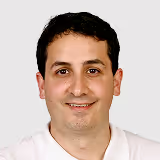
Marcel Kloos
Swiss-licensed dentist and founder of Medschool Experts
Marcel Kloos founded Medschool Experts while studying abroad; since then, over 500 study places have been secured. The Stuttgart-born dentist studied dentistry from 2015 to 2021 in Sofia and holds a Swiss dental licence.
Today he lives in Bern and runs Medschool Experts full-time as its owner.
More articles worth reading
Health Insurance for International Medical Students in Europe 2026
Scholarships and Funding for Medical Studies in Europe 2026
Medicine, Dentistry, Pharmacy or Veterinary Medicine? Choosing Your Degree Abroad in 2026
Ahmad
Sabrina
Rami
Noah
500+ students placed.
Now it's your turn!
No daydreaming, no empty promises. Just a clear plan — for the start of your medical degree.
40 minutes, no obligation