Study Medicine or Dentistry Abroad from the UK: GMC Registration, PLAB and the Best Destinations
23.09.2026

Why So Many UK Students Study Medicine Abroad
The bottleneck in the UK is structural. The number of home places in Medicine is capped by the government, and after a temporary increase during the pandemic, places returned to capped levels. At the same time, interest in Medicine remains high. Applications fell slightly from 24,150 in 2024 to 23,350 in 2025, but the ratio of applicants to places still leaves thousands of capable students without an offer every year.
Retaking a year and reapplying is an option, but it costs time without any guarantee. Studying abroad replaces this uncertainty with a clear plan. English-language programmes across Europe admit students on transparent criteria, and many of them have decades of experience teaching British students.
Graduate Entry and Dentistry
Graduate-entry Medicine in the UK has even fewer places, and Dentistry is among the most competitive courses in the UCAS system. For graduates and aspiring dentists, European programmes are often the quickest route to qualification.
How a European Degree Is Recognised in the UK
The UK left the EU in 2020, but the recognition of European medical and dental qualifications did not end. It continues under the so-called standstill provisions.
Medicine: GMC Registration Without PLAB
The General Medical Council classifies a medical qualification awarded in an EEA country or Switzerland as a relevant European qualification. Doctors holding such a qualification can apply for registration without sitting the PLAB exam, which is otherwise required of international medical graduates. In 2023, the government reviewed the standstill provisions and decided to retain the automatic recognition of EEA and Swiss qualifications for five years. For students starting today, this is a strong foundation.
What If the Rules Change?
Even if the standstill provisions were to end in the future, a European degree would not lose its value. It would then follow the international route: PLAB 1 and PLAB 2, which are now aligned with the Medical Licensing Assessment that UK graduates also sit. Thousands of doctors register with the GMC via PLAB every year. Your degree keeps its value either way.
English Language and Foundation Posts
The GMC requires evidence of English language skills for registration. For British students who studied in English, this is usually straightforward. After registration, graduates can apply for Foundation Programme places or entry-level posts in the NHS.
Dentistry: GDC Registration
The General Dental Council continues to recognise dental qualifications listed in Annex V of Directive 2005/36/EC. In 2023, these arrangements were extended for five years. Eligibility does not depend on nationality or country of residence. Graduates with other qualifications can register via the Overseas Registration Exam or the Licence in Dental Surgery.
{{cta}}Which Destination Countries Suit UK Students?
For British students, EU countries are the natural choice, because their degrees count as relevant European qualifications. The following countries are especially popular.
Bulgaria and Romania
Both countries have long-established English-language programmes in Medicine and Dentistry with large British cohorts. Living costs are moderate, and the degrees fall under EU recognition.
Poland
Poland offers numerous English-language MD programmes with strong clinical training and a large international student community. It is popular with British students who want a large, modern university city.
Hungary, the Czech Republic and Slovakia
These Central European countries have taught Medicine and Dentistry in English for decades. Their six-year programmes follow EU standards and have produced many doctors now working in the NHS.
Croatia, Lithuania, Latvia and Other EU Countries
Further EU countries offer English-language programmes with smaller cohorts. They can be an excellent fit for students who prefer a more personal learning environment.
Ireland
Ireland is geographically and culturally close and teaches in English. Its programmes are highly regarded, and an Irish degree is recognised as a European qualification.
{{callout}}Practical Tips for UK Students
Choose an EU Programme for the Simplest Route
An EU degree currently gives you the most direct route to GMC or GDC registration. Programmes outside the EU can work too, but usually via PLAB or the ORE.
Plan Your Finances Early
UK student finance does not generally cover full degrees abroad, so it pays to plan early. Tuition and living costs in many EU countries are moderate compared with UK costs for international students, and some families combine savings with private education loans.
Use Your Summers in the NHS
Clinical electives and observerships in UK hospitals keep you connected to the NHS and give you references that help with Foundation applications.
Learn the Local Language
Teaching is in English, but patients in clinical years often speak the local language. Learning the basics makes your clinical training much richer.
Keep an Eye on UK Exams
Familiarity with the Medical Licensing Assessment format and UK clinical guidelines helps your transition, whatever the recognition rules look like when you graduate.
How We Help You Find the Right Programme
The right European programme is the basis for a smooth return to the UK. We offer solutions for exactly this. Contact us and we check individually which of our 25+ partner universities fits you, your budget and your goals in the NHS. Marcel or another experienced consultant on our team will review your situation and give you a clear recommendation.
The Author's View
Many British families I speak to believe that Brexit closed the European route. It did not. The GMC and the GDC continue to recognise European qualifications, and the government deliberately kept this arrangement in place because the NHS depends on doctors and dentists trained abroad.
What I recommend to UK students is simple: choose an EU programme, stay connected to the NHS through electives, and familiarise yourself with UK clinical standards along the way. Students who do this return home well prepared, whatever the rules look like when they graduate.
I also encourage families to look beyond the question of recognition. Six years in another European country give students a second language, an international network and the experience of working in a different health system. British graduates of European schools often tell me that these years made them more adaptable and more confident on the ward. Those are qualities that serve a doctor or dentist for an entire career, wherever it leads.
If you missed out on a UK place, it is not the end of your medical career. For many, it is the beginning of an international one. Book a consultation and let us find the right programme for you.
Conclusion
- For 2025 entry, 23,350 people applied to study Medicine through UCAS, for roughly 7,600 places.
- The GMC classifies medical qualifications from the EEA and Switzerland as relevant European qualifications, which allows registration without PLAB.
- In 2023, the government retained the automatic recognition of EEA and Swiss qualifications for five years.
- The GDC recognises EEA dental qualifications listed in Directive 2005/36/EC, regardless of nationality.
- Bulgaria, Romania, Poland, Hungary, the Czech Republic, Slovakia and Ireland are popular destinations for UK students.
Many doctors and dentists working in the NHS today began their careers in Europe. With the right programme, you can follow them and return with a qualification that opens doors in the UK and across Europe. Book your free consultation and start planning today.
Frequently Asked Questions
Do I need to take PLAB with a European medical degree?
No, not at present. The GMC classifies medical qualifications from the EEA and Switzerland as relevant European qualifications, and doctors with such a qualification can register without PLAB.
How long will European degrees be recognised in the UK?
In 2023, the government decided to retain automatic recognition of EEA and Swiss qualifications for five years. If the rules change later, the PLAB route remains open to graduates of European schools.
Can I work as a dentist in the UK with a European dental degree?
Yes. The GDC recognises dental qualifications listed in Annex V of Directive 2005/36/EC, and these arrangements were extended in 2023 for five years. Eligibility does not depend on nationality.
Can I apply for the Foundation Programme after studying abroad?
Yes. Graduates of European medical schools can apply for Foundation Programme places or entry-level posts in the NHS once they meet the registration requirements.
Is it cheaper to study Medicine abroad than in the UK?
In many EU countries, tuition and living costs are moderate. Your personal budget depends on the country and programme, which we look at together in the consultation.
Do European universities require the UCAT or A-levels?
Most European programmes do not use the UCAT. Admission is usually based on your A-level or equivalent results in biology and chemistry and, depending on the programme, an entrance exam or interview. This gives students who narrowly missed a UK offer a realistic second chance.
How long does a European medical degree take?
Most European medical programmes last six years and combine preclinical sciences with extensive clinical training. Dentistry programmes usually take five to six years. Graduates finish with a qualification that is recognised across the EU.
Can I transfer back to a UK medical school later?
Transfers into UK medical schools are rare and not something to plan around. Most students complete their full degree in Europe and return to the UK through GMC registration, which is the clearer and more reliable path.
What about graduate-entry students?
Graduates with a science degree have excellent options in Europe. Depending on the programme and their prior studies, some universities may credit parts of their previous coursework, which can shorten the path to qualification.
Which university abroad is right for me?
That depends on your grades, budget and career goals. Contact us and we check individually which of our 25+ partner universities fits you.
What students say about Medschool Experts
Over 500 placements at more than 25 partner universities across 10+ countries. Read independent student reviews on Trustpilot.
About the author
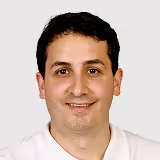
Marcel Kloos
Swiss-licensed dentist and founder of Medschool Experts
Marcel Kloos founded Medschool Experts while studying abroad; since then, over 500 study places have been secured. The Stuttgart-born dentist studied dentistry from 2015 to 2021 in Sofia and holds a Swiss dental licence.
Today he lives in Bern and runs Medschool Experts full-time as its owner.
More articles worth reading
Study Medicine or Dentistry Abroad from Brazil: Revalida, EU Passports and the Best Destinations
Study Medicine or Dentistry Abroad from the Gulf States: Licensing in Saudi Arabia, the UAE, Kuwait, Qatar, Oman and Bahrain
Study Medicine or Dentistry Abroad from Nigeria: MDCN Assessment Exam, Recognition and the Best Destinations

Ahmad

Sabrina

Rami

Noah
500+ students placed.
Now it's your turn!
No daydreaming, no empty promises. Just a clear plan — for the start of your medical degree.
40 minutes, no obligation