Studying Medicine in Iaşi: Costs, Structure and Recognition
17.09.2026

Iași at a glance
Iași is located in eastern Romania, around twenty kilometres from the border with the Republic of Moldova, and has around 300,000 inhabitants. The city is a long-established university town with several higher education institutions and one of the larger botanical gardens in Eastern Europe. For medical studies, that means plenty of academic infrastructure, a low cost of living, and a location further from Germany than the western Romanian sites. The table below summarises the key facts.
| Feature | Details (as of 2026) |
|---|---|
| University | Grigore T. Popa University of Medicine and Pharmacy, Faculty of Medicine founded 1879 |
| Programmes for international students | Medicine, Dentistry |
| Language of instruction | English, with Romanian as a compulsory subject throughout the programme |
| Standard programme length | 6 years, 12 semesters |
| Tuition fee | €4,500 per semester in both Medicine and Dentistry |
| Admissions process | Assessment of academic record and interview, no written test |
| Places for 2026/2027 | 200 in Medicine, 70 in Dentistry (umfiasi.ro) |
| Start of studies | Winter semester |
| Cost of living | approx. €400 to €600 per month |
| Recognition | automatic under Directive 2005/36/EC |
| City | around 300,000 inhabitants, eastern Romania near the Republic of Moldova |
Comparing this table with other Romanian locations quickly shows that the fee isn't what sets them apart — the admissions process is. You can find a comparison of all locations in the country in our overview of Romania.
University and teaching hospitals
The university traces back to the Faculty of Medicine established at the University of Iași in 1879, and is named after the anatomist Grigore T. Popa. Today it is organised into four faculties: Medicine, Dentistry, Pharmacy and Medical Bioengineering. According to the university, more than 800 students are enrolled each year in the Faculty of Medicine's programmes alone (umfiasi.ro, 2026). George Emil Palade, who received the 1974 Nobel Prize in Physiology or Medicine, was born in Iași — a connection the city still highlights as part of its academic identity today.
The clinical infrastructure is the real reason Iași works as a location. The university teaches at eight hospitals in the city: the “Sfântul Spiridon” County Emergency Hospital, the “Sfânta Maria” Children's Hospital, the Regional Oncology Institute, the Institute of Cardiovascular Diseases, the Socola Psychiatric University Hospital, the Parhon Hospital, the Railway Workers' Hospital and the Neurosurgery Clinic. According to figures from the Romanian Ministry of Health, “Sfântul Spiridon” alone has 1,153 beds, of which 1,128 are for inpatient admission, and is classified as a level 1A emergency unit — the highest level in the Romanian system, covering trauma, cardiovascular care, surgery, neurology and neonatology.
In conversations with students from Iași, I'm repeatedly struck by how early ward routine comes up. That's not down to any special curriculum — it's simply the scale of the hospital network. A facility with more than a thousand beds and its own oncology and cardiology institutes brings a case density that you don't need in the pre-clinical years, but that becomes very relevant from the third year onward.
Which programmes are available, and in what language?
Two programmes are relevant for international applicants: Medicine and Dentistry, each six years and taught in English. At Grigore T. Popa University, both are also offered in Romanian and French. Pharmacy and Physiotherapy are aimed at a different group of applicants but are listed here for completeness. It's important to understand the difference between the language of instruction and the language used on the ward: lectures, course materials and exams are in English, while Romanian is spoken at the bedside.
| Programme | Standard duration | Languages |
|---|---|---|
| Medicine | 6 years, 12 semesters | English, French, Romanian |
| Dentistry | 6 years, 12 semesters | English, French, Romanian |
| Pharmacy | 5 years | English, Romanian |
| Physiotherapy | 3 years | English, Romanian |
English at B2 level is required. That's enough to get started, since medical terminology is new to everyone and is built up over the first semesters. In Iași, you'll learn anatomical terms twice anyway — in English and in Latin. Romanian classes run alongside the programme from the start and are not an optional extra but a compulsory subject; without it, ward work later on simply doesn't work.
How does admission work?
Grigore T. Popa University allocates places through a two-stage process. First it assesses your academic record, then an admissions interview follows. There is no written test in biology or chemistry, and no aptitude test in the traditional sense either. The university runs the entire process online, and you don't need to travel to Iași for it. Deadlines shift slightly each year, so book a free consultation with us to get the exact dates for your intended intake.
Registration, the application itself, and scheduling the interview are organised for you by our team at Medschool Experts. We take care of the paperwork. Your job is to prepare the content, which has two parts: first, we refresh your foundations in biology and chemistry with you, since they're assumed knowledge in the first year and you'll need them if you're applying in parallel to a location with an entrance test. Second, we work through the motivation interview with you: why medicine, why Romania, how you picture the medical profession, and how you'll cope with studying in a foreign language.
I consider this one of the fairest admissions processes in Romania. If you tend to struggle under time pressure in multiple-choice exams despite knowing the material, you'll find a calmer path here. On the other hand, without a test, the interview counts for even more. Whether Iași is the right location for you is something we assess individually in a free consultation — and we have a suitable partner university for almost every situation.
What does the programme cost?
Tuition is €4,500 per semester, in both Medicine and Dentistry. In its admissions regulations for the 2026/2027 academic year, the university states this as €9,000 per academic year, payable in two instalments — two-thirds in July and the remainder shortly after. For Pharmacy, the rate is €8,000 per year.
| Programme | Fee per semester | Fee per academic year |
|---|---|---|
| Medicine | €4,500 | €9,000 |
| Dentistry | €4,500 | €9,000 |
| Pharmacy | €4,000 | €8,000 |
More interesting than the per-semester figure is the total across the full programme. The following calculation is our own estimate, not a price quoted by the university: it fixes the tuition fee, applies the midpoint of our cost-of-living range, and adds a flat amount for textbooks, insurance and trips home.
| Item | Calculation | Total |
|---|---|---|
| Tuition fees | 12 semesters x €4,500 | €54,000 |
| Cost of living | 72 months x €500 | €36,000 |
| Textbooks, insurance, trips home | 6 years x approx. €1,000 | €6,000 |
| Total (estimate) | – | approx. €96,000 |
In Dentistry, instruments and consumables are an additional cost — something I remember well from my own studies. How the fees, a study loan and study-abroad BAföG add up in your specific case is something we work through with you in a free consultation. Compared with the other Romanian locations in our series, Iași stacks up as follows:
| Location | Fee per semester | Admissions process |
|---|---|---|
| Iași | €4,500 | Assessment of academic record and interview |
| Timișoara | €4,500 | Language test and multiple-choice entrance test |
| Cluj-Napoca | €5,000 | Selection based on application, no test |
You can find the details on the other two locations in our articles on Timișoara and Cluj.
{{cta}}
How is the programme structured?
The curriculum follows the classic European pattern: two pre-clinical years, three clinical years, and a final practical year. What sets Iași apart from German faculties is not so much the sequence of subjects as the Romanian classes, which run alongside the programme from the start and become essential working knowledge in later semesters.
| Stage | Years of study | Focus |
|---|---|---|
| Pre-clinical | 1 to 2 | Anatomy, physiology, biochemistry, histology, embryology, alongside Romanian classes |
| Clinical stage | 3 to 5 | Internal medicine, surgery, paediatrics, gynaecology, neurology, psychiatry with placements at the university hospitals |
| Practical year | 6 | predominantly practical training, comparable to the German "Praktisches Jahr" |
At the end of the first two years, there's a Romanian intermediate examination. It's part of the local programme structure, but since 2023 it's no longer recognised in Germany as equivalent to the “Ärztliche Vorprüfung” (pre-clinical state exam). This mainly matters if you're considering a later transfer; it has no bearing on your degree in Iași or the subsequent licensing process. Your performance is documented throughout in ECTS credits and recorded on the Transcript of Records.
Where can you practise as a doctor with this degree?
Romania has been a member of the European Union since 2007. The Romanian medical qualification “Diploma de licență de doctor-medic” is listed in Annex V of Directive 2005/36/EC under point 5.1.1, as amended by Delegated Decision (EU) 2023/2383 of 23 May 2023, applicable since 9 October 2023. This means automatic recognition applies: no equivalence assessment, no knowledge test.
| Country | Path to professional licensing |
|---|---|
| Germany | Apply for a licence (Approbation) with the relevant state authority; automatic recognition under 2005/36/EC, proof of German language skills including medical terminology |
| Austria | Recognition by the Austrian Medical Chamber, entry in the register of physicians |
| Switzerland | Recognition of the EU diploma by the competent federal authority, followed by registration and a practising licence from the canton |
| Rest of the EU and EEA | Automatic recognition under 2005/36/EC, registration with the national professional body, usually with proof of language skills |
| United Kingdom | Registration with the General Medical Council; since Brexit, a separate process with language and knowledge assessments |
| USA | ECFMG certification and the USMLE; since 1 January 2023, the faculty must be accredited by a WFME-recognised agency |
One more sentence on the US rule, since it's often misunderstood: Romania's state quality-assurance agency is ARACIS, but it does not appear on the WFME's list of recognised accreditation agencies. For Romania, the WFME lists the Independent Agency for Accreditation and Rating (IAAR), recognised until January 2028. Whether your faculty is accredited there can be checked in the World Directory of Medical Schools. For Germany, Austria, Switzerland and the EU, this is irrelevant — only Annex V matters there.
Dentist, pharmacist, psychologist, veterinarian: the legal position by profession
Dentist. The Romanian dental qualification is listed in Annex V under point 5.3.2 and is therefore automatically recognised, just like the medical one. The programme in Iași also runs for six years and is taught in English. After graduating, you apply for your dental licence with the authority in your German federal state and can then start as an associate dentist or pursue further specialisation.
Pharmacist. Pharmacy is listed in Annex V under point 5.6.2 and is therefore also harmonised. Grigore T. Popa University offers the programme with a standard duration of five years, at a fee of €8,000 per year. In addition to the recognised diploma, obtaining a German pharmacist's licence also requires proof of language proficiency.
Psychologist. Psychology and psychotherapy are not harmonised under EU law. There's no entry in Annex V, so each national authority decides individually whether and how it recognises a foreign qualification. In Germany, the path to becoming a licensed psychotherapist is also tied to specific programme content. In any case, Psychology is not a programme we place students in at Iași.
Veterinarian. Veterinary medicine is harmonised under point 5.4.2 of Annex V and is therefore automatically recognised across Europe. In Iași, however, it's not offered at Grigore T. Popa University but at a separate institution in the city. If this path interests you, get in touch — we'll help you work out which location fits in a free consultation.
Career paths after graduation
With your diploma from Iași and a German medical licence, you're on the same footing as graduates of German faculties when applying for a residency position. Specialist training follows the regulations of the relevant state medical association, and where you studied makes no difference there. If you know early on which direction you want to go, you can arrange your clinical electives and practical year in Iași accordingly.
Being taught in English pays off later on. English is the working language for research placements, professional literature, and starting a career in Scandinavia, Ireland or the Netherlands. On top of that, your Romanian classes keep Romanian hospitals open to you — an option most German graduates don't have. We've covered in detail which paths an EU medical degree opens up worldwide in our overview of career paths with an EU medical degree.
There are also opportunities outside clinical practice: public health administration, medical research, pharmacovigilance, medical journalism or public health more broadly. The Regional Oncology Institute and the Institute of Cardiovascular Diseases in Iași are research centres where students can get involved in early projects.
Lateral entry, transfers and moving back to Germany
A transfer from Iași to a German faculty is possible, but not something you can plan for with certainty. Two conditions have to be met at the same time: there needs to be a free place in the matching advanced semester, and the German faculty has to recognise the credits you earned in Romania. Neither is something you decide. Your ECTS credits and Transcript of Records from Iași form the basis of every credit-recognition application, so you should collect them after every year of study.
One important point I mentioned earlier: since 2023, the Romanian intermediate examination is no longer recognised in Germany as equivalent to the “Ärztliche Vorprüfung”. So if you want to transfer after your second year, you can't rely on already having your Physikum in hand. My recommendation is simple: go to Iași planning to finish your degree there. A transfer is then an option, not a requirement. You can find the detailed process in our article on moving back to Germany.
Lateral entry into a higher semester at Iași itself is also decided on a case-by-case basis. If you've already completed semesters at another university, we'll assess this individually in a free consultation.
Life in Iași: the city, getting around, costs
Iași is a student city, but not the kind you'd recognise from a holiday brochure. The cityscape is shaped by historic churches, 19th-century buildings and the Palace of Culture, alongside the botanical garden, one of the larger ones in Eastern Europe. Prices are noticeably lower than in Germany: a meal at an inexpensive restaurant costs around €5.20, a cappuccino about €1.50.
| Item | Amount in Lei | Converted |
|---|---|---|
| One-bedroom flat in the city centre | 2,500 | approx. €477 |
| One-bedroom flat outside the centre | 2,036 | approx. €389 |
| Monthly public transport pass | 130 | approx. €25 |
These figures come from Numbeo, dated 26 July 2026, converted at a rate of around 5.24 Lei per euro (August 2026). They apply to a complete flat. Most international students live in university halls or share a flat; a room in a shared flat costs roughly €100 to €300 a month. With groceries and public transport included, that puts you in the €400 to €600 a month range we use in our calculations. See how this compares across Europe in our overview of cost of living for medical students.
It's also worth being clear-eyed about the map: Iași sits on the eastern edge of the European Union. I've noticed that students there head home for a spontaneous weekend less often than those in Timișoara or Cluj-Napoca. In exchange, more everyday life happens in the city itself, and Romanian language skills develop faster.
Who this location suits
Iași suits you well if you'd rather start without an entrance test and present yourself better in an interview than in a multiple-choice exam. It suits you if a large hospital network matters to you and you want early exposure to ward practice. And it suits you if you want to stay at the lower end of the Romanian fee range without giving up an English-taught programme.
It suits you less well if short travel distances to Germany matter a lot to you, or if the idea of a compulsory second language alongside English doesn't sit well with you. Neither is a dealbreaker, but both are points you should think through honestly before deciding.
My assessment: Iași is one of the most solid Romanian locations for anyone who has a clear yes to medicine but a difficult relationship with entrance tests. The trade-off is the distance and the compulsory Romanian classes — both manageable if you plan for them from the start. Whether this location suits your situation is something we can look at together: simply book a free consultation.
Author's Opinion
I studied dentistry in Sofia from 2015 to 2021, and I know the moment when studying abroad turns from an abstract idea into a concrete decision. Bulgaria and Romania aren't the same, but the questions are identical: Is my English good enough, how tough will the first year be, will a diploma from Eastern Europe hold up back home? I can say today that these questions are entirely reasonable — and that the answers turn out less dramatic than you'd expect going in.
Two things convince me about Iași. First, the admissions process: in my view, assessing academic record plus an interview identifies who's genuinely suited to this degree more accurately than a single test day. Second, the clinical infrastructure. Eight teaching hospitals, including one with over a thousand beds and the highest emergency classification, aren't just window dressing — they're where real learning happens from the third year onward.
The Romanian language requirement is the point I get asked about most, and it's a real one. The language is compulsory, it's examined, and without it, ward work from the clinical stage onward simply doesn't function. That's on top of an already demanding curriculum. Students who plan for it get through well; those who treat it as an afterthought run into time pressure in year three.
Today, I look at study locations differently than I did as an applicant: what matters to me is less the prospectus and more the question of how many of our students actually hold their diploma after six years. Iași leaves a calm, reliable impression in that respect — and that's exactly what a place to study needs to deliver.
Conclusion
Studying medicine in Iași is a genuinely attractive option — and it's just one of many strong choices in our network. At Medschool Experts, we work with the largest network of official partner universities, and for every student we individually assess the highest possible year of entry, which is often possible in the final two years of the programme. Wherever you're starting from, there's likely a path that fits your situation.
Book a free consultation with us today, and let's find the right route into medicine for you.
Frequently asked questions about studying medicine in Iași
Is there an entrance test in Iași?
No. Grigore T. Popa University assesses your academic record and then invites you to an interview. There's no written test in biology or chemistry. The interview focuses mainly on your motivation and your idea of the medical profession. If you tend to struggle under time pressure in entrance tests, you'll find a calmer route to a place here.
What requirements do I need for Iași?
You need a general higher education entrance qualification and English at B2 level, since Medicine and Dentistry are taught in English. The Romanian system has no numerus clausus, so your school-leaving grade alone doesn't decide your place. Whether your profile fits is something we assess individually in a free consultation. We take care of the organisation.
How high are the tuition fees in Iași?
They amount to €4,500 per semester, in both Medicine and Dentistry. The university states this in its admissions regulations for 2026/2027 as €9,000 per academic year. Over twelve semesters, that comes to €54,000 in fees alone. That makes Iași one of the more affordable English-taught medical programmes in the European Union.
What does the programme cost in total?
Our estimate for the full six years is around €96,000. That includes €54,000 in tuition fees, €36,000 in living costs at €500 a month, and around €6,000 for textbooks, insurance and trips home. In Dentistry, instruments and consumables add to this. This is our own calculation, not a price quoted by the university.
How much does life in Iași cost?
Budget around €400 to €600 a month for rent, groceries and public transport. A room in shared accommodation costs roughly €100 to €300, a monthly public transport pass around €25 according to Numbeo, as of July 2026. A meal at an inexpensive restaurant is around €5.20. Over six years, this still adds up.
Do I need to learn Romanian for the programme?
Yes. Subject teaching is in English, and Romanian runs alongside it as a compulsory subject. It's examined, and it's a prerequisite for working with patients at the university hospitals from the clinical stage onward. Romanian is a Romance language, so it's easier to pick up if you know Latin or French. Don't underestimate the effort involved.
Is my English good enough for Iași?
Proof of B2 level is required, since lectures, course materials and exams run entirely in English. If you did solidly in upper-secondary English classes, you'll usually reach this level without major extra effort. Medical terminology is new to everyone regardless and is built up over the first semesters. You'll learn anatomical terms in both English and Latin.
How is the programme in Iași structured?
It takes six years, or twelve semesters. Years one and two are pre-clinical, covering anatomy, physiology, biochemistry, histology and embryology, alongside Romanian classes. From the third year, the clinical stage follows with placements at the university hospitals. The sixth year is predominantly practical and corresponds to the German "Praktisches Jahr".
Is the degree recognised in Germany?
Yes. The Romanian medical qualification is listed in Annex V of Directive 2005/36/EC under point 5.1.1, and the dental one under 5.3.2. This means the diploma is automatically recognised in Germany, Austria and Switzerland. There's no equivalence assessment and no knowledge test. The relevant version is the 2023 Delegated Decision.
Does the Romanian intermediate exam count as the Physikum?
No. The intermediate exam after the first two years of study is part of the programme structure in Romania, but since 2023 it's no longer recognised in Germany as equivalent to the “Ärztliche Vorprüfung”. It has no bearing on your degree in Iași or your subsequent licensing. It only becomes relevant if you're considering a transfer to Germany.
How do I get my German medical licence?
You apply with the licensing authority in the German state where you want to work. Alongside your recognised diploma, you'll typically need to show proof of German language skills including medical terminology, as well as personal and health suitability. Processing times vary considerably between states, so plan for that.
How large is the university's hospital network?
Grigore T. Popa University teaches at eight hospitals in Iași, including the Sfântul Spiridon County Emergency Hospital, the Sfânta Maria Children's Hospital, the Regional Oncology Institute and the Institute of Cardiovascular Diseases. According to the Romanian Ministry of Health, Sfântul Spiridon has 1,153 beds, of which 1,128 are for inpatient admission, and is classified as the highest-level 1A emergency unit.
When does the programme start, and when should I apply?
The programme starts in the winter semester only; there is no intake in the summer semester. Application deadlines shift slightly from year to year, so it's best to apply as early as possible in the year before your intended start. Book a free consultation with us and we'll guide you through the exact timeline and next steps.
What students say about Medschool Experts
Over 500 placements at more than 25 partner universities across 10+ countries. Read independent student reviews on Trustpilot.
About the author
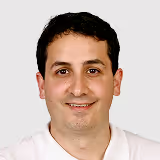
Marcel Kloos
Swiss-licensed dentist and founder of Medschool Experts
Marcel Kloos founded Medschool Experts while studying abroad; since then, over 500 study places have been secured. The Stuttgart-born dentist studied dentistry from 2015 to 2021 in Sofia and holds a Swiss dental licence.
Today he lives in Bern and runs Medschool Experts full-time as its owner.
More articles worth reading
Health Insurance for International Medical Students in Europe 2026
Scholarships and Funding for Medical Studies in Europe 2026
Medicine, Dentistry, Pharmacy or Veterinary Medicine? Choosing Your Degree Abroad in 2026
Ahmad
Sabrina
Rami
Noah
500+ students placed.
Now it's your turn!
No daydreaming, no empty promises. Just a clear plan — for the start of your medical degree.
40 minutes, no obligation