Tuition Fees Compared: All NC-Free Medical Universities in Europe 2026
17.09.2026

How to read this overview
Figures show tuition fees per semester for the English-language programmes, unless noted otherwise. Universities adjust their fees regularly, sometimes even during the course of study. These figures are for orientation only – the binding numbers are whatever the relevant university states in your admission letter. You'll find a full overview of all study locations on our universities page.
Czech Republic
| University | Human Medicine | Dentistry |
|---|---|---|
| Charles University Pilsen | €8,000 | €8,000 |
| Charles University Prague (2nd Faculty) | €8,660 | – |
| Charles University Prague (3rd Faculty) | €8,650 | – |
| Masaryk University Brno | €7,840 | €8,250 |
| Palacky University Olomouc | €6,250 | €7,000 |
Hungary
| University | Human Medicine | Dentistry |
|---|---|---|
| Semmelweis Budapest | €9,340 (German) / €8,850 (English) | €9,340 (German) / €8,850 (English) |
| University of Pécs | €7,875 (German) / €7,090 (English) | €7,500 (German) / €7,340 (English) |
| University of Szeged | €7,600 (German) / €7,900 (English) | approx. €7,640 |
| University of Debrecen | €7,150 | €7,400 |
Hungary is the only location with several German-language programmes – the differences between the four cities are covered in our overview of Hungary.
Poland
| University | Human Medicine | Dentistry |
|---|---|---|
| Medical University of Lodz | approx. €7,460 | approx. €8,320 |
| Medical University of Poznan | approx. €8,735 | approx. €8,845 |
| Medical University of Bialystok | approx. €7,860 | – |
Other Polish locations such as Szczecin, Wroclaw, and Katowice are covered in our overview of Poland.
Slovakia
| University | Human Medicine | Dentistry |
|---|---|---|
| Comenius University Bratislava | €6,500 | €7,250 |
| UPJS University Kosice | €6,500 | €6,750 |
| Jessenius Faculty Martin | €5,750 | – |
The Czech Republic and Slovakia are covered together in our joint overview for both countries.
The Baltics
| University | Human Medicine | Dentistry |
|---|---|---|
| Riga Stradins University (Latvia) | €6,750 | €7,750 |
| University of Latvia, Riga | approx. €6,138 | €8,250 |
| University of Health Sciences Kaunas (Lithuania) | approx. €6,450 | approx. €6,900 |
What to keep in mind about credit recognition in the Baltics is covered in our overview of Riga, Kaunas, and Vilnius.
{{cta}}
Romania, Croatia, and Cyprus
| University | Human Medicine | Dentistry |
|---|---|---|
| Victor Babes University Timisoara | €4,250 | €4,250 |
| University of Cluj | €5,000 | €5,000 |
| University of Split | €6,000 | – |
| University of Zagreb | €6,100 | – |
| University of Nicosia | €11,000 | – |
Timisoara and Cluj are the most affordable EU locations of all – both profiled in Studying Medicine in Romania.
Bulgaria
In Bulgaria, fees are traditionally stated per academic year, payable in two instalments. Currently, they run at around €9,950 per year in Sofia for human medicine and €10,000 for dentistry, around €10,000 in Varna, roughly €9,000 to €10,000 in Plovdiv, and around €9,000 in Pleven and at Trakia University in Stara Zagora. Since 1 January 2026, fees there are also billed in euros.
The special case: a German-language programme with clinical training in Germany
The Faculty of Medicine at Osijek, part of Josip Juraj Strossmayer University in Croatia, offers a distinctive model: a fully German-language human medicine programme run in cooperation with a hospital group. The pre-clinical part and the final semester take place in Osijek, while semesters six through eleven involve bedside teaching at selected locations in Germany. Each cohort numbers around 60 students, taught in groups of six to ten. Tuition is €8,000 per semester, and admission runs through an assessment centre with a knowledge test and an interview.
What to consider besides price
- Credit transfer if you return: Curricula differ. If you might want to move back to Germany later, check the credit transfer situation before choosing a location.
- Cost of living: A low fee in an expensive city can end up costing more than a higher fee in an affordable one – see the figures in our monthly budget by location.
- Language: German-language programmes exist in Budapest, Pécs, Szeged, and Osijek; all others are taught in English.
- Admissions process: Everything from a straightforward document review to a full assessment centre is represented.
- Accessibility: A direct flight or train connection determines how often you can get home.
Which combination of fees, cost of living, and credit transfer works out best for you is something we work through together in a free consultation.
Where is it cheapest to study?
Within the EU, Timisoara and Cluj in Romania, along with Martin in Slovakia, sit at the lower end. What matters, though, is the overall calculation of fees, cost of living, and credit transfer prospects.
Are all these degrees recognised in Germany?
All the universities listed are located within the EU or the EEA. Their degrees are automatically recognised under Directive 2005/36/EC, provided the faculty is listed in Annex V. For locations outside the EU, additional steps need to be factored in.
Author's opinion
Price tables are useful, but they're never the whole reason behind a decision. I've seen students choose the cheapest location and be happy with it – and others for whom a good flight connection home ended up mattering more than a €2,000 difference per year.
My advice: work out the total cost over six years, including living expenses, first – then check which of the affordable locations actually fits your life. The most expensive path is almost always the one where you wait three years for cost reasons and end up going abroad anyway.
Talk to Medschool Experts
Fees are only part of the picture. Get in touch with Medschool Experts – we run the largest network of official partner universities, and we assess the highest possible year of entry individually for every student, with entry often possible even in the final two years of study. Book a free consultation and find the location that fits your budget and your plans.
Frequently Asked Questions About Medical Tuition Fees
Where is medicine cheapest in Europe?
The lowest fees are found in the Western Balkans: in Foca (Bosnia and Herzegovina), human medicine costs around €3,500 per academic year. Within the EU, Bulgaria and Serbia are the most affordable, while the Czech Republic, Hungary, and Cyprus are considerably higher.
Are the fees given per semester or per year?
In this overview, figures are per semester for the English-language programmes, unless noted otherwise. Double the figure for the annual fee, and multiply by twelve semesters for the total cost.
Are there additional costs on top of tuition?
Yes. Budget for a one-off enrolment fee, costs for certified translations and recognition of your school certificates, and course materials. In dentistry, instruments and materials are an additional cost depending on the location; at some universities, the faculty provides them.
Are all these degrees recognised in Germany?
Degrees from EU states are automatically recognised under Directive 2005/36/EC. For locations outside the EU, such as Bosnia and Herzegovina or Serbia, recognition goes through an equivalency assessment by the relevant state examination office, which is standard practice for accredited faculties.
Are German-language programmes more expensive than English-language ones?
Usually, yes. At universities offering both, such as in Hungary, the German-language programme is typically a few hundred euros per semester more than the English one. Academically, the programmes don't differ.
Do tuition fees increase during your studies?
Adjustments are common, usually in line with inflation. So don't just plan today's price times twelve semesters – build in a buffer, and ask to see your target university's fee schedule before you apply.
How can this be financed?
German study-abroad BAföG provides up to €992 a month and covers tuition fees up to €5,600 a year as a non-repayable grant. On top of that, there are education funds with income-based repayment, student loans, and part-time work during semester breaks.
What should I consider besides price?
The faculty's accreditation, the language of instruction in the clinical part, group sizes for bedside teaching, the option of doing clinical electives and your final clinical year in Germany, and how well semesters transfer if you switch universities later.
What students say about Medschool Experts
Over 500 placements at more than 25 partner universities across 10+ countries. Read independent student reviews on Trustpilot.
About the author
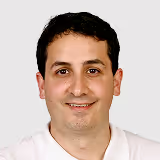
Marcel Kloos
Swiss-licensed dentist and founder of Medschool Experts
Marcel Kloos founded Medschool Experts while studying abroad; since then, over 500 study places have been secured. The Stuttgart-born dentist studied dentistry from 2015 to 2021 in Sofia and holds a Swiss dental licence.
Today he lives in Bern and runs Medschool Experts full-time as its owner.
More articles worth reading
Health Insurance for International Medical Students in Europe 2026
Scholarships and Funding for Medical Studies in Europe 2026
Medicine, Dentistry, Pharmacy or Veterinary Medicine? Choosing Your Degree Abroad in 2026
Ahmad
Sabrina
Rami
Noah
500+ students placed.
Now it's your turn!
No daydreaming, no empty promises. Just a clear plan — for the start of your medical degree.
40 minutes, no obligation