Study Medicine or Dentistry Abroad from Canada: MCCQE, CaRMS and the Best Destinations
23.09.2026

Why So Many Canadians Look Abroad
Canadian medical school admission is shaped by three factors. First, seat numbers: even with recent expansion, the number of first-year places remains small compared with demand. Second, provincial priorities: many schools reserve most of their places for residents of their own province, which narrows the options for students from provinces with only one or two faculties. Third, the length of the path: in most provinces, you complete at least two to four years of undergraduate study before medical school begins.
Studying abroad offers a different rhythm. Many European programmes accept students directly after high school or after a first degree, teach entirely in English and admit on a transparent basis. For many Canadians, this turns an uncertain waiting game into a clear six-year plan.
Dentistry Follows the Same Logic
Canada's dental schools admit only a few hundred students each year, and competition is intense. A dental degree from abroad, combined with the national equivalency process, is a well-known route back into Canadian practice.
How a Foreign Medical Degree Is Recognised in Canada
In Canada, the path back home has four building blocks: a recognised school, the Medical Council of Canada exams, the residency match and provincial licensing.
Building Block 1: A Recognised School
Your medical school must be listed in the World Directory of Medical Schools with a Canada sponsor note. This listing confirms that graduates are eligible for the Medical Council of Canada's exams and services. Checking this note is the first step before choosing any programme.
Building Block 2: The MCC Exams
The Medical Council of Canada Qualifying Examination Part I (MCCQE Part I) tests medical knowledge and clinical decision-making. It is required for residency in all provinces except Quebec. The National Assessment Collaboration (NAC) Examination assesses clinical skills and is required by most provinces for international medical graduates applying to residency. You can take the MCCQE Part I from abroad, which means you can prepare during your final years of study.
Building Block 3: CaRMS and the IMG Stream
Residency positions are allocated through the Canadian Resident Matching Service (CaRMS). Canadian citizens and permanent residents who studied abroad apply through the international medical graduate stream. Several provinces reserve positions for this group, and many of these positions come with a return-of-service agreement, a commitment to work in the province for a defined period after residency.
Building Block 4: Provincial Licensing
After residency and certification by the Royal College of Physicians and Surgeons of Canada or the College of Family Physicians of Canada, the provincial college grants the full licence. Several provinces have also opened practice-ready assessment routes for experienced internationally trained physicians.
What Applies to Dentistry
Dentists trained outside Canada and the USA usually complete the National Dental Examining Board of Canada (NDEB) Equivalency Process, a series of assessments of fundamental knowledge, clinical judgement and clinical skills. After passing, graduates take the NDEB certification exams and apply for provincial licensing. Alternatively, some graduates complete a degree completion programme at a Canadian dental school.
{{cta}}Which Destination Countries Suit Canadian Students?
Canadian students benefit from choosing programmes that are well known to Canadian and American regulators. The following countries are especially popular.
Ireland
Ireland is one of the traditional destinations for Canadians. English-language teaching, a familiar culture and a long history of Canadian graduates returning home make it an attractive option.
Poland
In Poland, several universities run English-language MD programmes designed for North American students, with curricula that prepare for both the USMLE and the MCCQE. Clinical rotations in North America are possible in some programmes, which strengthens a later CaRMS application.
Hungary and the Czech Republic
Both countries offer six-year English-language programmes in Medicine and Dentistry with large international cohorts. They combine EU quality standards with manageable living costs, and many Canadians have graduated from these countries and returned home.
The Caribbean
Caribbean medical schools follow a North American model, with basic sciences on the island and clinical rotations in hospitals in the USA and sometimes Canada. For Canadians who want to keep both the Canadian and the US residency route open, this can be a strategic choice.
Other EU Countries
Bulgaria, Romania, Slovakia and other EU countries also offer English-language programmes. They are particularly suitable for students who hold a European passport as well as Canadian citizenship.
{{callout}}Practical Tips for Canadian Students
Keep Two Doors Open
Many Canadians studying abroad prepare for both the MCCQE Part I and the USMLE. A US residency followed by a return to Canada is a common and respected path, because Canadian licensing bodies recognise residency training completed in the USA.
Check the Canada Sponsor Note
Before you commit to any programme, confirm that the school carries the Canada sponsor note in the World Directory. This single check protects your eligibility for the MCC exams.
Plan Canadian Electives
Clinical electives in Canada give you references from Canadian physicians and familiarity with the Canadian system. Both make a noticeable difference in CaRMS applications.
Understand Return of Service
Return-of-service agreements are common for IMG positions. They are an excellent way into practice, especially in family medicine and in underserved regions, and many graduates stay in their province long after the agreement ends.
Look at Your Provincial Options Early
Eligibility rules and exam requirements differ slightly between provinces. Knowing where you want to practise helps you choose the right exams and electives.
How We Help You Choose the Right Programme
The right school abroad is the foundation of a smooth return to Canada. We offer solutions for exactly this. Contact us and we check individually which of our 25+ partner universities fits you, your province and your career goals. Marcel or another experienced consultant on our team will review your background and give you a clear recommendation.
The Author's View
Canadian students often come to us after one or two unsuccessful application cycles at home. They are usually excellent candidates, and they are often surprised to hear how many doctors practising in Canada today began their careers abroad. The numbers from the last three residency matches tell a clear story: the door for Canadians who studied abroad is open wider than it has been in years.
What makes the difference is planning. Choosing a school with the right listing, preparing for the MCCQE during the clinical years, arranging electives in Canada and understanding how return of service works: these are the elements that turn a foreign degree into a Canadian career. None of it is out of reach.
Another point I stress is flexibility. Canadians who study abroad often discover that they enjoy working in more than one health system. Some complete residency in the USA and return to Canada later, others start in family medicine in a smaller community and move into a specialty afterwards. A well-chosen programme abroad supports all of these paths, which is a real advantage in a career that lasts decades.
If you are a Canadian student who is serious about medicine, the path abroad is not a detour. It is often the fastest and most reliable way to reach your goal. Book a consultation and let us plan it with you.
Conclusion
- Canada's 17 faculties of medicine fill roughly 3,000 first-year seats, far fewer than the number of qualified applicants.
- In 2025, 851 international medical graduates matched to Canadian residency, up from 671 in 2024 and 555 in 2023.
- A foreign degree works in Canada with a school listed in the World Directory with a Canada sponsor note, the MCCQE Part I, the NAC Examination in most provinces and a CaRMS match.
- Dentists return through the NDEB Equivalency Process.
- Ireland, Poland, Hungary, the Czech Republic and the Caribbean are popular destinations for Canadians.
More Canadians than ever are coming home after studying abroad and starting residency. With the right programme and a clear plan, you can be one of them. Book your free consultation and let us help you take the first step.
Frequently Asked Questions
Can I practise medicine in Canada with a degree from Europe?
Yes. Canadian citizens and permanent residents with a medical degree from a school listed in the World Directory with a Canada sponsor note can take the MCC exams, apply to residency through CaRMS and obtain a provincial licence.
Which exams do I need to pass?
The MCCQE Part I is required in all provinces except Quebec, and the NAC Examination is required by most provinces for international medical graduates applying to residency.
What is a return-of-service agreement?
Many residency positions for international medical graduates require you to work in the province for a defined period after completing residency. It is a structured way into practice and is common in family medicine.
Can I combine a Canadian and a US career plan?
Yes. Many Canadians studying abroad prepare for both the MCCQE and the USMLE. Residency training completed in the USA is recognised by Canadian licensing bodies, so this approach keeps both options open.
How do Canadian dentists trained abroad get licensed?
They usually complete the NDEB Equivalency Process, which assesses knowledge, clinical judgement and clinical skills, then pass the NDEB certification exams and apply to their provincial dental regulator.
Do I need an undergraduate degree before studying Medicine in Europe?
No. Most European programmes admit students directly after high school, based on their school results in biology and chemistry and, in some cases, an entrance exam or interview. Students who already hold a science degree can often apply as well, and some programmes may credit parts of their previous studies.
How many IMGs match to residency in Canada?
In the 2025 residency match, 851 international medical graduates matched to a position in Canada, compared with 671 in 2024 and 555 in 2023. The trend shows that the path for well-prepared Canadians who studied abroad is widening.
When can I take the MCCQE Part I?
The MCCQE Part I can be taken from abroad once you meet the eligibility requirements, which allows many students to sit it close to graduation. Taking it early gives you a result to include in your CaRMS application.
Which university abroad is right for me?
That depends on your academic background, your province and your career goals. Contact us and we check individually which of our 25+ partner universities fits you.
What students say about Medschool Experts
Over 500 placements at more than 25 partner universities across 10+ countries. Read independent student reviews on Trustpilot.
About the author
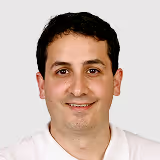
Marcel Kloos
Swiss-licensed dentist and founder of Medschool Experts
Marcel Kloos founded Medschool Experts while studying abroad; since then, over 500 study places have been secured. The Stuttgart-born dentist studied dentistry from 2015 to 2021 in Sofia and holds a Swiss dental licence.
Today he lives in Bern and runs Medschool Experts full-time as its owner.
More articles worth reading
Study Medicine or Dentistry Abroad from Brazil: Revalida, EU Passports and the Best Destinations
Study Medicine or Dentistry Abroad from the Gulf States: Licensing in Saudi Arabia, the UAE, Kuwait, Qatar, Oman and Bahrain
Study Medicine or Dentistry Abroad from Nigeria: MDCN Assessment Exam, Recognition and the Best Destinations
Ahmad
Sabrina
Rami
Noah
500+ students placed.
Now it's your turn!
No daydreaming, no empty promises. Just a clear plan — for the start of your medical degree.
40 minutes, no obligation