Medical School in Sofia: Universities, Costs and Recognition
17.09.2026

What does studying medicine in Sofia cost in 2026?
In the 2026/2027 academic year, studying medicine in Sofia costs 9,950 euros per year for human medicine at the Medical University of Sofia, 10,000 euros for English-language dentistry, and 8,000 euros for pharmacy. At the Faculty of Medicine of Sofia University, human medicine costs self-funding students 8,000 euros per year. All the amounts given are annual figures.
| Programme | University in Sofia | Fee per year |
|---|---|---|
| Human medicine (English) | Medical University of Sofia | 9,950 euros |
| Human medicine (English) | Sofia University “St. Kliment Ohridski” | 8,000 euros |
| Dentistry (English) | Medical University of Sofia | 10,000 euros |
| Dentistry (Bulgarian) | Medical University of Sofia | 6,550 euros |
| Pharmacy | Medical University of Sofia | 8,000 euros |
| Veterinary medicine (English) | University of Forestry, Sofia | around 5,200 euros in the first year |
Bulgaria adopted the euro on 1 January 2026 at the irrevocably fixed rate of 1.95583 lev to the euro. The universities have quoted their fees in euros ever since. There is therefore no longer any currency risk, and converting lev amounts from earlier years is unambiguous.
My assessment of how prices are developing: the amounts for human medicine and dentistry have stood unchanged at 9,950 and 10,000 euros since the 2025/2026 academic year. The university therefore did not raise fees across the currency changeover. That is no promise for the years ahead, but it is a good sign for predictability. Even so, never rely on figures from a three-year-old blog post – not even mine.
Which universities in Sofia train students in medicine, dentistry, pharmacy, and veterinary medicine?
In 2026, three state universities in Sofia train students in regulated health professions: the Medical University of Sofia with human medicine, dentistry, and pharmacy; the Faculty of Medicine of Sofia University “St. Kliment Ohridski” with human medicine and nursing; and the University of Forestry, Sofia, with veterinary medicine. Few people know that the city has two medical faculties.
| University | Subjects | Accreditation valid until |
|---|---|---|
| Medical University of Sofia | Human medicine, dentistry, pharmacy, public health | 25 September 2031 |
| Sofia University “St. Kliment Ohridski” | Human medicine, nursing, rehabilitation, pharmacy | 25 July 2030 |
| University of Forestry, Sofia | Veterinary medicine | 12 September 2030 |
The Faculty of Medicine of Sofia University is the younger of the two routes. Its academic council adopted the English-language medical curriculum in 2012; its clinical bases are Lozenets University Hospital and the Military Medical Academy in Sofia. The Military Medical Academy is therefore a large teaching hospital, but not a university in its own right.
Veterinary medicine at the University of Forestry has also been taught in English since 2011 and lasts eleven semesters, that is five and a half years. This faculty is named in Annex V of Directive 2005/36/EC as an issuing body for Bulgarian veterinary diplomas, alongside Trakia University in Stara Zagora. There is more on this in our article on studying veterinary medicine in Bulgaria.
One point I always add: with the European Association of Establishments for Veterinary Education, the Sofia faculty currently holds candidate status, while Trakia University is a full member. This makes no difference to recognition of the diploma within the European Union. Anyone intending to work outside Europe later should be aware of it.
How is the Medical University of Sofia set up?
The Medical University of Sofia goes back to the law of 10 November 1917, under which the Faculty of Medicine of Sofia University was founded during the reign of Tsar Ferdinand I. The first lecture followed a year later. In 1950 the faculty was hived off and converted into a Medical Academy; today's independent university grew out of that.
| Feature | Status | What it means for you |
|---|---|---|
| Founded | 1917, independent since 1950 | established structures, a settled teaching culture |
| Faculties | 4 plus a Medical College | human medicine, dentistry, pharmacy, public health |
| Students | around 10,000, of whom 3,315 international | a good third from abroad |
| Group size | up to ten students per teacher | hands-on teaching rather than mass lectures |
Today the university comprises four faculties – medicine, dental medicine, pharmacy, and public health – plus a Medical College, a branch in Vratsa, and around 1,000 academic staff. Some 10,000 people study there: roughly 3,700 in human medicine, 1,500 in dental medicine, 1,400 in pharmacy, and 3,860 in the other health professions. Each year around 300 international students begin human medicine. Over more than a hundred years, around 82,000 people have graduated here, including some 10,500 from abroad.
Clinical training runs through thirteen university hospitals in the city, among them the Aleksandrovska Hospital, the children's hospital, the Maychin Dom maternity hospital, and the Pirogov emergency hospital. This breadth is the real advantage of a capital city: what never comes through the door of a smaller hospital, you see here as a matter of routine.
How international is the Medical University of Sofia?
In the 2025/2026 academic year, the Medical University of Sofia counted 3,315 international students from 71 countries, 2,026 of them from the European Union. With around 10,000 students in total, that is a good third. This makes Sofia one of the most international centres of medical education in Europe.
That figure only acquires a face in the canteen. I sat at tables there with someone from Alaska, next to fellow students from Greece, Russia, and Australia, along with Italy, Spain, Portugal, the United States, Canada, Palestine, the United Arab Emirates, and the United Kingdom. In my time there were over 60 countries. A genuine melting pot. It shapes you for life.
The effect goes far beyond travel stories. When a fellow student from Canada and one from the Emirates discuss the same case in a seminar, two health systems come to the table with them. You learn early that guidelines do not look the same everywhere, and that the question "how do you do this where you're from?" often yields more than the textbook. Medicine is a global profession. In Sofia you notice that from the first semester.
In practical terms this later shows up in your network. Anyone who spends six years learning alongside people from four continents ends up with contacts at hospitals they would otherwise never have approached – for a clinical placement, for an observership, for the question of how registration in another country actually works. What doors the degree opens worldwide is set out in the guide Career paths with an EU medical degree.
And there is a side effect I had underestimated: in a group where everyone comes from somewhere else, nobody is the foreigner. That takes an enormous amount of pressure out of the first semester. Anyone in Germany who worries about being an outsider abroad can strike that concern off the list for Sofia.
How large are the study groups in Sofia?
In seminars and practical courses at the Medical University of Sofia, there are up to ten students per teacher. Lectures are held in large cohorts; the rest of the week is not. In my view this is the single most important quality factor of the location – more important than any ranking.
The difference is immediately noticeable in daily life. You cannot hide, and you get answers to your own questions. Standing four to a table in the dissection course rather than twelve means you have the scalpel in your hand instead of a view over four shoulders. It is precisely those hours that determine in the end how confident you are with a patient.
The examination culture fits with this. Assessment is predominantly oral, and in practical subjects it takes place at the specimen or at the bedside. That is uncomfortable, because you cannot tick a box for knowledge. But it is also the most honest test of whether you have genuinely understood something.
My assessment, with a caveat: this judgement rests on six years of my own study and on feedback from the students we have placed. I am not aware of any comparative study on the relationship between group size and academic success in medical education. A founding year, at any rate, tells you less about your day-to-day studies than the question of how many people are standing at the table with you and whether the teacher knows your name.
How does the programme in Sofia work and how long does it take?
Human medicine at the Medical University of Sofia lasts six years and is divided into four pre-clinical, six clinical, and two practical semesters. At the end come five state examinations: internal medicine, surgery, paediatrics, obstetrics and gynaecology, and hygiene and ecology. The clinical placement comprises 1,440 hours over 180 calendar days.
| Programme | Duration | Degree |
|---|---|---|
| Human medicine | 6 years | Magister, five state examinations |
| Dentistry | 5.5 years | Magister, six state examinations |
| Pharmacy | 5 years, 240 credits | Magister, five state examinations |
| Veterinary medicine | 5.5 years | Veterinary surgeon |
Dentistry lasts five and a half years including the six-month final placement and ends with six state examinations, among them prosthodontics, conservative dentistry, orthodontics, and periodontology. In between there are summer placements of 30 days each. This is exactly the path I took.
What is striking is what is missing: there is no Physikum (Germany's intermediate medical examination) in the German sense. You are examined from the outset, in semester examinations. How that works in practice we have described in a separate article on examinations and assessment in Bulgaria, and the structure of the degree year by year in the article Structure of medical studies in Bulgaria.
For context on the European framework: Article 24(2) of Directive 2005/36/EC requires at least five years and at least 5,500 hours for basic medical training; Article 34(2) requires at least five years and 5,000 hours for dentists. Sofia exceeds both.
How much Bulgarian do you need in the English-language programme?
Bulgarian is a compulsory subject in the English-language programme at the Medical University of Sofia. In human medicine it runs for three academic years with 420 teaching hours and 18 credits, in dentistry for four semesters with 240 hours and 8 credits, and in pharmacy for two semesters with 60 hours and 5 credits.
| Programme | Bulgarian, scope | Form of assessment |
|---|---|---|
| Human medicine | 6 semesters, 420 hours, 18 credits | continuous assessment, colloquia |
| Dentistry | 4 semesters, 240 hours, 8 credits | semester tests and an annual examination |
| Pharmacy | 2 semesters, 60 hours, 5 credits | final examination, written and oral |
My own calculation: 420 hours spread over six semesters of roughly 15 weeks each works out at just under five hours of Bulgarian a week over three years. This is not a minor subject you can breeze through. Nor is it an obstacle, though: it is the key to the ward. Without Bulgarian you cannot hold a conversation with an 80-year-old patient at her bedside. That is precisely why the subject is in the curriculum. What it feels like I describe in the article Learning Bulgarian during a medical degree.
{{cta}}How well is the training in Sofia rated officially?
On 25 September 2025, the Bulgarian National Evaluation and Accreditation Agency granted the Medical University of Sofia institutional accreditation with a score of 9.55 out of 10 for six years, valid until 25 September 2031. The field of medicine was rated 9.20 on 30 April 2026, dental medicine 9.48, and pharmacy 9.31.
| Assessment | Result | Status |
|---|---|---|
| Institutional accreditation | 9.55 out of 10 | 25 September 2025, valid until 2031 |
| Field of medicine | 9.20 | 30 April 2026 |
| National university ranking, Bulgaria | 1st place in all five fields | 2025 edition |
| US News Best Global Universities | 355th in clinical medicine | 2025/2026 edition |
In the national university ranking published by the Bulgarian Ministry of Education, the university took first place in all five fields in 2023, 2024, and 2025. Internationally it sits in the 601 to 650 band in the QS subject ranking for medicine 2026. It is therefore the highest-rated university in Bulgaria, but not a world-leading research university.
My assessment: global rankings weight research output, citations, and reputation surveys. None of these criteria measures the quality of undergraduate teaching in small groups. Read rankings as background information, then, not as a basis for a decision. More telling are the accreditation scores, the equipment of the hospitals, and the number of students per teacher in practical courses.
What does living in Sofia cost per month?
Living in Sofia costs students between 500 and 800 euros a month in 2026, including a room in a shared flat. The largest item is rent, the smallest public transport: the monthly pass for all lines costs students 7.50 euros. That figure is the most striking difference from German university cities.
| Item | Amount per month | Note |
|---|---|---|
| Room in a shared flat | 250 to 400 euros | depending on location and fittings |
| Utilities | 60 to 90 euros | higher in winter |
| Food and everyday costs | 250 to 320 euros | a restaurant meal from 15 euros |
| Public transport, student pass | 7.50 euros | all lines, fare from 1 January 2026 |
A few individual prices for orientation, as of August 2026: a litre of milk 1.74 euros, twelve eggs 3.84 euros, a single public transport ticket 0.80 euros. The standard monthly pass for all lines costs 25.50 euros, the annual pass 185 euros. Fares were rounded down in passengers' favour when the euro was introduced.
My own six-year calculation for human medicine at the Medical University of Sofia, flagged as an estimate: 9,950 euros in tuition per year comes to 59,700 euros over six years. Reckoning with 650 euros a month for living costs over twelve months, I arrive at 46,800 euros. Add four flights home a year at around 150 euros each, which makes 3,600 euros. A total of around 110,000 euros. At Sofia University, with an annual fee of 8,000 euros, the figure falls by 11,700 euros to around 98,000 euros.
This calculation is deliberately not flattering. It assumes twelve months a year, not ten, and it assumes no part-time work. Anyone who gets a place in halls of residence or shares a room will come in below it. What a degree in Germany costs over the same period we have set out side by side in the cost comparison with Germany, and the funding routes are in the article Financing a medical degree abroad.
Where may you work with a degree from Sofia?
A medical or dental diploma from Sofia is automatically recognised throughout the European Union. The basis is Annex V of Directive 2005/36/EC, which Bulgaria joined on accession on 1 January 2007 – for doctors under item 5.1.1, for dentists under 5.3.2, along with pharmacists and veterinary surgeons. No individual substantive review of the degree takes place.
| Country | Recognition | Particulars |
|---|---|---|
| Germany | automatic | German medical licence (Approbation) via the state authority, EU conformity certificate |
| Austria | automatic | entry in the physicians' register, six months of basic training |
| Switzerland | automatic for EU and EFTA citizens | B2 language certificate, fee of 800 to 1,000 francs |
| Rest of the EU | automatic | national registration required |
There is one point about the German Approbation that is often reported incorrectly. The general language examination and the specialist language examination are waived if schooling or vocational training was completed in German in Germany. Recognised for this purpose are a degree from a German-language university, at least ten years of general schooling in German, or vocational training of at least three years conducted in German. The legal anchor is section 3(1), first sentence, no. 5 of the Federal Medical Practitioners Act together with the resolution of the 87th Conference of Health Ministers of 26 and 27 June 2014. Implementation rests with the federal states, which is why this question belongs in every initial consultation.
For Switzerland: the competent commission at the Federal Office of Public Health recognises medical and dental diplomas from the European Union directly, requires citizenship of an EU or EFTA state as well as a language certificate at level B2 in the official language of the canton, and charges 800 to 1,000 francs. As of July 2026, processing takes around three months. I went through this process myself. In Austria, the basic medical training was shortened from nine to six months with effect from 1 August 2026.
In the United Kingdom, the General Medical Council continues to treat Bulgarian degrees as a recognised European qualification, with a cut-off date of 31 December 2020. For dentists, the General Dental Council extended the near-automatic procedure by five years in 2023.
And the route to the USA?
Graduates of the Medical University of Sofia can pursue US certification. The university is listed in the World Directory of Medical Schools under the identifier F0000617, carries the note required for this purpose, and is listed for graduating classes from 1953 onwards. The additional accreditation requirement discussed in 2023 was postponed and does not affect eligibility.
My reading: the route to the United States or Canada is open, but it is work – examinations, application cycles, a visa. For the vast majority of our students the European route is the realistic one, and with a diploma from Sofia it could hardly be simpler. Anyone with the USA firmly in view should factor that into the choice of location from the outset.
What career paths are open after graduation?
A degree from Sofia is a European entry ticket, not a Bulgarian one. You can begin specialist training in Germany, Austria, Switzerland, Scandinavia, or the Netherlands; admission depends on the diploma, not on the country of study. What routes exist worldwide and how registration works in individual countries is set out in detail in the guide Career paths with an EU medical degree.
Bulgaria trains a strikingly large number of doctors. According to Eurostat data, in 2024 there were around 31.4 medical graduates per 100,000 inhabitants; the EU average is around 15. My own calculation: with 6,423,207 inhabitants as at 31 December 2025, that corresponds to around 2,000 medical graduates a year. Bulgaria therefore trains roughly twice as many as the European average – a country that takes medical education seriously.
Who studies there is also notable. In the 2024/2025 academic year, 16,157 international students were enrolled at Bulgarian universities; 61.5 per cent of them in a health subject and 45.8 per cent in human medicine. Germany accounts for 9.5 per cent of all international students. My own calculation: that is around 7,400 people studying medicine and around 1,500 from Germany.
What is life in Sofia like?
Sofia lies at around 550 metres above sea level, with individual districts higher than 650 metres, making it one of the highest-lying capitals in Europe. The municipality of Sofia counted exactly 1,303,813 inhabitants as at 31 December 2025, which is 20.3 per cent of Bulgaria's population. The city is surrounded by mountains on three sides.
Vitosha to the south is reachable from the city by gondola. It has been protected since 27 October 1934, making it the oldest nature park in the Balkans; it covers 27,105 hectares and attracts over 3.5 million visitors a year. The summit of Cherni Vrah stands at 2,290 metres. In winter you can ski after your lecture. That is not a marketing line, it is geography.
Accessibility is the practical point for families. Sofia Airport set a record in 2025 with 8.4 million passengers and lies ten kilometres east of the centre, connected by metro line M4 in about twenty minutes. From there, direct services run to Frankfurt, Munich, Berlin, Hamburg, Cologne, Stuttgart, Memmingen, and Nuremberg, plus Vienna, Zurich, and Basel. Flight times range from 1:35 to 2:45 hours depending on the destination.
What everyday life feels like is hard to capture in figures. There are separate articles for that: Sofia as a student city and A day studying medicine in Sofia.
All articles on studying medicine in Sofia and Bulgaria at a glance
This guide is the starting point. Beneath it lies a whole archive drawn from my own experience as a student and from our advisory practice. Everything is sorted by topic here.
Sofia as a place to study
- Sofia as a student city – housing, free time, and life on the ground
- A day studying medicine in Sofia – daily student life from morning to night
- Sofia or Plovdiv? – the two Bulgarian locations compared directly
- Medicine and dentistry in Varna – the alternative on the Black Sea
Studying, examinations, and language
- The structure of medical studies in Bulgaria – explained year by year
- Examinations and the assessment system – sessions, oral exams, three attempts
- Learning Bulgarian during a medical degree – how important the language really is
- The dissection course and body donors – how anatomy is taught in Sofia
- Practical courses in the dentistry programme – from the phantom head to prosthodontics
First-hand accounts from Sofia
- From law student to dentist in Sofia – how my own path began
- My first year studying medicine – an honest account of the start
- Charité Berlin or Sofia? – an interview with Kristina, who knows both
- My professors in Sofia – an archive piece from 2018 with today's perspective
- More than just a plan B – why plan B turned out, in hindsight, to be plan A
- From student blog to Medschool Experts – what grew out of the degree
Deciding, costs, and the way back
- Why Bulgaria is a strong location – the arguments at a glance
- Advantages and disadvantages compared – both sides weighed honestly
- Arriving in Bulgaria – flat, insurance, flights, driving licence
- The cost comparison with Germany – is studying abroad really more expensive?
- Tuition fees across Europe – all NC-free universities compared
- Switching back to Germany – recognition and entry to a higher semester
- Veterinary medicine in Bulgaria – the veterinary route
Who is Sofia the right choice for?
Sofia suits people who want a degree recognised across Europe without waiting for a numerus clausus place, who cope well with English as the language of instruction, and who are willing to learn a new language alongside their studies. It suits families who value a direct connection home. And it suits everyone who understands the degree as an international entry ticket.
Sofia is a less good fit for people looking for a German-language programme – that does not exist here, though it does in Hungary and in Osijek. And it is a less good fit for anyone looking for the lowest price: in Romania and in Foča the fees are considerably lower. A comparison of all the locations is in the guide Studying medicine abroad without a numerus clausus.
Which university fits your school certificate, your budget, and your timetable cannot be read off a table. That is exactly what the free consultation is for – we assess your case individually and tell you honestly where your chances are best.
The author's view
I went to Sofia in 2015 and graduated from the Faculty of Dental Medicine in 2021 in the English-language programme. Six years is a long time. Long enough to leave the romantic phase behind and see the place as it is: a capital city with outstanding hospitals, committed teachers, a great deal of personal responsibility, and an administration that will not carry anything for you. Anyone expecting structure from outside will struggle. Anyone who supplies it themselves will thrive there.
What shaped me most were the practical courses. Working in small groups on the phantom head and later with patients was the core of the training, not an accessory. That handwork cannot be shortened and cannot be replaced by a video. It is also the reason I consider rankings of little use on this question. No ranking in the world measures how often you yourself have drilled, sutured, or examined.
Our teaching was entirely in English, and in hindsight that was one of the greatest advantages. The technical language of medicine is English. Anyone examined in it for six years later reads any study without a detour and feels at home at any international congress. My class of 2021 is spread across half of Europe today.
My assessment: Sofia is in a stronger position today than during my own studies. The accreditation score of 9.55 from September 2025 and the reassessment of the field of medicine in April 2026 point to a university that is taken seriously by its own regulator. This assessment rests on the accreditation register and on what students under our supervision report to me. It is not evidence that every programme is equally well supported – quality in Sofia, too, is a question of the individual department.
What I pass on to young people: the degree from Sofia opened Switzerland to me. I am a Swiss-licensed dentist, I live with my family in Bern, and I run Medschool Experts from there. This path was never at any point a second choice. It was simply the path that worked – and it is open today to anyone who is serious about taking it.
Summary
- Sofia has three universities offering regulated health professions: the Medical University of Sofia, the Faculty of Medicine of Sofia University, and the University of Forestry with veterinary medicine.
- In 2026/2027 the tuition fees at the Medical University of Sofia are 9,950 euros a year for human medicine, 10,000 euros for English-language dentistry, and 8,000 euros for pharmacy.
- The university was founded in 1917, has been independent since 1950, and teaches seminars and practical courses in groups of up to ten students per teacher.
- The Bulgarian accreditation agency awarded it a score of 9.55 out of 10 on 25 September 2025, valid until 2031; the field of medicine was rated 9.20 in April 2026.
- Via Annex V of Directive 2005/36/EC, the diploma has been automatically recognised EU-wide since 1 January 2007; the language examination and specialist language examination are waived for those with German-language schooling or vocational training.
- Over six years I calculate around 110,000 euros including living costs – an estimate based on twelve months a year and no part-time work.
Further reading
- A day studying medicine in Sofia – what daily student life on the ground really feels like.
- Sofia or Plovdiv? – a direct comparison of the two Bulgarian student cities.
- The structure of medical studies in Bulgaria – all six years in detail.
- Why Bulgaria is a strong location – the arguments beyond the fees.
- Career paths with an EU medical degree – where you can work after graduating.
Frequently Asked Questions About Studying Medicine in Sofia
What does studying medicine in Sofia cost per year?
At the Medical University of Sofia, human medicine costs 9,950 euros a year in the 2026/2027 academic year, English-language dentistry 10,000 euros, and pharmacy 8,000 euros. At the Faculty of Medicine of Sofia University, human medicine costs 8,000 euros a year. These are annual amounts, not per-semester amounts.
Can I study medicine in English in Sofia?
Yes. Both the Medical University of Sofia and the Faculty of Medicine of Sofia University offer human medicine entirely in English, and the Medical University additionally offers dentistry and pharmacy. There is no German-language programme in Sofia; for that you would study in Hungary or in Osijek, for example.
When was the Medical University of Sofia founded?
The Faculty of Medicine of Sofia University was founded in 1917, with the first lecture a year later. In 1950 the faculty was hived off and converted into a Medical Academy; today's independent Medical University of Sofia, with four faculties, grew out of that.
How large are the study groups at the Medical University of Sofia?
In seminars and practical courses there are up to ten students per teacher. Lectures are held in large cohorts, practical teaching is not. Assessment is predominantly oral, and in practical subjects it takes place at the specimen or at the bedside.
Is there a numerus clausus in Sofia?
No. Admission in Sofia does not depend on a German school-leaving grade average but on the university's own aptitude procedure. Whether your certificate is enough for Sofia and which location suits your profile is something we assess individually in a free consultation.
Is a degree from Sofia recognised in Germany?
Yes, automatically. Bulgarian medical, dental, pharmacy, and veterinary diplomas have been listed in Annex V of Directive 2005/36/EC since 1 January 2007. The Approbation is granted by the competent state authority on the basis of the Federal Medical Practitioners Act; no equivalence assessment or knowledge examination is required.
Do I have to sit a specialist language examination?
Anyone who completed schooling or vocational training in German in Germany has to sit neither the general language examination nor the specialist language examination. Ten years of German-language schooling, three years of German-language vocational training, or a German-language university degree are recognised for this purpose. Implementation rests with the federal states.
Do I have to learn Bulgarian if I study in English?
Yes, Bulgarian is a compulsory subject. In human medicine it amounts to 420 teaching hours over six semesters and 18 credits, in dentistry 240 hours over four semesters, and in pharmacy 60 hours. The reason is practical: without the local language you cannot hold a conversation with a patient on the ward.
How long does the dentistry programme in Sofia take?
The dentistry programme at the Medical University of Sofia lasts five and a half years including the six-month final placement. At the end come six state examinations, among them prosthodontics, conservative dentistry, orthodontics, and periodontology. There are also summer placements of 30 days each during the programme.
Is there a Physikum in Bulgaria?
No, there is no Physikum in the German sense in the Bulgarian medical programme. You are examined from the outset in semester examinations, very often orally. Each academic year has two examination sessions, in January and June, plus a third opportunity in September.
Which countries do students in Sofia come from?
In the 2025/2026 academic year, 3,315 international students from 71 countries studied at the Medical University of Sofia, 2,026 of them from the European Union. Countries represented include Greece, Italy, Spain, Portugal, the United Kingdom, the United States, Canada, Australia, and the United Arab Emirates.
How much money do I need in Sofia per month?
Most students in Sofia manage on 500 to 800 euros a month, including a room in a shared flat. The monthly public transport pass costs students 7.50 euros, a simple restaurant meal 15 euros, and a litre of milk 1.74 euros. Rent is the decisive item.
Can I transfer to Germany after a few semesters?
Transferring into a higher semester at a German faculty is possible in principle. The receiving university decides case by case on the extent of recognition, and the state examination offices are responsible. How this works is described in detail in our article on switching back to Germany.
Can I work in Switzerland with a degree from Sofia?
Yes, if you hold citizenship of an EU or EFTA state. The competent commission at the Federal Office of Public Health recognises Bulgarian medical and dental diplomas directly, requires a language certificate at level B2, and charges 800 to 1,000 francs. As of July 2026, processing takes around three months.
Are veterinary medicine and pharmacy also available in Sofia?
Yes. Pharmacy is studied at the Medical University of Sofia over five years and 240 credits. Veterinary medicine runs at the University of Forestry, Sofia, over eleven semesters, and has also been taught in English since 2011. This faculty is named in Annex V of the EU directive as an issuing body.
How often can I get home from Sofia?
As often as you like. Sofia Airport is ten kilometres from the centre and reachable by metro line M4 in about twenty minutes. Direct services run to Frankfurt, Munich, Berlin, Hamburg, Stuttgart, Vienna, Zurich, and Basel, among others, with flight times between 1:35 and 2:45 hours.
What students say about Medschool Experts
Over 500 placements at more than 25 partner universities across 10+ countries. Read independent student reviews on Trustpilot.
About the author
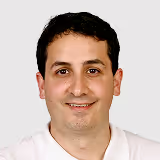
Marcel Kloos
Swiss-licensed dentist and founder of Medschool Experts
Marcel Kloos founded Medschool Experts while studying abroad; since then, over 500 study places have been secured. The Stuttgart-born dentist studied dentistry from 2015 to 2021 in Sofia and holds a Swiss dental licence.
Today he lives in Bern and runs Medschool Experts full-time as its owner.
More articles worth reading
Health Insurance for International Medical Students in Europe 2026
Scholarships and Funding for Medical Studies in Europe 2026
Medicine, Dentistry, Pharmacy or Veterinary Medicine? Choosing Your Degree Abroad in 2026
Ahmad
Sabrina
Rami
Noah
500+ students placed.
Now it's your turn!
No daydreaming, no empty promises. Just a clear plan — for the start of your medical degree.
40 minutes, no obligation