Graduate Entry Medicine for Science Graduates: Higher Semester Entry at European and Caribbean Universities
22.09.2026

Why Science Graduates Are Rethinking Their Career Path
Laboratory automation has already reshaped hiring at most mid-sized biotech firms. Software now handles PCR analysis, image quantification, and large portions of data validation that junior researchers used to own. Roles that once offered stable, long-term careers — research assistant positions, chemical analysis labs, biotech process roles — are being compressed by tools that replicate key functions at scale. A biology graduate who spent four years mastering those techniques is competing for fewer positions in a market that moved while they were finishing their degree.
Medicine responds differently to technological change. Clinical judgment, patient communication, physical examination, and ethical decision-making under uncertainty are capacities that do not automate. When economic disruption closes doors in other professions, hospitals remain open. Demand for physicians grows with ageing populations, rising chronic disease prevalence, and expanding healthcare access in middle-income countries. Physician shortages in both Europe and North America are projected to persist well into the 2040s, making the profession one of the most structurally secure career choices available to any graduate cohort today.
Beyond job security, there is the question of mobility. A physician qualified in Europe can use the EU Directive on the recognition of professional qualifications to practice across 27 member states with minimal additional bureaucracy. A graduate of a Caribbean medical school eligible for USMLE licensing has an equally direct path into North American healthcare. Few professions offer this combination of demand certainty and genuine international portability. For a science graduate weighing their options, the credit transfer route makes medicine more accessible than it has ever been.
If you are ready to explore whether this path fits your background, our advisors at Medschool Experts are available for a no-cost consultation.
What Higher Semester Entry Means
Higher semester entry — also called advanced standing or credit transfer — is a formal process in which a university reviews an applicant's previous academic record and awards recognition for subjects already studied at the required level. The student then joins the programme not at the beginning, but at the point where their knowledge genuinely starts. The credits awarded reduce the number of years required to complete the degree.
European medical universities — particularly in Central and Eastern Europe, the Baltic states, and parts of the Mediterranean region — have long operated flexible credit frameworks that make this recognition possible. Many were designed from the outset to accept international students, and their administrative structures reflect that: credit evaluations are formal, documented, and handled by dedicated academic offices. Caribbean universities with USMLE-eligible programmes have similarly developed structured pathways for graduates entering with prior science qualifications.
The evaluation process begins with a detailed review of official university transcripts, a module-by-module mapping against the host university's curriculum, and an assessment of whether the level and depth of each subject meets the standard required for recognition. Because no two BSc programmes are identical, the outcome is always individual. That is why Medschool Experts treats every applicant's file separately, assesses it against a network of more than 25 partner universities, and recommends only placements where the credit outcome is genuinely strong. To start your personal evaluation, visit our services page or book a free consultation at /contact.
Which Science Degrees Qualify for Credit Transfer
Medical curricula in their pre-clinical phase cover specific subject areas at a defined academic level: anatomy, histology, physiology, biochemistry, cell biology, microbiology, immunology, pathology, and pharmacology form the core. The more your degree overlaps with these areas at university level — meaning taught modules with formal examinations — the stronger the case for credit recognition.
Degrees that consistently produce strong transfer outcomes include Biomedical Science, Biochemistry, Biology, Molecular Biology, Pharmacy, Pharmacology, Physiology, Neuroscience, and Genetics or Genomics. Degrees in Chemistry, Physics, and Mathematics can also produce meaningful credit outcomes, particularly for pharmacology and biophysics modules, although the overlap tends to be narrower. A double major combining life sciences with chemistry or physics typically produces better outcomes than a single-subject physical science degree.
| Degree | Core overlapping subjects | Typical medical credit areas |
|---|---|---|
| BSc Biomedical Science | Anatomy, pathology, microbiology, physiology | Broad pre-clinical modules |
| BSc Biochemistry | Biochemistry, molecular biology, cell biology | Pre-clinical core sciences |
| BSc Biology or Molecular Biology | Cell biology, genetics, physiology | Cell science, physiology modules |
| BSc Pharmacy or Pharmacology | Pharmacology, physiology, clinical biochemistry | Pre-clinical and early clinical |
| BSc Neuroscience | Neuroanatomy, physiology, biochemistry | Anatomy, neuroscience modules |
| BSc Chemistry | Organic chemistry, analytical chemistry | Pharmacology and chemistry modules |
| BSc Physics or Biophysics | Biophysics, imaging principles | Medical physics modules |
| BSc Genetics or Genomics | Molecular genetics, cell biology | Genetics and molecular medicine |
Postgraduate science qualifications — an MSc in Molecular Medicine, a Master's in Public Health, or a research degree in a biomedical field — add further weight to the file. They demonstrate academic maturity and often cover clinical or translational content that maps directly onto medical school modules. Our team at Medschool Experts routinely works with applicants holding both undergraduate and postgraduate science credentials, and the combination typically strengthens the credit evaluation significantly.
European Medical Schools and Higher Semester Entry
Europe offers the widest range of options for science graduates pursuing advanced entry into medicine. The EU Directive on the recognition of professional qualifications means that a degree from a recognised European medical school allows you to apply for a license to practice in any EU member state — a significant structural advantage over programmes that require national examinations in each country separately.
Within Europe, institutions in Romania, Bulgaria, Hungary, Czechia, Latvia, Lithuania, Estonia, and Poland have established robust English-language programmes with formal credit transfer provisions. These countries combine well-structured academic frameworks with relatively affordable tuition — fees in Eastern Europe can start from as little as €250 per month, making them accessible to graduates who cannot or do not wish to take on the kind of debt associated with UK or North American medical education. Spain, Italy, and Malta offer Mediterranean options at somewhat higher price points but with appealing environments and proximity to major European clinical networks.
All partner universities in the Medschool Experts network are accredited by their respective national medical authorities and listed in the WHO Directory of Medical Schools. Our universities page provides an overview of the institutions in our network, and our advisors can walk you through the specific accreditation status of any programme that interests you.
Caribbean Medical Schools and the USMLE Pathway
For science graduates with aspirations to practice in the United States or Canada, Caribbean medical schools represent an established and well-trodden route. Schools in Barbados, Dominica, Grenada, Nevis, and other island nations have been training physicians for the North American market for decades. Their curricula are built around the United States Medical Licensing Examination, and their graduates regularly match into residency programmes across the US healthcare system.
Caribbean institutions have developed credit transfer frameworks for science graduates, though the structure differs somewhat from European models. The pre-clinical component is where prior science learning is most likely to be recognised. A strong BSc in Biology, Biochemistry, or Biomedical Science can produce meaningful credit recognition that reduces the time spent in the pre-clinical phase, allowing students to reach clinical rotations sooner.
Tuition at Caribbean schools varies significantly by institution. Living costs on the islands are generally moderate, and most schools provide on-campus or affiliated housing for international students. The key advantage of the Caribbean route is its direct alignment with the USMLE framework — students are embedded in board examination preparation from day one.
| Region | Key countries | Tuition from (monthly) | Language | Primary licensing pathway |
|---|---|---|---|---|
| Eastern Europe | Romania, Bulgaria, Poland | €250 | English | EU Directive |
| Baltic States | Latvia, Lithuania, Estonia | €300 | English | EU Directive |
| Central Europe | Hungary, Czechia, Slovakia | €350 | English | EU Directive |
| Mediterranean | Spain, Malta, Italy | €400 | English or local | EU Directive |
| Caribbean | Barbados, Dominica, Grenada | €350 | English | USMLE (USA or Canada) |
| Western Europe | Ireland, Netherlands | €1,000+ | English | EU Directive, PLAB |
The Science Graduate's Advantage in Medical Education
Students from a science background consistently outperform in pharmacology. That alone is worth noting.
For chemistry or biochemistry graduates who already think in receptor kinetics, molecular mechanism, and dose-response relationships, pharmacology is familiar territory. Histology comes more naturally to those with microscopy experience. Physiology builds directly on the foundations of a biology or biomedical science degree. Even research methods — a component of most modern medical programmes — sits comfortably within a graduate's existing framework.
There is also a maturity effect. Science graduates entering medicine have already completed one degree, which means they have developed study habits, time management strategies, and academic resilience that younger direct-entry students are still building. From what we see with the students we place, this shows up most clearly during exam season: graduates handle the workload differently, with less panic and more considered pacing. Read first-person accounts from graduates who made this switch at medschool-experts.com/student-stories.
The Medschool Experts Approach to Higher Semester Placement
Credit transfer is not a standardised process. The difference between a generic application and a strategically prepared one can be measured in years of study time. Medschool Experts has spent more than a decade documenting which universities evaluate credits generously, which programmes are structured to make advanced entry realistic, and which combinations of degree background and destination produce the strongest outcomes. That accumulated knowledge is the core of what the service offers.
Working with a science graduate, the team begins by conducting a detailed analysis of the applicant's academic record. Module by module, the transcripts are mapped against the medical curricula of universities across the network. The analysis identifies the strongest matches — not just where credits are likely to be recognised, but where the combination of credit outcome, programme quality, accreditation status, location, cost, and post-graduation licensing pathway best fits the individual's goals.
The result is a personalised recommendation that accounts for the full picture. Medschool Experts' record at partner universities — frequently achieving entry at year four or year five for well-qualified science graduates — reflects both the quality of the partner relationships and the rigour of the preparation provided for each application. No two cases are identical, which is why the consultation is always the starting point. Explore the full range of placement and advisory services at /services.
{{cta}}What the Evaluation and Application Process Looks Like
The process of applying for higher semester entry through Medschool Experts begins with a free consultation. This initial meeting is a substantive conversation in which an advisor reviews your academic background, discusses your career ambitions, and gives an honest assessment of what credit transfer might achieve in your specific case. If the pathway is viable, the team proceeds to a detailed credit analysis. If this route is not the right fit, that will be stated clearly rather than pursued anyway.
Following the consultation, applicants who proceed work with the team to assemble and present their academic documentation in the format required by the receiving universities. The focus throughout is on presenting the applicant's existing knowledge in the most compelling way for the credit evaluation — not fabricating credentials, but ensuring that real academic achievements are communicated clearly and completely. For specific requirements, timelines, and documentation, all details are handled through the personalised consultation rather than through a generic public checklist. Visit /contact to arrange yours.
Tuition Fees, Living Costs, and Financial Planning
Tuition fees at European medical schools start from approximately €250 per month — a fraction of the cost of medical education in the UK or North America. When you factor in the time saved through higher semester entry, the total cost of completing a medical degree via this route can be dramatically lower than starting from scratch at a domestic institution.
Living costs vary substantially by destination. Eastern European capitals and smaller university cities offer affordable accommodation, food, and transport — students typically budget €500–800 per month for living expenses outside of tuition. The Baltic states fall in a similar range. Caribbean islands vary depending on the island and whether university housing is used. Western European destinations carry higher living costs but offer English-speaking environments and proximity to major clinical networks.
Financial planning should account not only for the years of study but for the licensing examinations that follow graduation. European licensing through the EU Directive is typically the most administratively straightforward. Our advisors can help you build a realistic financial model for the entire pathway, from enrollment through to qualification, during the initial consultation at /contact.
Global Licensing Pathways After Graduation
The value of a medical degree is inseparable from the licensing frameworks that determine where it allows you to practice. For graduates of European medical schools, the EU Directive on the recognition of professional qualifications creates a right — subject to language requirements and country-specific registration — to apply for medical registration in any EU member state. A graduate of a Romanian, Latvian, or Bulgarian medical school can apply to practice in Germany, France, the Netherlands, Sweden, or any of the other 27 member states. This is one of the most powerful structural features of a European medical qualification.
For graduates of Caribbean schools, the USMLE pathway opens doors in the United States and Canada. The three-step examination is demanding, but Caribbean schools invest heavily in USMLE preparation, and match rates at well-established Caribbean institutions are competitive. A Caribbean MD with strong examination scores has a realistic path to a US residency programme in a broad range of specialities.
The UK's PLAB examination offers a further route for graduates of both European and Caribbean schools who wish to practice in the National Health Service. Medschool Experts advises students on which licensing pathway best fits their career goals from the very beginning of the placement process — the choice of university and destination is always made with post-graduation licensing firmly in view. For a full discussion of the options relevant to your background, arrange a consultation at /contact.
Student Life Abroad as a Science Graduate
Most students adjust faster than they expect. That is consistent feedback from students we have placed.
Eastern European university cities — Cluj-Napoca, Riga, Sofia, and others across our partner network — combine affordable urban living with genuine student culture. Historic city centres, well-developed public transport networks, and active social scenes built around large student populations make them genuinely pleasant places to live for several years. Caribbean campuses offer a very different experience: smaller, campus-focused environments with a high proportion of international students and an immersive preparation atmosphere built around clinical licensing examinations.
For accounts of what daily life actually looks like at specific partner universities, the student stories section includes first-person testimonials covering a range of destinations. These are particularly useful for candidates choosing between two or more plausible options, and for partners or family members who want to understand what the move actually involves.
Marcel's take
I started my dental studies in Sofia in 2015. At least half of my cohort there were science graduates — people with degrees in biochemistry or biology who had realised that what they actually wanted was clinical work, not bench research. What struck me then, and what I still see now in the students we place, is how quickly they get up to speed. The science background is not a compromise. It is an advantage.
The most common thing I hear in early consultations is some version of: "I feel like I'm starting too late." A 26-year-old with a BSc in Biomedical Science thinks they are five years behind the people who went straight into medicine from school. They are not. They have already covered material that takes direct-entry students two or three years to learn for the first time. The credit transfer process is the formal acknowledgement of that — not a loophole, not a shortcut, but a recognition of real prior learning.
From what we see with the students we place, the ones who do best are not always the ones with the highest grades. They are the ones who are honest about why they want medicine, realistic about the work ahead, and willing to start with a genuine assessment of their file rather than a set of assumptions about what it should look like. If that description fits you — reach out at /contact. Every placement we have ever made has started exactly there.
Summary
- Science graduates with BSc or MSc degrees in biology, biochemistry, biomedical science, pharmacy, chemistry, or related fields can apply for credit transfer into medical school at an advanced stage of the programme.
- European universities — particularly in Eastern Europe and the Baltic states — and Caribbean medical schools offer formal higher semester entry pathways with tuition starting from €250 per month.
- Credit transfer is evaluated individually, based on a module-by-module comparison of the applicant's transcripts against the medical curriculum of the receiving university.
- Medschool Experts works with a network of more than 25 partner universities and regularly achieves entry at year four or year five for well-qualified science graduates.
- A European medical degree opens licensing pathways across 27 EU member states via the EU Directive; Caribbean degrees provide direct preparation for the USMLE; both routes are generally eligible for PLAB in the United Kingdom.
- The total cost of completing medicine via higher semester entry in Europe or the Caribbean is substantially lower than comparable domestic pathways in the UK or Germany, with tuition starting from €250 per month and living costs from approximately €500 per month.
- The first step is a free, personalised consultation with Medschool Experts — no generic checklists, no fixed public deadlines, and no assumptions about your file until it has been individually reviewed.
Conclusion
Science graduates are some of the most well-prepared candidates for higher semester entry into medicine. Their academic training overlaps significantly with the pre-clinical phase of medical education, their capacity for rigorous study is already demonstrated, and their reasons for switching — whether prompted by the disruption of science-adjacent careers or by a long-standing interest in medicine — are typically clear and compelling. The credit transfer routes available through European and Caribbean universities are real, documented, and regularly used by graduates who go on to become practicing physicians.
The difference between a successful placement and a missed opportunity almost always comes down to the quality of the preparation and the strength of the match between the applicant and the institution. Medschool Experts exists precisely to provide that match — not on the basis of generic advice, but on the basis of a detailed, individual analysis of each applicant's file. If you are a science graduate ready to take medicine seriously as a career option, the most valuable thing you can do today is start that conversation. Book your free consultation at medschool-experts.com/contact.
Frequently Asked Questions
Can I really enter medical school mid-programme with a science degree?
Yes — higher semester entry is a formal, documented process at many European and Caribbean medical universities. A credit transfer evaluation compares your undergraduate modules against the medical curriculum and determines where you qualify to enter. The outcome is individual and depends on your specific degree and the receiving institution, but the process is entirely standard at universities in the Medschool Experts network. There is no shortcut involved — only the recognition of prior learning that meets the required academic standard.
Which science degrees are most likely to qualify for advanced entry?
Degrees with strong overlap with medical pre-clinical content produce the best outcomes: Biomedical Science, Biochemistry, Biology, Pharmacy, Pharmacology, Physiology, and Neuroscience are among the strongest. Chemistry and Physics degrees can also produce meaningful credit recognition, particularly for pharmacology and biophysics modules. A postgraduate science qualification — an MSc or research degree — strengthens the application further by demonstrating depth and academic maturity beyond the undergraduate level.
How does Medschool Experts improve my credit transfer outcome?
The team has spent more than a decade documenting credit evaluation practices across a network of more than 25 partner universities. They know which institutions recognise which types of prior learning most generously, and which universities best match a given applicant's academic background. The preparation of each application is structured to present the applicant's existing knowledge as clearly and completely as possible, which consistently produces stronger credit outcomes than self-managed applications.
Are European and Caribbean medical degrees recognised for practice in my country?
European degrees from accredited universities allow graduates to apply for registration across EU member states via the EU Directive on professional qualifications recognition. Caribbean degrees from USMLE-eligible institutions are designed for the North American licensing pathway. Both types of degree are generally eligible for PLAB in the United Kingdom. The specific recognition status relevant to your target country is always confirmed during the consultation process at /contact.
Do I need to speak the local language to study in Eastern Europe?
Medschool Experts partners exclusively with universities that offer full English-language medical programmes. Instruction, examinations, and clinical teaching are all conducted in English. Local language proficiency is not required for admission or for completing the programme, though developing some facility with the local language tends to be practically helpful for everyday life and is widely encouraged by students who have made the move.
What are the total costs of studying medicine in Eastern Europe or the Caribbean?
Tuition starts from approximately €250 per month at Eastern European partner universities. Living costs typically add €500–800 per month depending on the country and city. Caribbean costs are broadly comparable, with some variation by island and accommodation arrangement. The total expenditure over the remaining years of study is significantly lower than comparable domestic medical education in the UK or Germany — particularly when years saved through credit transfer are taken into account across the full cost model.
Is there a minimum GPA or test score required for credit transfer?
Medschool Experts does not publish generic minimum academic thresholds because the evaluation is always individual. What matters is the content and level of your degree modules, not a single aggregated figure. A degree with strong coverage of relevant subjects at university level is a stronger candidate regardless of the GPA attached to it than a general science degree with little overlap. To understand how your specific record is likely to be evaluated, the only reliable step is a personalised consultation at /contact.
How long does the application process take from initial consultation to enrollment?
Timelines vary by university and intake period. The process begins with a free consultation, proceeds to a detailed credit analysis, and culminates in a formal application to the selected institution. Medschool Experts coordinates the process with each partner university's admissions team. All specific timeline questions are addressed during the consultation, where the team can give realistic estimates based on current intake schedules at the relevant institutions and the applicant's own readiness to proceed.
What students say about Medschool Experts
Over 500 placements at more than 25 partner universities across 10+ countries. Read independent student reviews on Trustpilot.
About the author
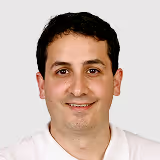
Marcel Kloos
Swiss-licensed dentist and founder of Medschool Experts
Marcel Kloos founded Medschool Experts while studying abroad; since then, over 500 study places have been secured. The Stuttgart-born dentist studied dentistry from 2015 to 2021 in Sofia and holds a Swiss dental licence.
Today he lives in Bern and runs Medschool Experts full-time as its owner.
More articles worth reading
Biology or Chemistry Degree to Medicine: Credit Transfer into a Higher Semester at European Universities
UK-Bangladeshi Heritage: How Your EU Medical Degree Is Recognised in the UK and in Bangladesh
Irish Heritage in the UK: How Medical Degree Recognition Works in Both Countries

Ahmad

Sabrina

Rami

Noah
500+ students placed.
Now it's your turn!
No daydreaming, no empty promises. Just a clear plan — for the start of your medical degree.
40 minutes, no obligation