Studying Medicine Abroad Without an Entrance Exam: Best Locations, Costs, Funding and Recognition
17.09.2026

The essentials, at a glance
A medical degree abroad without an NC is a fully regular human medicine, dentistry or veterinary medicine programme at a state-recognised university in Europe, where admission is decided not by your school-leaving grade but by an entrance exam. The key facts, at a glance:
- Annual tuition: €3,500 (Foča, Bosnia and Herzegovina) to €23,000 (Nicosia, Cyprus).
- Cheapest EU location: Pleven and Stara Zagora in Bulgaria, at €9,000 a year each.
- Duration: six years for human medicine, five years for dentistry.
- Language of instruction: mostly English; German-taught programmes in Pécs and Szeged, and German-language modules at Semmelweis University Budapest.
- Recognition: automatic within the EU under Directive 2005/36/EC; via an individual equivalence assessment outside the EU.
- Cost of living: €500 to €1,000 a month, or €36,000 to €72,000 over six years — a cost block roughly the same size as tuition.
- Funding: BAföG for studying abroad (maximum €992 a month), German child benefit (€259 a month), summer jobs, and student loans through Sparkasse Herford or apoBank.
- Access: not based on your school-leaving grade — we assess individually which location fits your profile.
As of August 2026. Compiled by Medschool Experts from over 500 placements at more than 25 partner universities in over 10 countries.
Why study abroad at all?
Because abroad, an entrance exam decides whether you get to study medicine — not a number from your school-leaving certificate.
The maths in Germany is sobering for most applicants: the number of places in human medicine has stayed nearly unchanged for decades, while the number of applicants is a multiple of that. Anyone without top grades has to compete through aptitude tests, selection interviews, bonus factors and extra qualifications — with an uncertain outcome and a loss of time nobody gets back.
Studying abroad flips that logic: the NC measures how you performed at school years ago. An entrance test measures what you know today — and that's something you can prepare for deliberately.
What that means in practice
- No numerus clausus, no waiting semesters, no foundation year (Studienkolleg). You start directly in the first semester.
- A four-year head start. Starting at 18 or 19 instead of 22 or 23 means gaining clinical experience four years earlier and entering the profession sooner.
- Teaching in English, sometimes German. Medical literature is international anyway; working in English early makes you more confident later in clinical practice, research and at conferences.
- A lower cost of living. In many study locations, rent, food and everyday costs sit well below German levels — and over six years that makes a bigger difference than most people expect.
NC-free means: your school-leaving grade isn't the reason your plan to study medicine fails. The difference from the German system isn't in how demanding it is, but in what's measured: not a number from your school years, but what you bring today. Whether and where that works out for you is something we look at together — in a free initial consultation.
Is a medical degree from abroad recognised in Germany?
Yes. A medical degree completed entirely within the EU is automatically recognised under Directive 2005/36/EC. For programmes outside the EU, an individual equivalence assessment decides.
Within the EU: automatic recognition
For doctors, Directive 2005/36/EC on the recognition of professional qualifications applies across the European Union (supplemented by 2013/55/EU). It sets minimum requirements for medical training — among them at least six years of training with 5,500 hours of instruction. If a programme meets these requirements, the degree is automatically recognised in other member states, with no further aptitude or knowledge test. You then apply for your medical licence (Approbation) with the relevant state authority; you'll also need language certificates (German B2/C1 plus the medical language exam), a health certificate and a certificate of good conduct.
Outside the EU: an equivalence assessment
Locations in Bosnia and Herzegovina or Serbia aren't in the EU. Instead of automatic recognition, an individual equivalence assessment of the degree applies — an established, well-trodden path, but one that needs to be set up correctly from the start. What matters is the university's ANABIN status and how comparable the curriculum's content is.
What about Austria, Switzerland and the United Kingdom?
The same EU directive applies to Austria. For Switzerland, the Free Movement of Persons Agreement applies; professional licensing runs through MEBEKO. Individual locations — Niš, for instance — are also listed with the British General Medical Council (GMC), which opens the path to the United Kingdom too.
How do you recognise a reputable university?
- An ANABIN listing from the Standing Conference of Ministers of Education with status H+
- A state university or a state-licensed programme
- A listing in the World Directory of Medical Schools, and where available, WFME accreditation as well
- An established English-language programme with international graduating classes
Not sure whether your preferred location would be recognisable in your case? We'll check it for you, free of charge and with no obligation: request advice now.
Which locations are available — and what do they cost?
Below is every location individually, each with its university, city, travel links and annual tuition. The closing assessment for each is based on feedback from our students and our ongoing support on the ground; it doesn't replace individual advice.
Studying medicine in Varna (Bulgaria) — €10,000 a year
Medical University Varna offers human medicine and dentistry entirely in English; annual tuition is €10,000. The programme is broadly international, with students from over 50 countries. Clinical training takes place at several university and teaching hospitals across the city.
Varna is Bulgaria's third-largest city and sits right on the Black Sea: beach, promenade, a Mediterranean climate from May to October — with a low cost of living. The airport is eight kilometres from campus, with direct flights to Berlin, Hamburg, Dortmund, Düsseldorf and Stuttgart; from Memmingen it's 2 hours 50 minutes.
Our assessment: Varna is the most frequently chosen location in our programme. Facilities, an established English-language curriculum, location and price are all well balanced here.
Studying medicine in Sofia (Bulgaria) — €10,000 a year
Medical University Sofia is Bulgaria's most established medical school; human medicine and dentistry are taught in English, with annual tuition of €10,000. Clinical training takes place at the capital's major university hospitals. In 2015, annual tuition stood at €8,000 — a useful reference point for how fees have moved over a decade.
Sofia has around 1.3 million residents and sits at the foot of the Vitosha mountains. The airport is twelve kilometres from the centre, with a direct 2 hour 20 minute flight to Frankfurt.
Our assessment: A good fit for anyone looking for a big city and a broad clinical range. Our founder, Marcel Kloos, studied here himself (graduating class of 2021) and knows the teaching and day-to-day student life first-hand.
Studying medicine in Plovdiv (Bulgaria) — €10,000 a year
Medical University Plovdiv offers human medicine and dentistry in English, at €10,000 a year. The English-language programme has run for decades; dentistry groups are small, which matters in a hands-on discipline.
Plovdiv is considered Europe's oldest continuously inhabited city: a Roman amphitheatre, an old town, and a lively cultural scene. Travel usually goes via Sofia (a 2 hour 20 minute flight), with Plovdiv's own airport twelve kilometres away.
Our assessment: An equally strong alternative to Varna for anyone who values culture and city life more than a seaside location.
Studying medicine in Burgas (Bulgaria) — €10,000 a year
Prof. Dr. Asen Zlatarov University in Burgas offers human medicine and dentistry in English; annual tuition is €10,000. Year groups are smaller than at the other Bulgarian locations, so support is correspondingly more personal.
Like Varna, Burgas sits on the Black Sea, but is more compact and quieter. The international airport is ten kilometres away, with Frankfurt and Munich reachable in 2 hours 45 minutes.
Our assessment: A good choice for anyone who prefers a manageable year group and a quieter city.
Studying medicine in Pleven (Bulgaria) — €9,000 a year
Medical University Pleven offers human medicine in English at €9,000 a year. Its affiliated university hospital is among the largest in the country, and the year group is strongly international.
Pleven is a compact university town in northern Bulgaria with a low cost of living and short distances. Travel goes via Sofia.
Our assessment: One of the cheapest ways to study human medicine without an NC anywhere within the EU.
Studying medicine at Trakia University Stara Zagora (Bulgaria) — €9,000 a year
Trakia University Stara Zagora offers human medicine and veterinary medicine in English, at €9,000 a year. It's one of the few NC-free locations for veterinary medicine in Europe; groups are small.
Stara Zagora sits centrally between Sofia and the Black Sea coast. Its cost of living is among the lowest anywhere in our network; travel goes via Sofia.
Our assessment: Attractively priced — and one of the most important locations in our programme for veterinary medicine.
Studying medicine in Foča (Bosnia and Herzegovina) — €3,500 a year
The Foča Faculty of Medicine at the University of East Sarajevo is, at €3,500 a year, the cheapest location in our entire network. It's a state faculty that is additionally co-funded through international programmes — including in cooperation with the WHO — which explains the low fees. Human medicine and dentistry are taught in English. The faculty holds the highest ANABIN status, H+, and has been WFME-accredited since 2025 (valid until 2033). In human medicine, the entire clinical practical year (Praktisches Jahr) can be completed at a German teaching hospital.
Foča sits on the Drina river in the east of the country, right by Sutjeska National Park. The faculty and university hospital form a connected campus, with the town centre two kilometres away. The nearest airport is Sarajevo (80 kilometres).
Our assessment: There's currently no comparable location on price. Worth bearing in mind is that it's outside the EU: recognition runs via the equivalence assessment and should be planned for from the start.
Studying medicine in Mostar (Bosnia and Herzegovina) — €9,000 a year
Unlike East Sarajevo, Mostar is a private university, which explains the higher fee of €9,000 a year in the same country. Teaching is in English, with small year groups.
With its Old Bridge, Mostar is one of Herzegovina's best-known places, Mediterranean in feel and close to Croatia's Adriatic coast.
Our assessment: Anyone focused mainly on cost is better off with Foča. Mostar becomes interesting when the city and surroundings justify the extra cost.
Dentistry at IUS Sarajevo — a dual degree from Bosnia and Turkey
Medschool Experts is the exclusive contract partner for the International University of Sarajevo (IUS). The dentistry programme leads to a dual degree from Bosnia and Turkey, allowing graduates to practise in both Turkey and the EU. The pre-clinical phase takes place in Sarajevo, and the clinical phase in Istanbul.
Admission is also possible with a vocational Abitur (Fachabitur) and a professional qualification. Human medicine isn't offered at IUS.
Our assessment: Particularly relevant for students with ties to Turkey who want to keep both job markets open.
Studying medicine in Niš (Serbia) — €6,000 a year
The Niš Faculty of Medicine offers human medicine in English at €6,000 a year and is attached to a large university hospital with a broad case mix. The faculty is listed with the General Medical Council, so the degree is also recognised in the United Kingdom.
Niš is Serbia's third-largest city, with a low cost of living; travel is usually via Belgrade.
Our assessment: Strong value for money, and especially interesting if you're considering the UK later on. Like Bosnia, Serbia is outside the EU — recognition runs via the equivalence assessment.
Studying medicine in Szczecin (Poland) — €14,000 a year
Pomeranian Medical University Szczecin offers human medicine in English at €14,000 a year. It's especially popular with German-speaking students: a 20-minute drive to the German border, and 100 kilometres to Berlin. That makes family visits and clinical placements at German teaching hospitals straightforward.
Szczecin sits on the Oder river, both a port city and a compact university town, with a cost of living below German levels. There's a direct 90-minute bus to Berlin.
Our assessment: The most logistically convenient location in the whole network.
Studying medicine in Katowice (Poland) — €14,000 a year
The Medical University of Silesia (SUM) in Katowice was founded in 1948 and, with around 9,000 students, is one of Poland's largest medical schools; annual tuition is €14,000. Clinical training takes place at several university hospitals across the metropolitan area. Our students describe the exams there as fair and well prepared for.
Katowice is the centre of the Silesian metropolitan region, home to 2.7 million people, and sits centrally between Vienna, Prague and Berlin. The airport is 30 kilometres away, with a direct 1 hour 30 minute flight to Frankfurt.
Our assessment: Research-strong, urban and very well connected.
Studying medicine in Wrocław (Poland) — €14,000 a year
Wrocław Medical University has existed since 1811 and is one of Poland's large, well-regarded faculties; human medicine in English costs €14,000 a year. Clinical training runs at the university hospital and several teaching hospitals.
With more than 130,000 students, Wrocław is one of Central Europe's liveliest university cities. The airport is 12 kilometres away, with a 1 hour 25 minute flight to Frankfurt.
Our assessment: The location with the strongest student city life in Poland.
Studying medicine in Poznań, Łódź and Białystok (Poland) — €17,470 / €14,920 / €15,720 a year
Three further Polish locations with established English-language programmes: Poznań University of Medical Sciences (human medicine and dentistry, €17,470 a year, airport 7 kilometres away, 1 hour 30 minutes to Frankfurt), the Medical University of Łódź (€14,920 a year, a large international community, travel via Warsaw), and the Medical University of Białystok (€15,720 a year, human medicine only, a baroque old town, low cost of living).
Our assessment: Solid alternatives once places in Szczecin, Katowice or Wrocław are no longer available.
Studying medicine in Pilsen (Czechia) — €16,000 a year
The Faculty of Medicine in Pilsen is one of five faculties of Charles University, has existed since 1945, and charges €16,000 a year. Around 2,000 students are enrolled, about 500 of them international — including one of the largest German-speaking communities anywhere. The campus reopened in 2022 after extensive modernisation and houses a Biomedical Research Center.
Pilsen sits between Prague and the German border and has around 189,000 residents. Prague is an hour away, and Nuremberg three hours by train.
Our assessment: One of the most modern campuses in our network, and conveniently close to the border.
Studying medicine in Budapest (Hungary) — €18,000 a year
Semmelweis University Budapest was founded in 1769 and is one of Europe's historically most significant medical universities; annual tuition is €18,000. Around 14,000 students from more than 110 countries are enrolled, a third of them international. Training mostly takes place in the university's own clinics; alongside English, German-language modules are available.
Budapest offers historic architecture along the Danube, lively neighbourhoods and very good public transport — with a moderate cost of living by European standards. The airport is 16 kilometres away, with a direct 1 hour 35 minute flight to Frankfurt.
Our assessment: The most prestigious location in our programme — and the fee reflects that at the upper end.
Studying medicine in Pécs, Szeged and Debrecen (Hungary) — €14,180 / €15,800 / €14,300 a year
University of Pécs is Hungary's oldest university and offers human medicine and dentistry in English and German (€14,180 a year). University of Szeged is research-strong and also offers German-language study (€15,800 a year). Debrecen (€14,300 a year) has a broad clinical range and its own airport five kilometres from campus, with connections to Memmingen and Dortmund.
Our assessment: Hungary has a very strong reputation in medical education. Anyone who wants to study in German will find the most obvious options in Pécs and Szeged.
Studying medicine in Bratislava (Slovakia) — €12,500 a year
Comenius University Bratislava was founded in 1919 and is Slovakia's oldest and largest higher education institution; human medicine in English costs €12,500 a year. Around 2,500 students study at the Faculty of Medicine, about a third of them international; the English-language programme has run since the 1990s.
Bratislava sits on the Danube, right on the Austrian border — Vienna is 60 minutes away by bus or train, and Budapest 2.5 hours.
Our assessment: A solid foundational education with a more classically structured, lecture-heavy curriculum; some subjects are less modernised than at the Bulgarian or Hungarian locations. A clear advantage is the location right next to Vienna.
Studying medicine in Martin (Slovakia) — €11,500 a year
The Jessenius Faculty in Martin offers human medicine in English at €11,500 a year. The location is much smaller than Bratislava, with a manageable year group and more personal support. Vienna is 250 kilometres away.
Our assessment: Teaching is classically structured, like Bratislava, but with the smallest groups and the lowest price in Slovakia.
Studying medicine in Riga (Latvia) — €12,000 a year
Rīga Stradiņš University offers human medicine and dentistry in English at €12,000 a year, and is one of the most international locations in our network, with students from Scandinavia, Germany and overseas.
Riga is the largest city in the Baltics, with a UNESCO World Heritage old town. The airport is ten kilometres away, with Berlin and Frankfurt two hours by flight. Cost of living runs higher than in Bulgaria.
Our assessment: A solid education in a strongly international setting; mid-range on tuition, but towards the higher end on living costs.
Studying medicine in Split and Zagreb (Croatia) — €12,000 / €10,200 a year
University of Split offers human medicine and dentistry in English on the Adriatic (€12,000 a year); the airport is 25 kilometres away, with a direct two-hour flight to Frankfurt. University of Zagreb focuses on dentistry (€10,200 a year) and veterinary medicine (€11,000 a year), with very small groups, its own equine clinic, and direct oversight from the dean's office. The airport is 15 kilometres away, and Frankfurt is 1 hour 40 minutes by flight.
Our assessment: Small year groups and good support; for veterinary medicine, Zagreb is one of the strongest locations in our programme.
Studying medicine in Malta (Pembroke and Valletta) — €15,000 a year
Two locations are available in Malta: Pembroke and Valletta, each at €15,000 a year. Teaching is in English — and unlike other locations, English is an official language here, including in day-to-day clinical work and everyday life. Starting in the summer semester is also possible, which can save a full year of waiting. The airport is eight kilometres away, with Frankfurt reachable in 2 hours 50 minutes.
Our assessment: A very well-equipped campus with excellent teaching quality. Cost of living runs higher than in Eastern Europe.
Studying medicine in Nicosia (Cyprus) — €23,000 a year
University of Nicosia was founded in 2011 and charges €23,000 a year for human medicine (€21,000 for veterinary medicine). The pre-clinical phase takes place on a modern campus with an anatomy centre, clinical skills labs and a virtual hospital. From the fourth year, selected students have the option of continuing clinical training at Klinik Hirslanden in Zurich — Switzerland's largest private hospital network. There are also partnerships with teaching hospitals in the US and the UK.
Nicosia is 50 kilometres from Larnaca airport, with a direct 3 hour 40 minute flight to Frankfurt.
Our assessment: The most modern facilities in our programme — and also the most expensive.
Dentistry in Lisbon (Portugal) — €10,500 a year
Medschool Experts has offered the dentistry place in Lisbon exclusively since 2026, at €10,500 a year. The location combines a well-connected, mild-climate Western European capital with a comparatively moderate fee.
Our assessment: One of the most interesting new locations for dentistry — Western European conditions at Eastern European price levels.
Dentistry and veterinary medicine in Madrid and Valencia (Spain) — €21,300 / €22,660 a year
In Madrid, dentistry is offered in English at a private university (five years, €21,300 a year). In Valencia, both dentistry (€22,660 a year) and veterinary medicine (€18,000 a year) are available, also at a private university and in English — veterinary medicine switches to Spanish from the fourth semester.
Our assessment: Modern facilities and small groups, but also the highest dentistry fees in our programme. Anyone flexible on location is significantly better off in Lisbon or Varna.
Studying medicine in Timișoara (Romania) — €10,000 a year
Victor Babeș University Timișoara offers human medicine and dentistry in English at €10,000 a year. The airport is twelve kilometres away, with Memmingen and Dortmund reachable in two hours. Timișoara is a large university city with an Austrian-influenced old town.
Our assessment: Facilities are more modern at several Bulgarian locations, and feedback from our students there tends to be slightly more positive. At a comparable fee, we therefore recommend Bulgaria over Romania more often.
Where can you study veterinary medicine without an NC?
At six locations — annual tuition in each case:
- Sofia (Bulgaria), University of Forestry — €6,000
- Stara Zagora (Bulgaria), Trakia University — €9,000
- Košice (Slovakia) — €10,500
- Zagreb (Croatia) — €11,000
- Valencia (Spain) — €18,000
- Nicosia (Cyprus) — €21,000
For context: Bulgaria has been an EU member since 1 January 2007 and adopted the euro on 1 January 2026 (conversion rate 1.95583 BGN per euro) — which removes any exchange-rate risk over the course of your studies. Foča, Mostar, Sarajevo and Niš are outside the EU.
All tuition figures are annual, as of August 2026. Subject to change by the universities and editorial error; we're happy to confirm current fees for you at any time on request.
Which location fits your budget and your profile? We'll help you work that out in a free chances check: request advice now.
{{cta}}
Why the cost of living matters just as much as tuition
Because living costs add up to €36,000 to €86,400 over 72 months — roughly the same amount as tuition.
- €500 a month (Foča, Niš, Stara Zagora, Pleven) → €36,000 across the whole degree
- €700 a month (Varna, Burgas, Sofia, Plovdiv, smaller Polish cities) → €50,400
- €1,000 a month (Budapest, Malta, Cyprus, Lisbon, Madrid, Valencia) → €72,000
- €1,200 a month (a major German city, for comparison) → €86,400
That's a gap of €50,400 between the cheapest and most expensive cost of living — roughly the same magnitude as the differences in tuition.
Why do we recommend Bulgaria over Romania more often?
Because at identical fees — Timișoara €10,000 a year, Varna €10,000 a year — three factors favour Bulgaria:
- Lower cost of living — a five-figure difference over six years.
- More modern facilities at several Bulgarian locations, with correspondingly more positive feedback from our students.
- Better travel links — Varna and Burgas have their own international airports with direct connections to Germany.
What does studying medicine abroad cost in total?
Between €57,000 and €210,000 over six years — tuition and living costs combined:
- Foča: €21,000 tuition + €36,000 living costs = €57,000
- Niš: €36,000 + €36,000 = €72,000
- Pleven, Stara Zagora, Mostar: €54,000 + €36,000 = €90,000
- Varna, Burgas, Sofia, Plovdiv: €60,000 + €50,400 = €110,400
- Szczecin, Wrocław, Katowice: €84,000 + €50,400 = €134,400
- Budapest: €108,000 + €72,000 = €180,000
- Nicosia: €138,000 + €72,000 = €210,000
For dentistry (five years), both figures come in correspondingly lower. For comparison: studying in an expensive German city means paying €86,400 on living costs alone — more than a complete degree in Foča costs including all fees.
Does every profile fit every university?
No. Universities have expectations of the students we send them, and we've contractually committed to meeting those expectations.
Our partner universities communicate these requirements to us in binding terms; they were most recently spelled out explicitly in our new agreements with the universities. So we don't place just anyone at any university — we stand behind the fact that the students we send meet each location's academic expectations. That protects both sides: the university from dropouts, and you from ending up somewhere you're out of your depth in the first year.
That's exactly why, once we've looked at your profile, we tell you specifically which university in which country we can place you at — and where we can get you in reliably, instead of leaving you to guess.
The earlier you get in touch, the wider your choice. Get free advice now.
How can you finance studying medicine abroad?
Through four building blocks: BAföG for studying abroad, German child benefit, a summer job, and student loans. Education funds aren't currently an option.
Education funds: not currently a route
For many years, education funds (Bildungsfonds) were the most important financing instrument for medical studies abroad, with providers such as Chancen eG and Deutsche Bildung offering this model.
Because of higher interest rates, Chancen eG and Deutsche Bildung have stopped accepting new students — for an indefinite period. As long as the interest-rate environment stays this way, no change is expected in the coming years.
1. BAföG for studying abroad
A degree completed entirely in the EU or Switzerland is, in principle, eligible for BAföG funding — not just a single semester abroad.
- Higher income thresholds: even if you don't qualify for BAföG in Germany, you may still qualify for study abroad.
- Monthly maximum currently €992.
- A tuition supplement of up to €5,600 — for a maximum of one year of your stay.
- A flat travel allowance of €250 each way within Europe, plus a subsidy towards international health insurance.
- Repayment: half grant, half interest-free loan — repayment starts years after graduation and is capped.
The relevant authority is the foreign BAföG office responsible for that country. Applications should be filed six months before your studies start.
2. Child benefit (Kindergeld)
Your entitlement to German child benefit continues while studying abroad, as long as you keep your residence in Germany and are under the age limit of 25. Since January 2026, child benefit has been €259 a month, or €3,108 a year. In Foča, that covers almost all of the tuition fee.
3. A summer job and semester breaks
At many locations, semester breaks add up to four to five months a year, and most students spend them in Germany. Two to three months of holiday work typically brings in €2,000 to €3,500 a year — noticeably more with a nursing or medical assistant background.
4. Student loan from Sparkasse Herford
The student loan from Sparkasse Herford is currently one of the few loans that funds a complete degree abroad, and it regularly performs very well in the CHE student loan test.
It's best understood as a consumer loan with a two-year repayment-free period. It's generally only granted with a guarantee from a working parent — or a family member who has been employed for at least two years and holds a permanent contract. Without that, the loan won't be approved.
5. apoBank and Horbach Ärztefinanz
apoBank offers students abroad a loan of currently up to €15,000 — tailored to the academic healthcare professions. We work with both apoBank and the financial service provider Horbach Ärztefinanz at Medschool Experts, and support you with the application and choosing the right option.
6. Scholarships and tax
Scholarship organisations and foundations are less competitive for students abroad than many assume. And: study costs can be claimed for tax purposes — as special expenses in a first degree, or, after completing vocational training or in a second degree, as anticipated income-related expenses with a loss carried forward. The details belong in the hands of a tax adviser.
Worked example: financing a degree in Varna
Annual need: €10,000 tuition plus €700 a month in living costs (€8,400) = €18,400 a year.
Coverage in the first year of study:
- BAföG at the maximum rate: €992 × 12 = €11,904
- Tuition supplement (one-off, first year only): €5,600
- Child benefit: €259 × 12 = €3,108
- Summer job: €2,500
That adds up to €23,112 — comfortably covering the €18,400 needed in the first year.
From the second year, the tuition supplement drops away: €11,904 + €3,108 + €2,500 = €17,512 against €18,400 needed. That leaves a gap of €888 a year, which can be closed through family support, an apoBank loan, or the student loan.
Important: the maximum BAföG rate assumes a corresponding level of need and depends on your parents' income; half of it is an interest-free, capped loan. Anyone who receives less BAföG needs to cover the difference through the other building blocks — or choose a cheaper location.
We'll work through your financing together with you — including the BAföG application, child benefit and loan options: request advice now.
How do you find the right university — and get in?
We don't answer this with a list, but by looking at your individual case. What a university wants to see and how its process is structured differs from location to location and year to year — a one-size-fits-all checklist online would, in your specific case, likely just be wrong. That's exactly why we don't publish one.
Instead, send us your profile: your transcripts, any study credits you've already earned, and the countries you're interested in. We assess that individually and then tell you specifically which university in which country we can place you at — and where we can get you in reliably.
Behind that stands the largest selection of official partner universities for human medicine, dentistry, pharmacy, nursing and veterinary medicine. If you're already studying and want to transfer, we also assess the highest possible year of entry — often that's entry in the final two years of study.
Everything else — organisation, liaising with the university, support all the way to the start of your studies — we take care of for you: book a free consultation now.
What happens after your degree?
Clinical placements, nursing internships and, depending on the location, the clinical practical year can be completed in Germany, Austria or Switzerland — arranged through Medizinerwelten at partner clinics. We also support transferring to a higher semester at a German university, including recognition of credits earned abroad. There's a dedicated programme for entering the Swiss job market: help applying for paid junior physician assistant positions, support finding a doctoral research post, and preparation for MEBEKO recognition.
Frequently asked questions about studying medicine abroad without an NC
Do I really not need an NC?
No. None of our partner universities apply the German numerus clausus. What matters is your profile as a whole — we assess individually which university in which country is the right fit.
Where is studying medicine abroad cheapest?
In Foča (Bosnia and Herzegovina) at €3,500 a year, followed by Niš (Serbia) at €6,000. Within the EU, Pleven and Stara Zagora in Bulgaria are cheapest, at €9,000 a year each.
Which countries are the best fit?
That depends on your budget and priorities. In our experience, Bulgaria offers the most balanced mix of fees, living costs and facilities; Poland scores on proximity to home, Hungary on tradition and German-language programmes, and Malta and Cyprus on especially modern facilities at higher cost. Bosnia and Herzegovina is the cheapest option, but is outside the EU.
How long does studying medicine abroad take?
Six years for human medicine, and five years for dentistry and veterinary medicine.
Can everyone be placed?
No. Universities set requirements for their applicants' profiles, and we've contractually committed to meeting them. We'll clarify what's realistic in your case in a free initial consultation.
Can I finance my studies through an education fund?
Not currently. Chancen eG and Deutsche Bildung have suspended new enrolments indefinitely because of interest rates. Realistic options right now are BAföG for studying abroad, child benefit, a summer job, and student loans through Sparkasse Herford or apoBank.
Is the degree recognised in Germany?
A degree completed entirely within the EU is eligible for recognition under Directive 2005/36/EC. For locations outside the EU, recognition runs via an equivalence assessment.
Is there a location also recognised in the United Kingdom?
Yes — the Niš Faculty of Medicine is listed with the General Medical Council.
Can I study in German?
Yes — Pécs and Szeged (Hungary) offer fully German-taught programmes, and German-language modules are available at Semmelweis University Budapest. All other locations teach in English.
What's special about IUS Sarajevo?
The dual dentistry degree from Bosnia and Turkey. The pre-clinical phase is in Sarajevo and the clinical phase in Istanbul; graduates can then practise in both Turkey and the EU. Admission is also possible with a vocational Abitur or a professional qualification. Human medicine isn't offered there.
Where can I study veterinary medicine without an NC?
At six locations: Sofia (€6,000), Stara Zagora (€9,000), Košice (€10,500), Zagreb (€11,000), Valencia (€18,000) and Nicosia (€21,000) — all per year.
What's the total cost of the degree?
Including living costs over six years: €57,000 in Foča, €72,000 in Niš, €110,400 in Varna, €134,400 in Poland, €210,000 in Nicosia.
Does child benefit continue?
Yes, as long as you keep your residence in Germany and stay under the age limit of 25 — since January 2026, that's €259 a month.
Do I have to emigrate?
No. You typically keep your German residence, and most students spend the four to five months of semester breaks at home.
Can I transfer back to Germany later?
Yes — we support transferring into a higher semester at German universities, including recognition of credits already earned.
What if I've already permanently failed in Germany?
That's a special case with its own rules — how your degree abroad is structured determines whether German medical licensure is still achievable at all. Be sure to read our guide on forced deregistration before you enrol.
The author's view
Reading through this overview, one thing stands out to me above all: the choice today is so large that the real difficulty is no longer access, but deciding. Ten years ago, I had to piece all of this together myself. Today the problem is more about filtering the right option out of twenty good ones.
My three filters from advisory practice: first, recognition – an EU location or a clear recognition path. Second, the budget over six years, not over one semester. Third, the question of whether you actually want to live there. Anyone who answers these three cleanly makes a good choice almost every time – regardless of which name ends up on the diploma.
Conclusion
Wherever your profile sits today, there's a realistic path to a place to study medicine, dentistry or veterinary medicine abroad. Medschool Experts works with the largest network of official partner universities in Europe, and we assess every applicant individually to find the highest possible year of entry — entry in the final two years of study is often possible. Reach out and let's map out your options together in a free, no-obligation consultation.
What does "NC-free" actually mean – and what's the catch?
NC-free means: your school-leaving grade isn't the reason your plan to study medicine fails. There's no catch in the sense of "worth less" – these programmes meet the same minimum EU requirements as German ones. The real difference lies in tuition fees, and in having to handle organisation, housing and paperwork yourself. Why that makes this the better choice for many people, not just a plan B, is covered in More Than Just a Plan B. And how much your school-leaving grade really says is examined in The Top-Grades Hysteria.
How realistic is a place in Germany without near-perfect grades?
Statistically, poor. The number of places has stayed almost unchanged for decades, while the number of applicants is a multiple of that. How allocation actually works through the top-grades quota, the ZEQ and the AdH is explained in Medical Place Allocation 2026. How many places each German state offers is shown in Medical Places by German State 2026. One special route is the rural-doctor quota (Landarztquote) – with a ten-year service commitment: see The Rural-Doctor Quota in NRW and the legal challenges against it.
Do I need the TMS to study abroad?
No. The TMS is a German instrument and plays no role at our partner universities. What actually counts in your case depends on the university and the country – exactly what we assess individually for you. For context on the German test: TMS 2026.
What does a place abroad cost per year?
Between €3,500 (Foča, Bosnia and Herzegovina) and around €24,000 (Nicosia, Cyprus). Within the EU, the range starts at €9,000 in Pleven and Stara Zagora. Every location with current annual tuition is listed in the Tuition Overview for All NC-Free Universities in Europe; the four cheapest are compared head-to-head in the location comparison.
What does living costs there run per month?
€500 to €1,000 a month depending on the location – or €36,000 to €72,000 over six years. That's the same cost block as tuition, and it's regularly underestimated. A worked monthly budget by location is in What Does Studying Medicine Abroad Really Cost?, and the country comparison in Cost of Living in Europe 2026.
Is studying abroad more expensive overall than Germany?
Not necessarily. In Germany you pay no tuition, but you do pay six years of living costs in an expensive city – easily €86,000 in Munich or Hamburg. A complete degree in Foča, including all fees, comes in below that. The full comparison is in Is Studying Medicine Abroad Really More Expensive?
How do I finance my studies?
Through four building blocks: BAföG for studying abroad (maximum €992 a month plus a tuition supplement of up to €5,600), child benefit (€259 a month), a summer job during semester breaks, and student loans. Education funds are currently closed to new applicants. All the routes with worked examples: Financing Medical Studies Abroad.
Will my degree be recognised in Germany?
Within the EU, yes, automatically: Directive 2005/36/EC obliges Germany to recognise the degree if it meets the minimum requirements – six years and 5,500 hours of instruction. There's no further aptitude or knowledge test. What else you need for licensure (language certificate, medical language exam, certificate of good conduct) is covered in Licensure and Recognition.
And if the university is outside the EU?
Then, instead of automatic recognition, an individual equivalence assessment applies, potentially with a knowledge test. This affects Foča, Mostar, Sarajevo, Niš, Novi Sad, Tirana, Tbilisi and Istanbul. The path is established, but needs to be set up correctly from the start – ANABIN status and the curriculum are what matter. Details: Recognition of Foreign Degrees in Healthcare Professions.
Where can I work worldwide with an EU medical degree?
Much further than most people think. Automatic recognition applies within the EU and the EFTA – from Portugal to Finland. Outside Europe, defined exam pathways get you there: the US via ECFMG certification and the USMLE steps, the UK via GMC registration and the PLAB, Canada via the MCCQE exams, and Australia and New Zealand via the AMC exams. Almost everywhere, the requirement is that your university is listed in the World Directory of Medical Schools. Which path takes how long and what it costs is covered in detail in Career Paths with an EU Medical Degree.
How do I get into Switzerland as a doctor?
Through the Free Movement of Persons Agreement and recognition by MEBEKO. Salaries run well above German levels, but so does the cost of living – the honest breakdown is in Moving to Switzerland as a Doctor. Dentists face their own rules: Moving to Switzerland as a Dentist.
And Austria?
The same EU directive, registration on the Austrian Medical Chamber's physician list, then the basic training period – which has run to just six months since August 2026. What that means for entering the profession is in Austria Shortens Basic Training; the full overview with salaries is in Moving to Austria as a Doctor.
What about Scandinavia?
Attractive, but linguistically demanding. Sweden requires C1-level Swedish for its "legitimation", and Norway requires the "autorisasjon" and, generally, the LIS1 entry year. Both are manageable but multi-stage processes: Moving to Sweden as a Doctor and Moving to Norway as a Doctor.
What about the Netherlands?
Professional licensing runs via BIG registration, plus a language certificate. Among EU citizens, this is one of the fastest paths of all – the details are in Moving to the Netherlands as a Doctor.
Why do you recommend Bulgaria so often?
Because fees, living costs and facilities are the most balanced there – and because the country has had the euro since January 2026, which removes exchange-rate risk over six years. The full reasoning is in Why Bulgaria Is a Strong Location, and the year-by-year structure of the degree in How Medical Studies in Bulgaria Are Structured. On settling in: Housing, Insurance, Flights.
Which Bulgarian location fits me?
Varna is on the coast and our most frequently chosen location – the study guide: Medicine and Dentistry in Varna. Sofia offers big-city life and a broad clinical range, Plovdiv offers culture with smaller year groups; both compared directly: Sofia or Plovdiv? What teaching there was actually like from a student's perspective is in My Take on My Professors.
What speaks for Poland?
Above all, the proximity: Szczecin is a 20-minute drive from the German border, and Wrocław and Katowice are a good ninety-minute flight away. All Polish locations at a glance: Studying Medicine in Poland, plus a profile of Wrocław Medical University.
Can I study in German abroad?
Yes. Fully German-taught programmes exist in Pécs and Szeged, German-language modules at Semmelweis University, and a German-taught programme in Osijek. The premium over English-taught locations quickly runs to €5,000–8,000 a year. Details: Hungary at a Glance, Semmelweis Budapest, University of Pécs and the German-taught programme in Osijek.
How good are Czechia and Slovakia?
Academically strong with a long tradition, but at the higher end on price and with more classically structured teaching. All locations: Czechia and Slovakia at a Glance, plus Charles University Prague.
And Romania?
Romania is an EU member, so the degree is automatically recognised. The cheapest location in our programme is Galați at €6,500 a year, followed by Timișoara. At a comparable price we more often recommend Bulgaria – because of the lower cost of living and more modern facilities. All locations: Medicine and Dentistry in Romania and Timișoara and Cluj in Detail.
What does the Baltics offer?
Very international year groups and good facilities, but a higher cost of living than in south-eastern Europe. The overview is in Medicine and Dentistry in the Baltics and Riga, Kaunas and Vilnius Compared; the biggest address is profiled in Rīga Stradiņš University.
What are the cheapest locations overall?
Foča at the University of East Sarajevo at €3,500 a year, followed by Niš at €6,000. Both are outside the EU – recognition runs via the equivalence assessment and should be planned for from the start. The study guides: Foča / University of East Sarajevo and Niš in Serbia, which is also listed with the British General Medical Council.
Is the south worth it – Malta, Cyprus, Spain?
If the budget and facilities work for you, yes: state-of-the-art campuses, English as an official language in Malta, and in some cases a summer-semester start. On the other hand, these are the highest fees in the programme. The comparison is in Studying Medicine in the South.
Can I study dentistry without an NC?
Yes, at numerous locations – from Foča through Varna and Plovdiv to Lisbon, Madrid and Valencia. The overview with prices: Dentistry Without an NC Abroad. Still deciding between the two fields? Dentistry or Human Medicine? can help, and how dentistry studies in Germany are structured under the ZApprO is covered in Dentistry Studies Under the 2021 ZApprO.
And veterinary medicine?
That's available NC-free too, including in Sofia, Stara Zagora, Košice, Zagreb, Valencia and Nicosia. The cheapest route is described in Veterinary Medicine in Bulgaria.
Is this possible with a vocational Abitur or without an Abitur at all?
At certain locations, yes – including via a recognised vocational qualification. Whether your qualification is sufficient and which university in which country could work for you is something we assess individually. The legal background is explained in Studying Medicine with a Vocational Abitur or No Abitur, and specific locations in Studying Medicine with a Vocational Abitur. What the path out of nursing actually looks like is told in From Nurse to Medical Student.
I've permanently failed in Germany. Is that the end?
No, but it's the case with the strictest rules. A completely fresh EU degree still leads to German licensure – provided no credits from the failed degree are transferred in. Required reading before enrolling anywhere: Forced Deregistration in Medical School and the personal take from a dentist and study adviser.
How many attempts do I actually get at my German university?
Each faculty sets its own rules – and the differences are substantial. We work through examination regulations one by one, including for Charité Berlin, RWTH Aachen and the University of Augsburg. Knowing deadlines, accommodations and withdrawal rules early on means you're less likely to lose your right to sit exams.
Can I transfer back to Germany later?
Yes, usually into the first clinical semester. The relevant state examination office decides on credit transfer first; typically one to four semesters get recognised. What's typical is covered in Transferring Back to Germany. Transferring between two universities abroad is also possible: Transferring Within Europe.
What do you need from me to get started?
Your transcripts, any study credits you've already earned, and the countries you're interested in. What documents a given university ultimately wants to see and how its process is structured differs from location to location and year to year – which is why we don't publish checklists on this. We assess your profile individually and tell you which university in which country we can place you at, and where we can get you in reliably – across our network of official partner universities for human medicine, dentistry, pharmacy, nursing and veterinary medicine. Book a free consultation now.
Can I do clinical placements and the practical year in Germany?
Clinical placements and nursing internships, generally yes; the clinical practical year, wholly or partly, depending on the location. What's changing with the practical-year reform is in The Clinical Practical Year 2026; what a placement outside Europe can look like is shown in the clinical placement in Bali.
What does the medical profession look like once I'm done?
Demand is high: the 2025 physician statistics show why new doctors are needed. How specialty training is evolving is covered by the 2026 model training regulations, Medical Specialty Training Under Pressure and the training networks in general practice. Anyone wanting to do research will find a model for it in Clinician Scientist. And whether artificial intelligence will make the profession redundant is answered by AI in Medical Education 2026 – short answer: no.
What's changing in German medical education itself?
Quite a bit, even if slowly. Reform of the licensing regulations is stuck in a funding dispute between the federal and state governments: 2026 update. New faculties are opening, such as Lusatia Medical University in Cottbus and the new building in Oldenburg — but measured against demand, these remain a small number of places.
Am I an outlier for studying abroad?
Quite the opposite: One in Eleven German Medical Students Is Enrolled Abroad. What a path like this can look like personally is told in From Law Student to Dentist in Sofia. Anyone still fundamentally unsure will find the sober perspective of career-choice research in What Should I Study? – and two serious alternatives in healthcare in the article on physician assistant studies and dental assistant training.
Which universities do you officially partner with?
Our partnerships are contractually agreed and publicly documented – including with the University of Niš, Medical University Varna, the International University of Sarajevo, EuroCampo Malta, two universities in Tbilisi and the Academy of Silesia in Katowice. For the University of East Sarajevo, we're its largest international partner agency, and in Switzerland its largest placement agency for medical study places.
I don't understand the technical terms – is there an overview?
Yes. From ANABIN through the knowledge test to WFME, our medical glossary explains every term that comes up during your studies and the recognition process.
What students say about Medschool Experts
Over 500 placements at more than 25 partner universities across 10+ countries. Read independent student reviews on Trustpilot.
About the author
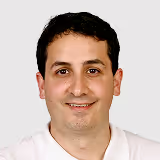
Marcel Kloos
Swiss-licensed dentist and founder of Medschool Experts
Marcel Kloos founded Medschool Experts while studying abroad; since then, over 500 study places have been secured. The Stuttgart-born dentist studied dentistry from 2015 to 2021 in Sofia and holds a Swiss dental licence.
Today he lives in Bern and runs Medschool Experts full-time as its owner.
More articles worth reading
Health Insurance for International Medical Students in Europe 2026
Scholarships and Funding for Medical Studies in Europe 2026
Medicine, Dentistry, Pharmacy or Veterinary Medicine? Choosing Your Degree Abroad in 2026
Ahmad
Sabrina
Rami
Noah
500+ students placed.
Now it's your turn!
No daydreaming, no empty promises. Just a clear plan — for the start of your medical degree.
40 minutes, no obligation